
The practical answer
- Short answer
- SAP partner valuation multiples have bifurcated in 2026. Discover why some firms trade at 13x EBITDA while others stall at 6x, and how 'Clean Core' IP drives premium exits.
- Best fit
- Industry: Professional Services. Function: Operations
- Operating path
- Exit Readiness → Operational Excellence → Transaction Advisory Services
- Key metric
- 35% Valuation premium for SAP partners with documented 'Clean Core' IP accelerators vs. pure services firms.
The Great Bifurcation: Why Your Multiple Isn't Your Competitor's
In the SAP ecosystem of 2026, the "average" multiple is a lie. While broad market data suggests IT services firms are trading between 8.8x and 11.0x EBITDA, this band hides a massive divergence in the SAP partner landscape. We are seeing a stark bifurcation between Generalist Staffing models and Specialized IP-Led consultancies.
If your revenue is primarily driven by generalist staff augmentation—selling "bodies" for S/4HANA migrations on a time-and-materials basis—buyers are treating you like a staffing agency. You are capped at 6x-8x EBITDA. Why? Because when the massive migration wave subsides after the 2027 ECC support deadline, your revenue cliff is terrifyingly steep.
Conversely, partners who have productized their delivery through "Clean Core" accelerators, industry-specific BTP extensions, and managed service wrappers are commanding 12x-14x EBITDA. Private Equity buyers aren't just buying your cash flow; they are buying your defensibility against the post-migration slump. They are paying a premium for firms that have converted "project revenue" into "platform revenue."
The Metric That Matters: Revenue Mix Quality
Stop looking at top-line growth. The valuation driver for 2026 is your IP-to-Services Ratio. Top-quartile firms generate 20%+ of their gross margin from proprietary IP (accelerators, pre-configured templates, or BTP apps). If 100% of your margin walks out the elevator every evening, your multiple walks with them.
Private equity isn't buying your backlog; they are buying your engine. If your delivery engine requires heroics to run, your multiple collapses. If it runs on documented IP and Clean Core principles, you set the price.
The "Clean Core" Premium: Engineering Higher Margins
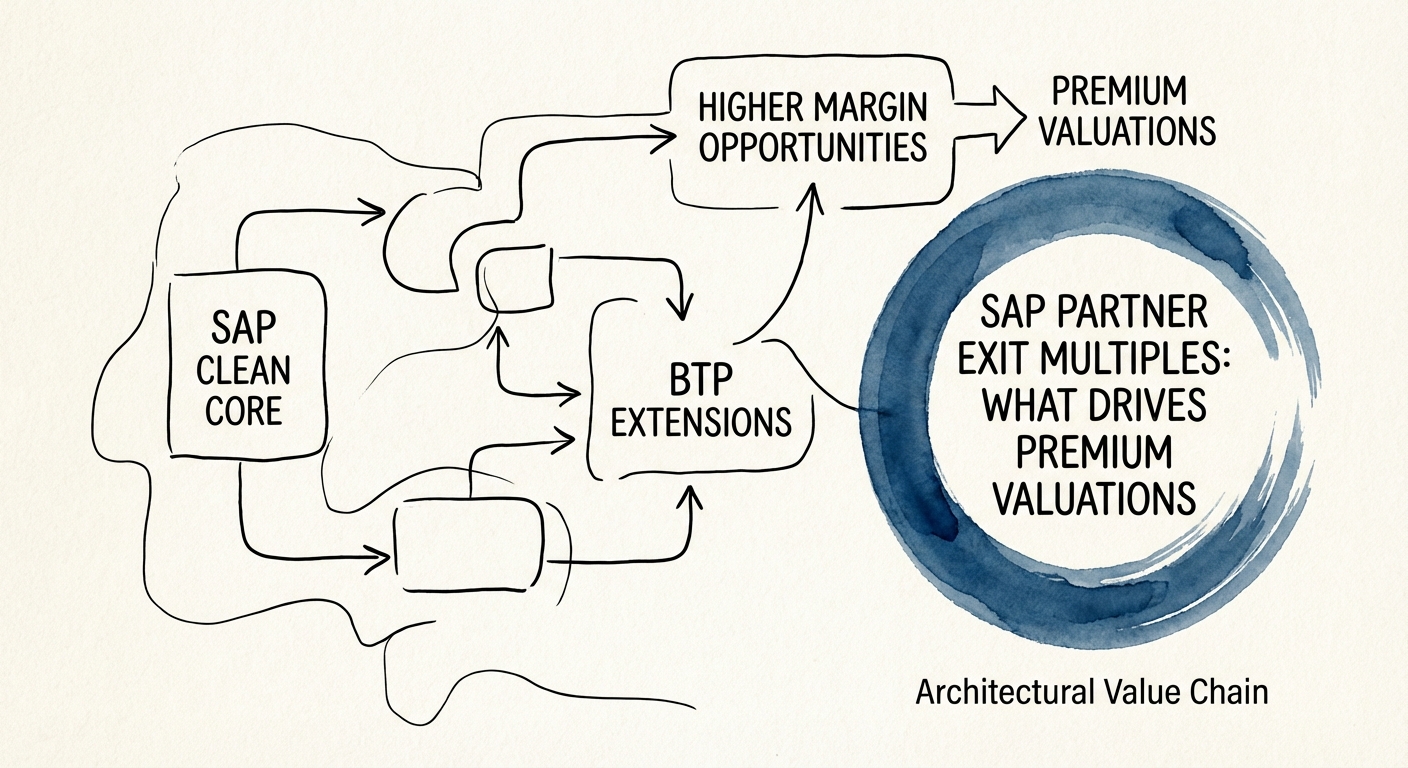
The market has shifted from "Get us to the cloud" to "Keep us clean in the cloud." SAP's aggressive push for Clean Core architectures—keeping the ERP standard and putting customizations on the Business Technology Platform (BTP)—has created a new valuation lever.
Partners who specialize in undoing twenty years of spaghetti code and replacing it with standardized, IP-backed BTP extensions are trading at SaaS-like premiums. Why? Because this work creates sticky, long-term managed services revenue (AMS) that persists long after the initial implementation.
We recently analyzed a deal where an SAP Gold Partner with $25M in revenue increased their valuation by 35% simply by repackaging their ad-hoc custom development services as a branded "Industry Cloud" solution. They didn't change the work; they changed the architecture of the revenue. By proving that their methodology reduced customer upgrade cycle times by 40%, they moved from a "vendor" bucket to a "strategic partner" bucket in the eyes of the acquirer.
The 2027 Catalyst
With thousands of SAP ECC customers still needing to migrate before the 2027/2030 deadlines, PE firms are executing Buy-and-Build strategies. They are acquiring regional boutique firms to build massive "migration factories." But they are picky. They want firms that have automated the migration process, not just firms that have hired more consultants.
Strategic Action: Positioning for the Exit Window
If you are a Founder of an SAP partner firm, your window to capture this premium is narrowing. The "migration super-cycle" is pricing in peak demand now. To maximize your exit multiple over the next 18 months, you must execute three specific operational shifts:
- Document Your IP: If your "proprietary methodology" only exists in your delivery lead's head, it's not IP. Hard-code your playbooks. Buyers pay for transferable process, not tribal knowledge.
- Shift to Managed Outcomes: Move at least 30% of your revenue from T&M to fixed-price managed outcomes or AMS. This proves to buyers that you have retention power beyond the initial "go-live."
- Validate Your Partner Status: The new "RISE with SAP Validated Partner" recognition isn't just a badge; it's a due diligence shortcut for buyers. It verifies that your team is certified on the latest cloud stack, reducing the buyer's technical risk assessment.
You speak fluent ABAP and fluent EBITDA. Now you need to speak fluent Scale. The partners who exit for life-changing money in 2026 won't be the ones with the most consultants; they will be the ones with the most leverage.