
The practical answer
- Short answer
- Are you a Reseller or a Consultant? Why Atlassian partners stall at $10M, the valuation gap between License and Services revenue, and the 2026 growth benchmarks.
- Best fit
- Industry: Professional Services. Function: Operations
- Operating path
- Exit Readiness → Operational Excellence → Transaction Advisory Services
- Key metric
- 12x EBITDA multiple for Specialized Partners (ITSM/Agile) vs. 4x for Resellers.
The "Server Era" Hangover: Why Your Revenue Mix is Toxic
For a decade, the Atlassian ecosystem offered one of the most lucrative arbitrage opportunities in the channel: high-margin license renewals on Server instances with minimal service delivery requirements. Many partners built "lifestyle businesses" on this passive income stream, wrapping light-touch support around substantial recurring software margins. That era ended in February 2024 with the Server EOL, but the valuation hangover is just beginning.
In 2026, Private Equity buyers are scrutinizing the quality of Atlassian partner revenue with extreme prejudice. They are bifurcating the market into two distinct asset classes: License Resellers and Strategic Consultants. The valuation gap between these two profiles is now a chasm.
The Reseller Trap
If more than 50% of your Gross Profit comes from license resale (Cloud or Data Center), your firm is effectively capped at a 4x-6x EBITDA multiple. Buyers view this revenue as low-quality and at-risk because Atlassian continues to compress partner margins on renewals and incentivize direct-to-vendor relationships for Enterprise (ELA) deals. You are not building enterprise value; you are renting Atlassian's customer list.
The Strategic Premium
Conversely, partners who have successfully pivoted to a "Services-First" model—specifically in high-demand specializations like ITSM (Jira Service Management), Agile-at-Scale (Jira Align), and System of Work (Rovo/AI)—are trading at 10x-12x EBITDA. These firms use licenses merely as a wedge to sell high-margin transformation services. Their metric of success isn't "Total License Volume" but Services Attach Rate—targeting $3-$5 of services for every $1 of license gross profit.
In 2026, being an 'Atlassian Partner' is no longer a business model; it's a channel strategy. The firms trading at 12x EBITDA are Consultancies first and Partners second.
Growth Benchmarks by Revenue Stage: The Valley of Death
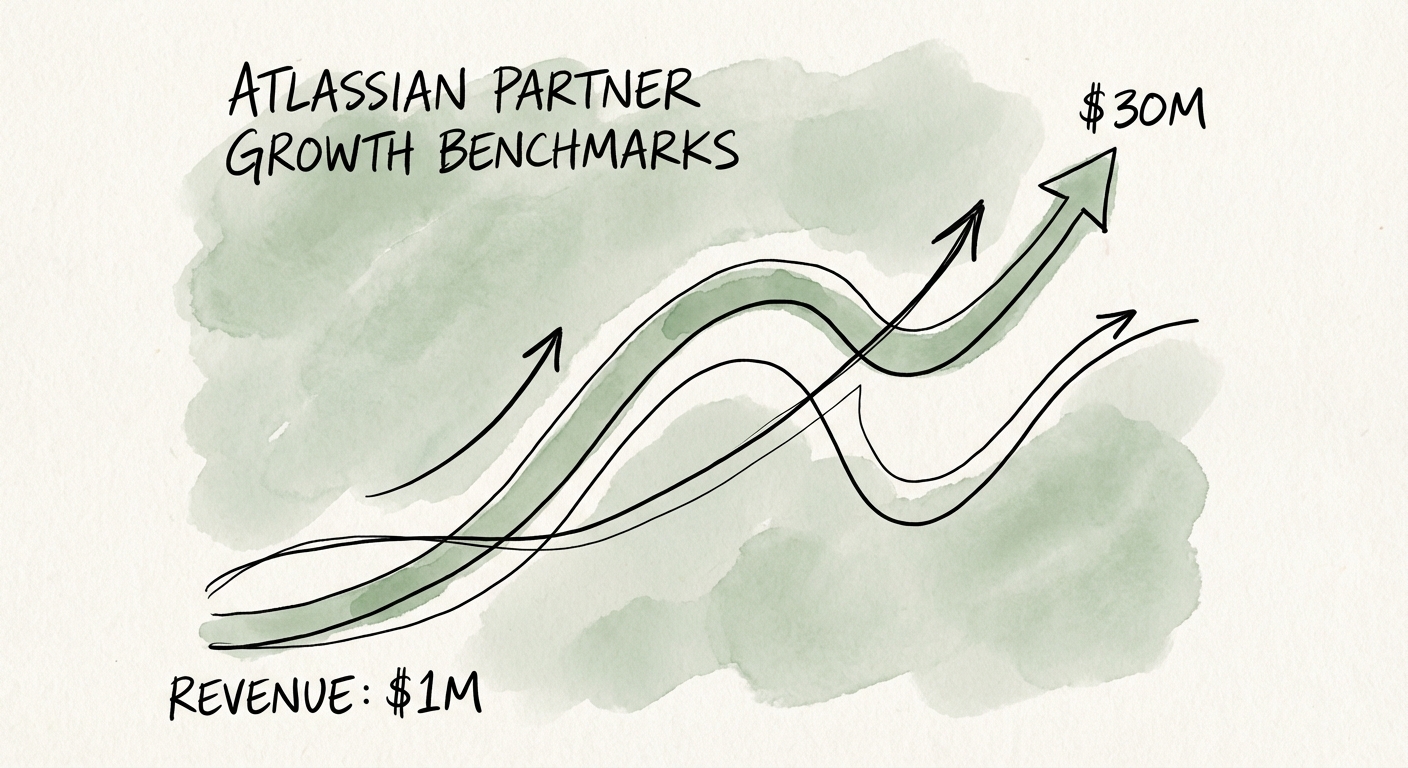
Growing an Atlassian practice requires navigating specific "break points" where your operational model must shift. We have analyzed the growth trajectories of over 50 partners to establish the following benchmarks for 2026.
Stage 1: The Founder-Led Specialist ($1M - $5M Revenue)
At this stage, growth is driven by the founder's personal reputation and technical expertise. You are likely a "niche" player, perhaps focused solely on migrations or a specific marketplace app integration.
- Target Growth Rate: 40%+ YoY
- Key Risk: Founder dependency. If you are the only one who can sell or architect the solution, your business is unsellable.
- Valuation Driver: specialized IP or unique technical capability (e.g., deep ITSM expertise that rivals ServiceNow shops).
Stage 2: The "Reseller" Plateau ($5M - $10M Revenue)
This is the "Valley of Death" for Atlassian partners. You have scaled revenue by aggregating licenses, but your services delivery is inconsistent. You are likely hitting the "Generalist Wall"—you do a little bit of everything (Jira, Confluence, Bitbucket) but own nothing. Growth often stalls here as license margins compress and you lack the delivery infrastructure to win competitive enterprise service bids.
- Target Growth Rate: 25%-30% YoY (Must outpace Atlassian's own Cloud growth rate of ~30%).
- Key Risk: Margin erosion. As you hire more expensive delivery talent to deliver services, your blended margins drop if you don't manage utilization strictly.
- Benchmark: You must maintain 70%+ utilization on your billable team while shifting the revenue mix toward services.
Stage 3: The Strategic Platform ($10M - $30M+ Revenue)
Firms that break through $10M in services revenue have typically specialized. They are no longer just "Atlassian Partners"; they are "Agile Transformation Consultancies" or "Enterprise Service Management Firms" powered by Atlassian. They compete with Global Systems Integrators (GSIs) and win on agility and depth.
- Target Growth Rate: 20%+ YoY (Organic)
- Target EBITDA: 18%-22% (Adjusted)
- Valuation Driver: Recurring Managed Services. The holy grail is not license renewal, but "Managed Transformation" contracts where you retain customers for continuous improvement, not just annual true-ups.
The "System of Work" Pivot: Your 2026 Exit Strategy
To maximize your exit value, you must align your growth story with Atlassian's strategic direction: the System of Work. The "Cloud Migration" gold rush is effectively over; the majority of complex migrations are either complete or locked in. The next wave of value creation is not in moving data, but in connecting teams.
1. Specialize or Die
Generalist "Gold" partners are being squeezed out. To command a premium, you must achieve Specialization badges (ITSM, Cloud, Agile at Scale). In due diligence, buyers will discount revenue that isn't tied to a defensible niche. If you are a generic "Jira Shop," you are a commodity.
2. The Managed Services Multiplier
Private Equity buyers pay maximum multiples for recurring services revenue. Moving a customer from a "Ticket-Based Support" model to a "Strategic Managed Service" (e.g., Owning the Agile Center of Excellence for a client) transforms your revenue quality. A dollar of Managed Services revenue is worth 2.5x more in enterprise value than a dollar of project revenue.
3. The AI & Data Play
With the launch of Rovo and Atlassian Intelligence, the partners winning the biggest deals are those who can articulate a data strategy. You are no longer configuring workflows; you are architecting the intelligence layer of the enterprise. Partners who can demonstrate successful AI deployments and knowledge management strategies are seeing a scarcity premium in the M&A market.
Diagnostic Question: If Atlassian disappeared tomorrow, would your customers still hire you for your process expertise? If the answer is "No," you are a Reseller. If the answer is "Yes," you are a Strategic Consultant ready for exit.