
The practical answer
- Short answer
- A diagnostic guide for 36-month exit planning. Learn why 6-month timelines fail and how to bridge the valuation gap from 4x to 10x EBITDA.
- Best fit
- Industry: Professional Services. Function: Operations
- Operating path
- Exit Readiness → Operational Excellence → Transaction Advisory Services
- Key metric
- 9.8% Average 2025 PS EBITDA Margin (Down from 15%)
The 'Tired Founder' Discount
Most service firm founders decide to sell the day they wake up and realize they can't do it anymore. They are burned out, the latest key client is threatening to churn, and the thought of another 12-month forecast cycle feels impossible. So, they call a broker and ask to be on the market in 90 days.
This is the 'Tired Founder' Discount. And it costs you millions.
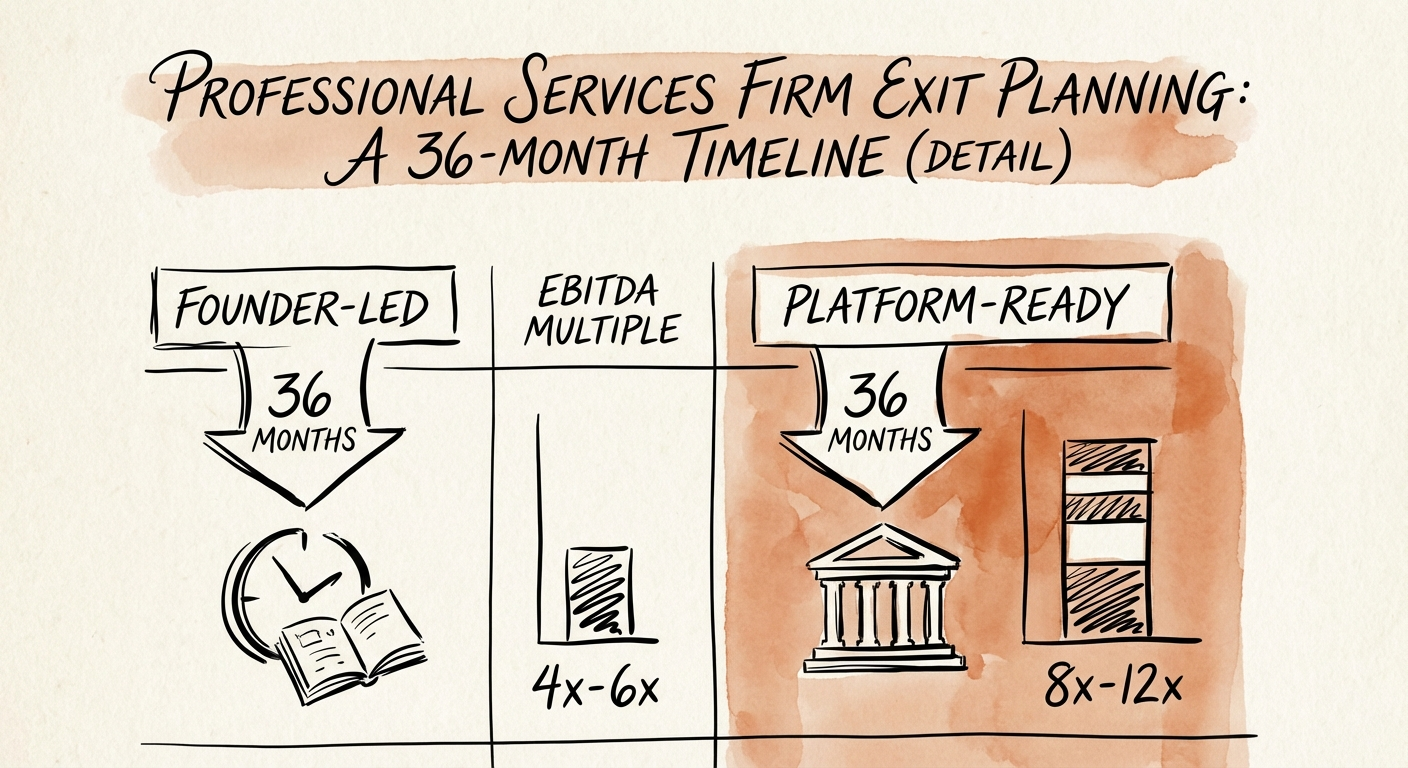
When you rush to market in under 12 months, you are selling a distressed asset, regardless of your revenue growth. Buyers—especially Private Equity sponsors—smell the burnout. They see 'Founder-Led Sales,' they see 'Tribal Knowledge' delivery, and they see a P&L that hasn't been scrubbed for add-backs. The result? You trade at a commodity multiple (3x–5x EBITDA) rather than a platform multiple (8x–12x EBITDA).
The Market Reality: 2025 Benchmarks
The gap between 'good' and 'great' in professional services has never been wider. According to the 2025 SPI Professional Services Maturity Benchmark, the average professional services firm saw EBITDA margins drop to 9.8% in 2024, the lowest in five years. Billable utilization fell to 68.9%, well below the 75% efficiency threshold required for premium valuations.
However, the top 20% of firms (Level 5 maturity) aren't just surviving; they are operating in a different financial reality. These firms generate 265% higher EBITDA than their Level 2 peers. When a PE firm looks at your business, they aren't just buying your client list; they are buying your maturity. If you try to sell a Level 2 firm in a Level 5 market, you will be priced accordingly.
You don't sell a services firm; you sell a system for generating cash flow. If that system requires your daily intervention, you are selling a job, not a business.
The 36-Month Value Creation Timeline
Real enterprise value is engineered, not discovered. To move from a 'Lifestyle Business' to a 'Strategic Asset,' you need a 36-month runway. Here is the diagnostic roadmap for founders who want to exit on their terms.
Months 36–24: Operational Engineering & Founder Extraction
Your primary goal in this phase is to decouple revenue from your personal intervention. If you left unexpectedly, would the revenue persist? If the answer is 'no,' you have no enterprise value.
- Fix Billable Utilization: Your target is 75%+. At 68.9% (the 2025 average), you are leaking margin. Implementing a resource management tool isn't enough; you need a margin playbook that enforces utilization targets weekly.
- Standardize Delivery: You cannot scale 'genius.' You must document your delivery methodologies into SOPs. Buyers pay a premium for transferable processes, not for a founder's intuition.
- Founder Extraction: Begin handing off key accounts. Start the 30-process extraction to ensure your leadership team can run the quarterly business reviews (QBRs) without you.
Months 24–12: Financial Infrastructure & Hygiene
Once operations are stable, you must prove it with data. The 'GAAP Gap' kills 50% of deals during due diligence.
- Switch to Accrual Accounting: If you are still running on Cash basis, stop. You need at least 24 months of clean Accrual history to pass a Quality of Earnings (QofE) study.
- Revenue Recognition Audit: Ensure you are compliant with ASC 606. Recognizing project revenue too early (before delivery) is a red flag that suggests you are 'borrowing from the future' to hit targets.
- EBITDA Add-Back Definitions: Start tracking your personal expenses and one-time costs now. Reconstructing these two years later is how you lose credibility.
Months 12–0: Commercial Engine & Deal Prep
The final year is about predictability. You need to show a backlog that guarantees the first 12 months of the buyer's ownership.
- Backlog Visibility: Move from 'eat what you kill' to 60%+ recurring or re-occurring revenue visibility.
- The Data Room: Populate your data room before you sign an engagement letter with a banker. A sparse data room signals risk; a full one signals confidence. Review our exit preparation timeline for the specific folder structures buyers expect.
The Mathematics of Patience
Why wait 36 months? Because the math of the 'Platform Premium' is undeniable. Let's look at two scenarios for the same $10M revenue firm.
Scenario A: The 6-Month Fire Sale
- Revenue: $10M
- EBITDA Margin: 10% (Industry Avg) = $1M EBITDA
- Growth: 5% (Stalled)
- Valuation Multiple: 4x (Key Person Risk)
- Exit Value: $4M
Scenario B: The 36-Month Engineered Exit
- Revenue: $12M (Improved Retention)
- EBITDA Margin: 20% (Optimized Utilization) = $2.4M EBITDA
- Growth: 15% (Systematic Sales)
- Valuation Multiple: 8x (Platform Ready)
- Exit Value: $19.2M
The difference is not 20% or 30%. It is nearly 5x. The revenue only grew slightly, but the quality of that revenue and the efficiency of the operations transformed the valuation.
Conclusion: Start the Clock Today
Exit planning is not about selling next week. It is about running your business today as if you could sell it next week. The disciplines that make a firm 'exit ready'—clean financials, documented processes, predictable sales—are the exact same disciplines that make it profitable and enjoyable to run. Don't wait until you are burned out. Build your exit while you still have the energy to engineer it.