
The practical answer
- Short answer
- Data-driven guide for UiPath partners: Revenue benchmarks, valuation multiples (6x vs 12x), and the shift from RPA implementation to Agentic Automation.
- Best fit
- Industry: Intelligent Automation. Function: Operations
- Operating path
- Exit Readiness → Operational Excellence → Transaction Advisory Services
- Key metric
- 13.6x Average EBITDA multiple for specialized 'Agentic Automation' consultancies vs. 7.5x for generalist RPA shops.
The 2026 Valuation Bifurcation: Why "Gold" Status Isn't Enough
For the better part of a decade, the path to a premium exit for UiPath partners was linear: hire more developers, bill more hours, and climb the tiered ladder from Authorized to Diamond. In 2026, that playbook is broken. Private equity buyers have bifurcated the market, creating a massive valuation gap between "RPA Implementation Shops" and "Agentic Strategy Partners."
The "Body Shop" Discount (5x - 7x EBITDA)
Firms that primarily focus on staff augmentation or "lift and shift" RPA implementations are seeing their multiples compress. With UiPath's own revenue growth stabilizing at ~11%, the market views pure-play implementation capability as a commodity. These firms typically exhibit:
- Revenue per Employee: <$160,000
- Gross Margins: <40%
- Project vs. Recurring Split: 80% Project / 20% Managed Services
The "Agentic" Premium (10x - 13.6x EBITDA)
Conversely, partners who have successfully pivoted to Agentic Automation—integrating Generative AI with UiPath's orchestration layer—are commanding premium multiples. These firms aren't just building bots; they are redesigning enterprise workflows. Their financial profile is distinct:
- Revenue per Employee: >$250,000
- Gross Margins: >55%
- Recurring Revenue: >45% (driven by "Automation-as-a-Service" contracts)
The message from the market is clear: If your revenue is tied to hours billed rather than outcomes delivered, you are trading at a discount.
In 2026, buyers aren't asking 'How many bots have you built?' They're asking 'How many autonomous agents have you deployed?' The former is a commodity; the latter is a 12x asset.
Breaking the Revenue Ceilings: $5M, $10M, and $25M
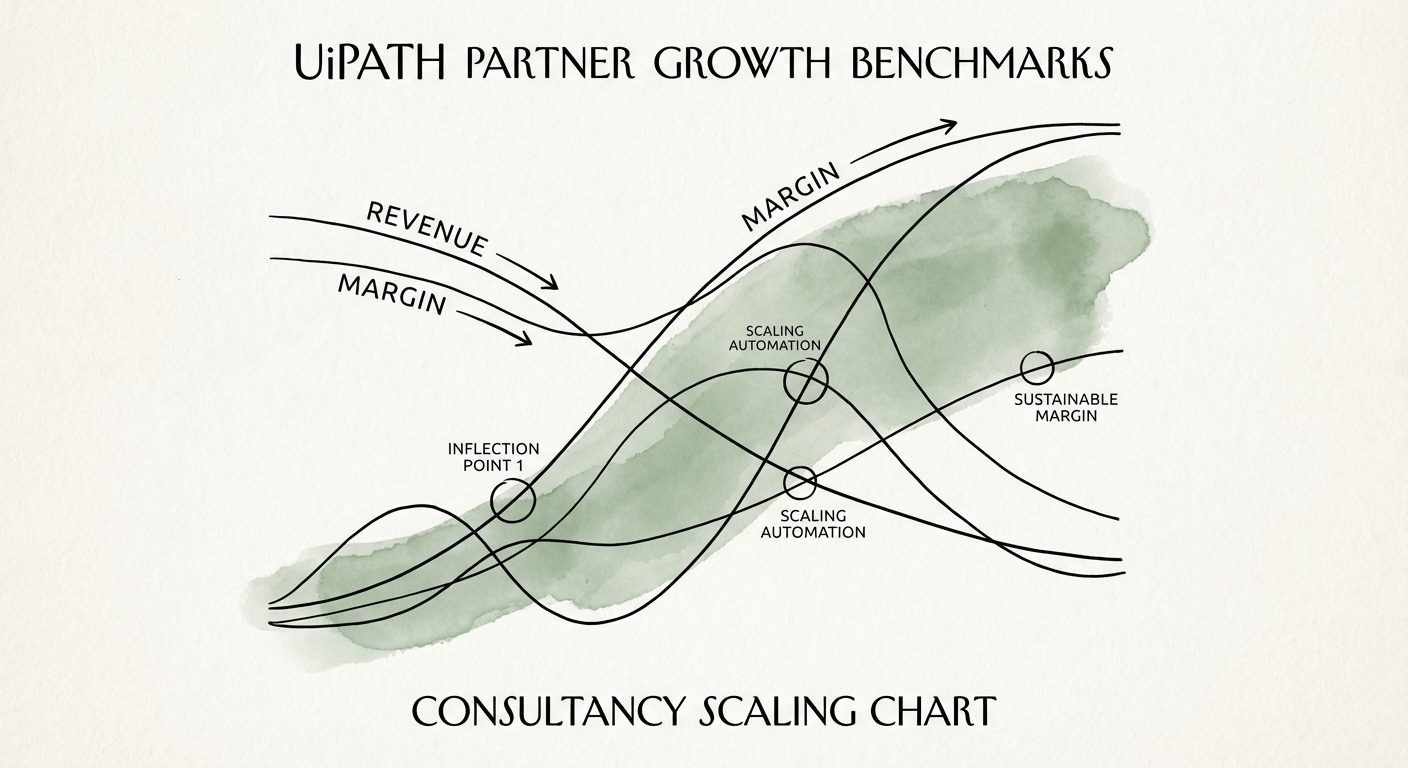
Scaling a UiPath practice involves navigating distinct "valleys of death" where operational complexity outpaces revenue growth. Our data from 2025 M&A transactions highlights three critical inflection points.
The $5M Trap: The "Founder Hero" Limit
At $5M in revenue, the firm is often still dependent on the founder for major sales and complex architecture. The "Fast Track Partner Badge" for Agentic Automation is often missing here, limiting access to high-margin enterprise pilots. To break this ceiling, you must transition from "Founder-led Sales" to a specialized sales team capable of selling business outcomes, not just bot licenses.
The $10M Inflection: The Margin Squeeze
Between $5M and $10M, many firms see EBITDA margins compress from 20% down to 8-12%. This is the cost of building a middle management layer and investing in the "Diamond" tier requirements (top percentile sales and delivery metrics). The danger here is getting stuck in the "low margin, high churn" cycle of basic maintenance support. Successful scalers invest here in proprietary IP or "Accelerators"—pre-built automation frameworks for specific verticals (e.g., Healthcare Revenue Cycle Management) that restore margins to 20%+.
The $25M Exit Zone: Strategic Asset Status
Firms surpassing $25M with >20% EBITDA margins are scarce assets. At this stage, buyers look for Agentic AI orchestration capability. They want to see that you aren't just automating tasks (RPA) but are deploying autonomous agents that can reason and make decisions. This capability is the difference between being acquired as a "tuck-in" for a larger GSI (lower multiple) or as a "platform" investment by a PE firm (higher multiple).
The "Agentic" Pivot: 3 Steps to Protect Your Multiple
To avoid the commoditization trap and position for a premium exit, UiPath partners must execute a strategic pivot over the next 18 months.
1. Shift from "Task" to "Process" Metrics
Stop reporting "hours saved" to your clients (and potential acquirers). Start reporting "decision velocity" and "process autonomy." Buyers in 2026 are paying for AI governance frameworks—proof that you can deploy agents safely in an enterprise environment. Documenting your proprietary governance methodology can add 1-2 turns to your multiple.
2. Productize Your Delivery
Pure services revenue is capped at ~1.5x revenue valuation. Intellectual Property (IP) can push that to 3x-4x. You don't need to become a software company, but you do need "IP-enabled services." Build reusable libraries for common Agentic workflows (e.g., "AI-driven Invoice Resolution" vs. just "Invoice Entry"). This reduces delivery costs, increases gross margins, and demonstrates scalability to investors.
3. The "Fast Track" Moat
Aggressively pursue UiPath's "Fast Track" badges for Agentic Automation. This isn't just vanity; it's a signal to PE buyers that you are technically ahead of the curve. In due diligence, we see a direct correlation between partners with advanced AI certifications and lower churn rates, as they are viewed as strategic advisors rather than replaceable vendors.