The practical answer
- Short answer
- For UiPath partners, the gap between 6x and 14x valuation multiples lies in the pivot from 'RPA Implementation' to 'Agentic AI Strategy.' Here is the 2026 exit roadmap.
- Best fit
- Industry: Intelligent Automation. Function: M&A Strategy
- Operating path
- Exit Readiness → Operational Excellence → Transaction Advisory Services
- Key metric
- 14x EBITDA multiple for 'Agentic AI' specialized partners vs. 6x for generalist implementation firms.
The 'Bot Builder' Discount vs. The Agentic Premium
In 2022, private equity firms bought UiPath partners for one reason: capacity. If you had certified developers and a roster of enterprise logos, you could command a decent multiple (8x-10x EBITDA) simply because the market was supply-constrained. In 2026, that thesis is dead. The commoditization of basic RPA development, combined with the rise of Generative AI, has bifurcated the market. Today, 'Bot Builders'—firms that primarily sell implementation hours to build brittle, rules-based automations—are trading at 5x-6x EBITDA. They are viewed as low-margin staffing businesses with high churn risks due to technical debt.
Conversely, the 'Agentic Strategists'—partners who have successfully pivoted to deploying Agentic AI and 'Autonomous Enterprise' workflows—are commanding 12x-14x EBITDA multiples. These firms aren't just scripting if/then logic; they are implementing self-healing, decision-making agents (using UiPath Autopilot and Clipboard AI) that fundamentally rewrite business processes. For a Private Equity buyer, the difference is clear: Bot Builders create maintenance liabilities; Agentic Strategists create scalable intellectual property.
The Valuation Matrix: Where Do You Sit?
To maximize your exit, you must honestly assess where your firm sits on the 2026 value chain:
- Tier 3 (The Body Shop): Revenue is 80%+ T&M (Time & Materials). Your 'IP' is just a repository of code snippets. Valuation: 4x-6x EBITDA.
- Tier 2 (The Managed Automation Provider): You have long-term contracts to run and maintain bot estates. You use process mining to find new opportunities. Valuation: 7x-9x EBITDA.
- Tier 1 (The Agentic Innovator): You sell outcomes, not hours. You have proprietary solution accelerators for specific verticals (e.g., 'Agentic Claims Processing for Regional Insurers'). Revenue is 40%+ recurring/managed. Valuation: 12x-14x EBITDA.
In 2026, nobody buys a 'UiPath Shop' to build more bots. They buy an 'Agentic AI Platform' to transform industries. If you're still selling hours, you're selling a commodity.
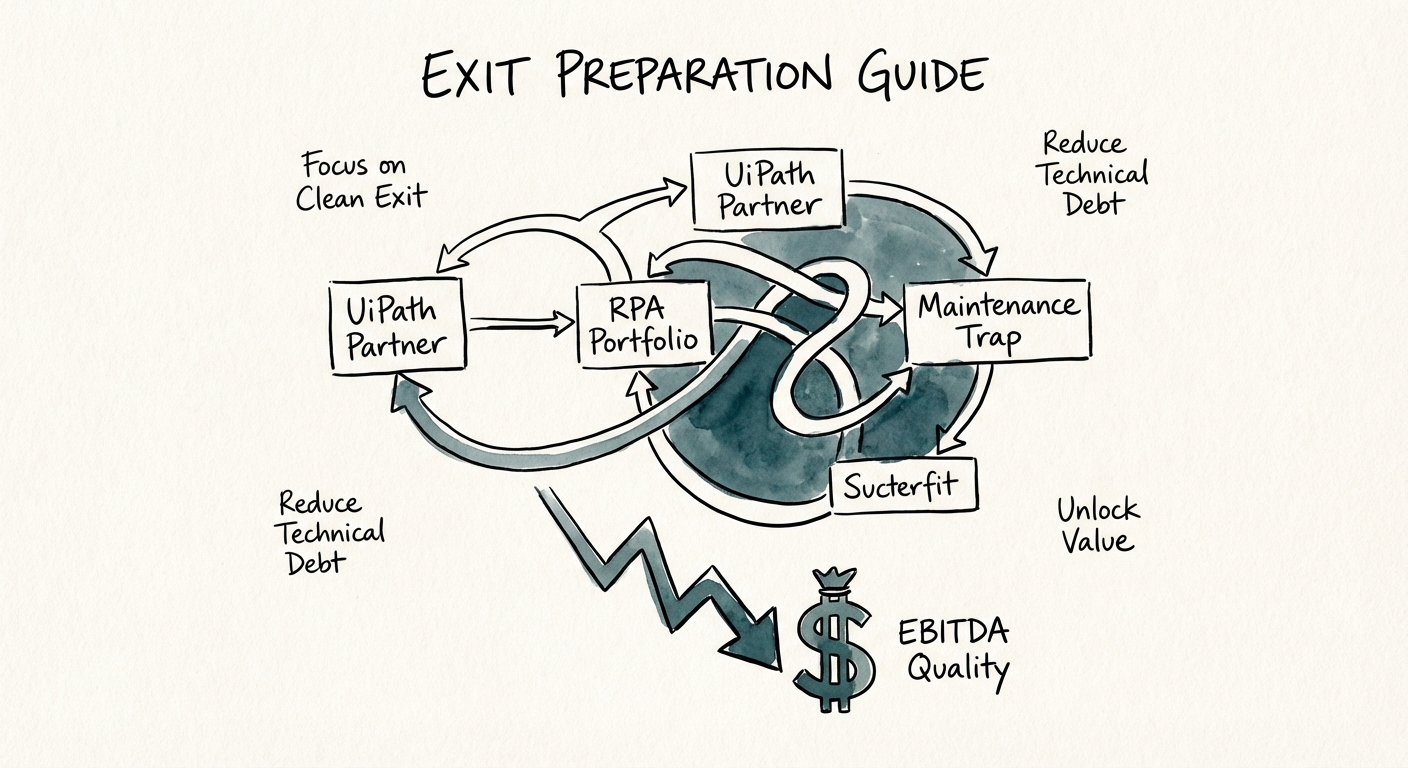
The 'Maintenance Trap': Why Technical Debt Changes Deals
The single biggest deal-killer for automation consultancies in 2026 isn't a lack of growth—it's the quality of the revenue. PE buyers have grown sophisticated. They now run deep technical due diligence on the bots themselves. If your revenue depends on an army of developers constantly fixing broken automations because of UI changes or legacy system updates, your EBITDA is considered 'low quality.'
We call this the 'Maintenance Trap.' It looks like high retention on a spreadsheet, but in reality, it's a 'Bad Revenue' churn bomb waiting to explode. Buyers deduct this maintenance burden from your valuation, treating it as a cost of goods sold (COGS) that will scale linearly with revenue. To escape this trap before a sale, you must demonstrate a shift toward resilient automation architectures.
Metrics That Matter in Due Diligence
Acquirers in 2026 are scrutinizing three specific technical metrics:
- Break-Fix Ratio: What percentage of your engineering hours are spent maintaining existing bots vs. deploying new ones? If it's over 30%, you have a scalability problem.
- Agentic Adoption Rate: What percentage of your deployments utilize semantic automation or AI agents rather than fragile UI selectors? This is a proxy for future-proofing.
- Consumption vs. License Revenue: Are you driving actual consumption (robot utilization), or just reselling licenses that sit on the shelf? Shelfware leads to churn, and churn kills exit multiples.
Strategic Pivot: From Project Revenue to Managed Outcomes
To bridge the gap from 6x to 14x, you cannot rely on 'land and expand' project work. You must productize your expertise into a Managed Agentic Service. This means selling a business outcome (e.g., 'Invoices Processed') rather than a technology input (e.g., 'Bots Built').
For example, instead of charging $50,000 to build an invoice processing bot, a premium partner charges a $5,000 monthly subscription for 'Accounts Payable Automation as a Service,' backed by their own IP and UiPath's Document Understanding. This shifts the revenue quality from 'one-off' to 'recurring,' and it aligns your incentives with the client's success. The PE market pays a premium for this predictability.
Furthermore, specialized industry focus is non-negotiable. Generalist 'we automate anything' firms are losing to specialists who 'automate Patient Intake for Orthopedics' or 'KYC for Community Banks.' Deep vertical expertise allows you to build reusable IP (Solution Accelerators) that drives margin expansion. In the 2025 M&A market, this IP is the difference between a service company valuation and a platform company valuation.