
The practical answer
- Short answer
- Why Zendesk partners are bifurcating into 6x 'ticket shops' and 14x 'agentic strategists'. A CEO's guide to maximizing exit value in the age of AI agents.
- Best fit
- Industry: Customer Experience (CX) Technology. Function: M&A Strategy
- Operating path
- Exit Readiness → Operational Excellence → Transaction Advisory Services
- Key metric
- 14x EBITDA multiple for Zendesk partners with 'Agentic AI' capabilities and vertical IP.
The 'Ticket Deflection' Trap vs. The Agentic Premium
For the last decade, the Zendesk partner ecosystem operated on a simple premise: complexity was the enemy, and ticket deflection was the goal. Partners built their valuations on the back of implementation hours—configuring triggers, setting up macros, and migrating legacy data from Salesforce Service Cloud or Freshdesk. In 2026, this model is a valuation trap that caps exits at 5x to 7x EBITDA.
The market has bifurcated. On one side are the 'Ticket Shops'—firms that view Zendesk as a support ticketing system. On the other are 'Agentic Strategists'—firms that view Zendesk as the orchestration layer for an autonomous AI workforce. With Zendesk pushing toward 80% automated resolution via agentic AI, the value of manual configuration is plummeting alongside billable hours.
Private equity buyers have adjusted their thesis accordingly. They are no longer buying capacity; they are buying outcomes. A partner that merely sets up the software is viewed as a commodity service provider. Conversely, a partner that designs the conversational architecture, trains the AI agents, and integrates them into backend ERPs (like NetSuite or SAP) trades at a premium. These firms are commanding 12x to 14x EBITDA multiples because they own the intelligence layer of the customer experience, not just the plumbing.
The days of trading on 'Gold' or 'Premier' badges are over. In 2026, buyers don't care about your partner tier; they care about your IP. If your revenue walks out the door every evening, you're a 5x asset. If your revenue is locked in code and recurring contracts, you're a 14x asset.
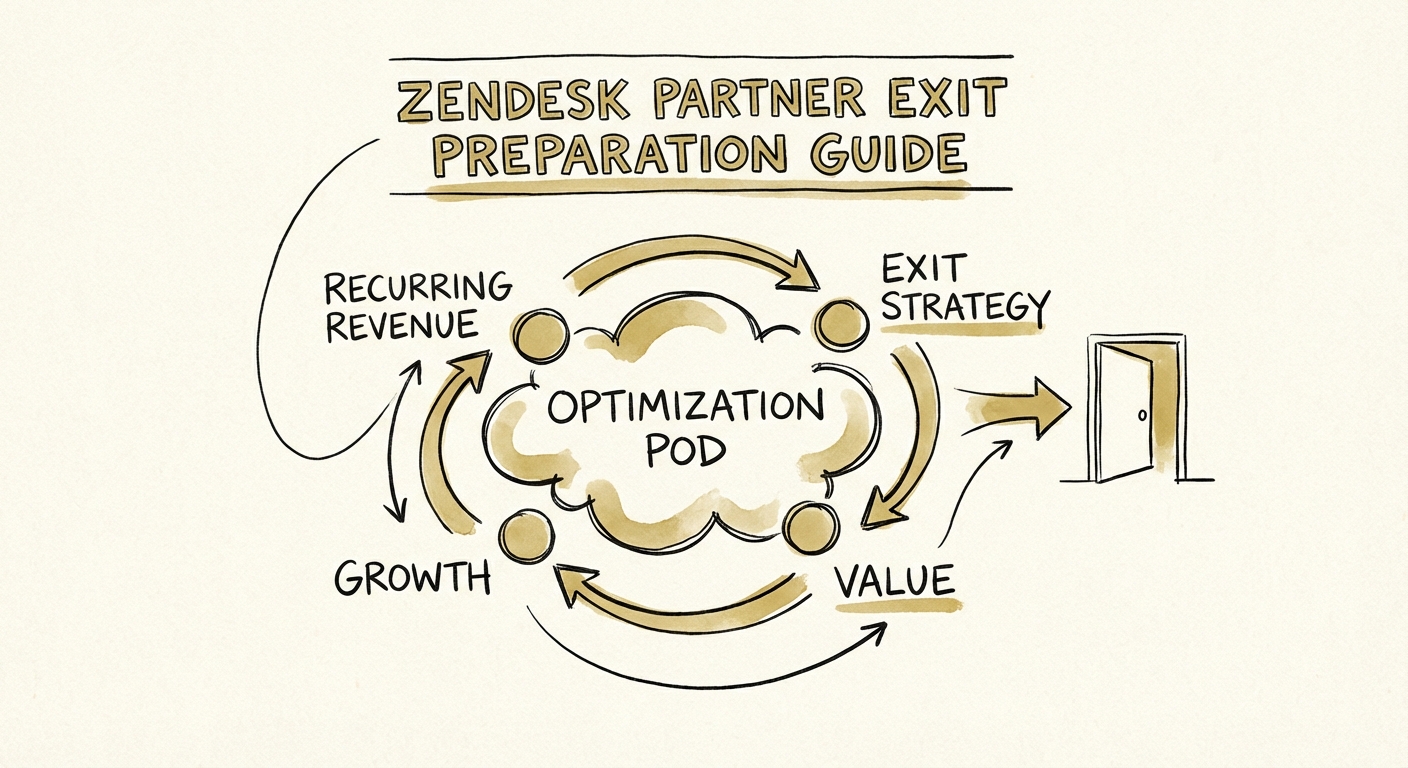
The 'Optimization Pod' Revenue Model: Escaping the Project Trap
The single biggest killer of Zendesk partner valuations is revenue unpredictability. 'Project-based' revenue—even if it comes from high-margin enterprise implementations—is discounted by acquirers because it resets to zero every January 1st. To unlock a premium multiple, partners must pivot from 'Projects' to 'Optimization Pods.'
The most valuable partners in the ecosystem (trading north of 12x EBITDA) have productized their services into recurring subscriptions. Instead of a $50,000 implementation fee, they charge $10,000 per month for a 'CX Optimization Pod.' This pod doesn't just answer tickets; it continuously tunes the AI models, updates knowledge base logic based on 'null result' searches, and optimizes Answer Bot flows. This shift transforms low-quality 'services revenue' into high-quality 'recurring revenue' (ARR).
This model aligns perfectly with the Private Equity 'buy-and-build' strategy. An acquirer looks at a $10M revenue shop. If $8M is one-off projects, the risk profile is high. If $6M is committed ARR from Optimization Pods with a Net Revenue Retention (NRR) of 110%, the asset becomes a platform for consolidation. In 2026, a dollar of Optimization Pod revenue is worth 2.5x more at exit than a dollar of implementation revenue.
Verticalization: The Death of the 'Generalist' Premier Partner
In the 2026 M&A landscape, 'Premier' status is just the table stakes to get into the data room. The real differentiator is vertical intellectual property (IP). PE firms are increasingly shying away from horizontal 'Zendesk for Everyone' shops in favor of deep vertical specialists. A firm that markets itself as a 'Zendesk Expert' trades at 6x. A firm that positions itself as 'The Zendesk Partner for Fintech Neobanks' trades at 14x.
Why the discrepancy? Speed to value and defensibility. The Fintech specialist comes with pre-built integrations for banking cores (like Marqeta or Galileo), pre-trained AI intents for 'chargeback disputes' or 'KYC failures,' and compliant security workflows. This is defensible IP.
Generalists are fighting a race to the bottom on hourly rates against global systems integrators (GSIs). Specialists are selling business outcomes. For Founders looking to exit, the message is clear: narrow your focus to widen your multiple. If you cannot demonstrate gross margins above 55% on your professional services—driven by reusable vertical IP—you will be priced as a staffing agency, not a technology consultancy.