The practical answer
- Short answer
- Product-based earnouts are bridging valuation gaps in 2026 tech M&A, but they only pay out 21% on average. Here is how to structure technical milestones that actually convert to cash.
- Best fit
- Industry: B2B Tech / SaaS. Function: Executive Leadership
- Operating path
- Exit Readiness → Operational Excellence → Transaction Advisory Services
- Key metric
- 63% Of product-based earnouts end in dispute when 'Commercial Availability' is not defined by objective technical acceptance criteria.
The Ambiguity Tax: Why 'Launched' Does Not Mean 'Paid'
In the resurgence of tech M&A in 2025, contingent consideration became the primary bridge for valuation gaps. However, data from SRS Acquiom and 2025 deal terms studies reveals a stark reality: the average earnout pays out just 21 cents on the dollar. For product-based milestones, the failure rate is often driven not by technical incompetence, but by semantic ambiguity.
The "Definition of Done" Gap
The most common error founders make is agreeing to milestones defined by marketing language rather than engineering acceptance criteria. A clause stating "$5M upon the launch of the AI Analytics Module" is a lawsuit waiting to happen. Does "launch" mean code committed? Beta release? General Availability (GA)? Or does it imply commercial traction?
We recently reviewed a definitive agreement where a $3M tranche was tied to "integration with the Buyer's core platform." The integration was technically complete within 90 days. However, the buyer refused payment, arguing that "integration" implied full commercial rollout to their customer base—a process they intentionally delayed. To protect your exit, technical milestones must be defined with the rigor of a Statement of Work (SOW), not a press release. Use objective completion criteria: specific API endpoints active, uptime SLAs met for 30 consecutive days, or passing a specific third-party security audit.
A product earnout based on 'commercial viability' is just a donation to the buyer's bottom line. If you build it, you should get paid—regardless of whether their sales team knows how to sell it.
The Budget Veto: Protecting Your Roadmap Post-Close
The fundamental paradox of a product earnout is that you are responsible for the output (the milestone), but the buyer controls the input (the budget and headcount). In 2026, where efficiency is paramount, acquirers frequently slash "redundant" R&D spend immediately post-close, inadvertently (or intentionally) sabotaging the very milestones they agreed to pay for.
Structuring Protective Covenants
You cannot rely on a "good faith" clause to protect your engineering resources. High-performing founders negotiate specific Operating Covenants that persist through the earnout period. These should explicitly detail:
- Minimum Headcount Maintenance: free from "synergy" layoffs for the relevant teams.
- Budgetary Autonomy: Guaranteed R&D spend levels as a percentage of revenue or a fixed dollar amount.
- Priority Access: Defined SLAs for dependencies on the buyer's shared services (e.g., if your AI feature needs access to their Data Lake, they cannot deprioritize your access ticket).
Without these protections, you are effectively betting your exit valuation on the buyer's internal resource allocation committee—a bet you will almost always lose.
Binary vs. Sliding Scale: Avoiding the 'All-or-Nothing' Trap
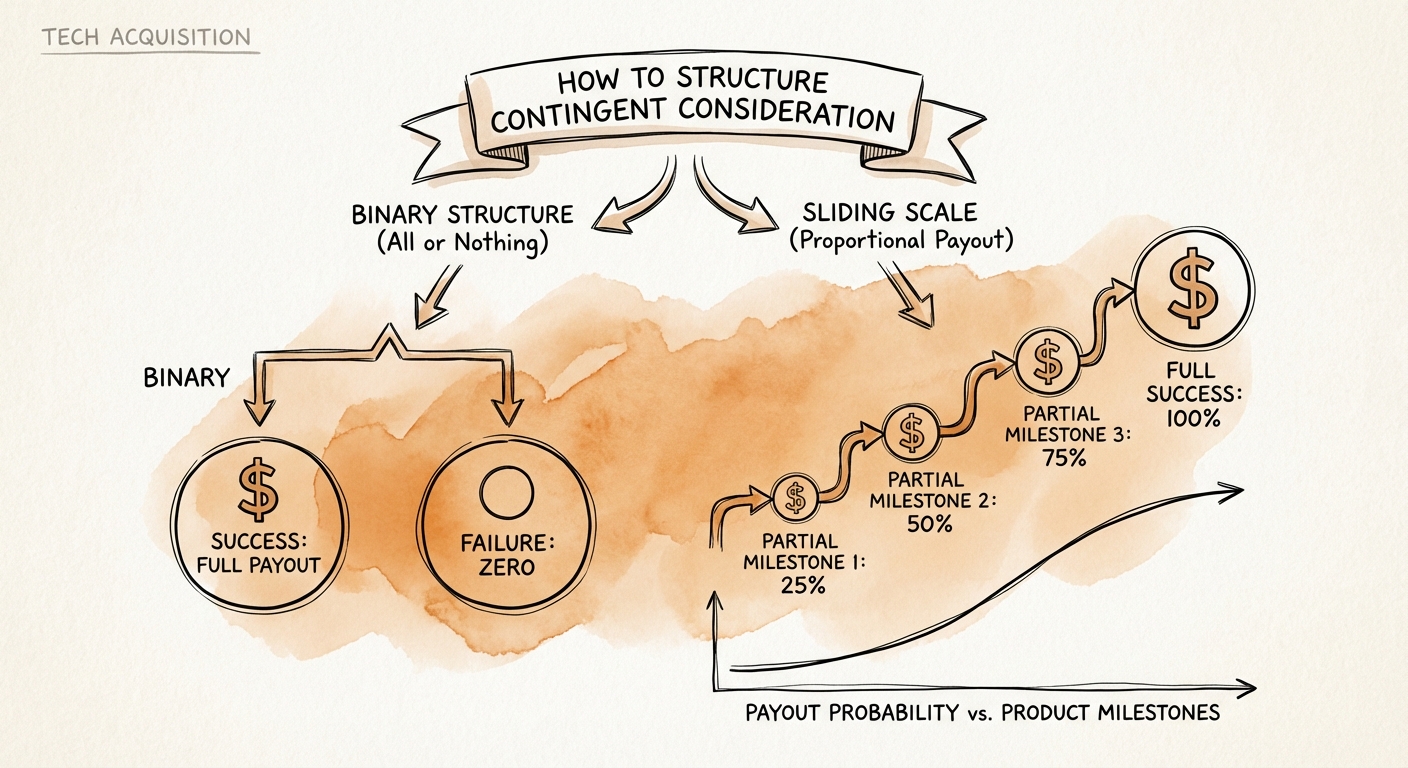
Technical milestones are often structured as binary events: you either ship the code or you don't. This "cliff" structure is dangerous because it incentivizes the buyer to find any reason to declare the milestone missed, saving them millions. If the requirement is "99.9% uptime" and you hit "99.8%", a binary structure pays zero.
The "Digital Option" Valuation Model
Instead, structure product earnouts with Graduated Payouts or a "Sliding Scale" mechanism. If the milestone is to migrate 500 customers to the new platform, a binary deal pays $0 for 499 migrations. A graduated deal might pay 80% of the tranche for 400 migrations and 100% for 500. This removes the incentive for the buyer to manufacture a near-miss failure. It aligns the financial outcome with the value delivered; a feature that is 90% complete is rarely worth zero to the acquirer, so it shouldn't be worth zero to you.
Furthermore, separate Technical Completion (which you control) from Commercial Success (which the buyer influences). If your earnout is tied to "Revenue from new AI product," you are exposed to their sales execution. Always decouple the build from the sell.