
The practical answer
- Short answer
- Why 'tribal knowledge' kills exit valuations. A CTO's guide to C4 model architecture documentation standards for private equity due diligence.
- Best fit
- Industry: Software & Technology. Function: Engineering & Product
- Operating path
- Process Documentation → Operational Excellence → Transaction Execution Services
- Key metric
- 70-90% M&A deals that fail to achieve strategic goals, often due to technical integration misalignment.
The 'Tribal Knowledge' Discount
In the high-stakes theater of M&A due diligence, there is no faster way to erode enterprise value than to present a technical architecture that exists solely in the mind of your CTO. We call this the "Tribal Knowledge Discount." When a private equity buyer's technical due diligence (TDD) team enters your data room, they aren't just looking for clean code; they are looking for transferability.
If understanding your system requires a two-hour whiteboard session with your founding engineer, you do not own a platform; you own a dependency. Recent data indicates that technical debt accounts for an average of 31% of the acquired codebase in modern M&A deals. However, this number skyrockets when documentation is missing. Buyers assume that undocumented complexity is effectively broken complexity. They will price in the cost of a complete rewrite or the risk of key-person flight, often resulting in a 15-20% holdback or a suppressed multiple.
The days of "trust me, it works" are finished. With 70-90% of M&A deals failing to achieve their strategic goals—often due to integration misalignment—buyers are now demanding rigorous, standardized architectural artifacts before they sign the LOI. They need to know if your "microservices" are actually a distributed monolith, and if your "AI" is just a wrapper around an OpenAI API. Your documentation is the only evidence that defends your valuation against these assumptions.
If understanding your system requires a whiteboard session with your founding engineer, you do not own a platform; you own a dependency.
The C4 Model: The New Standard for Data Rooms
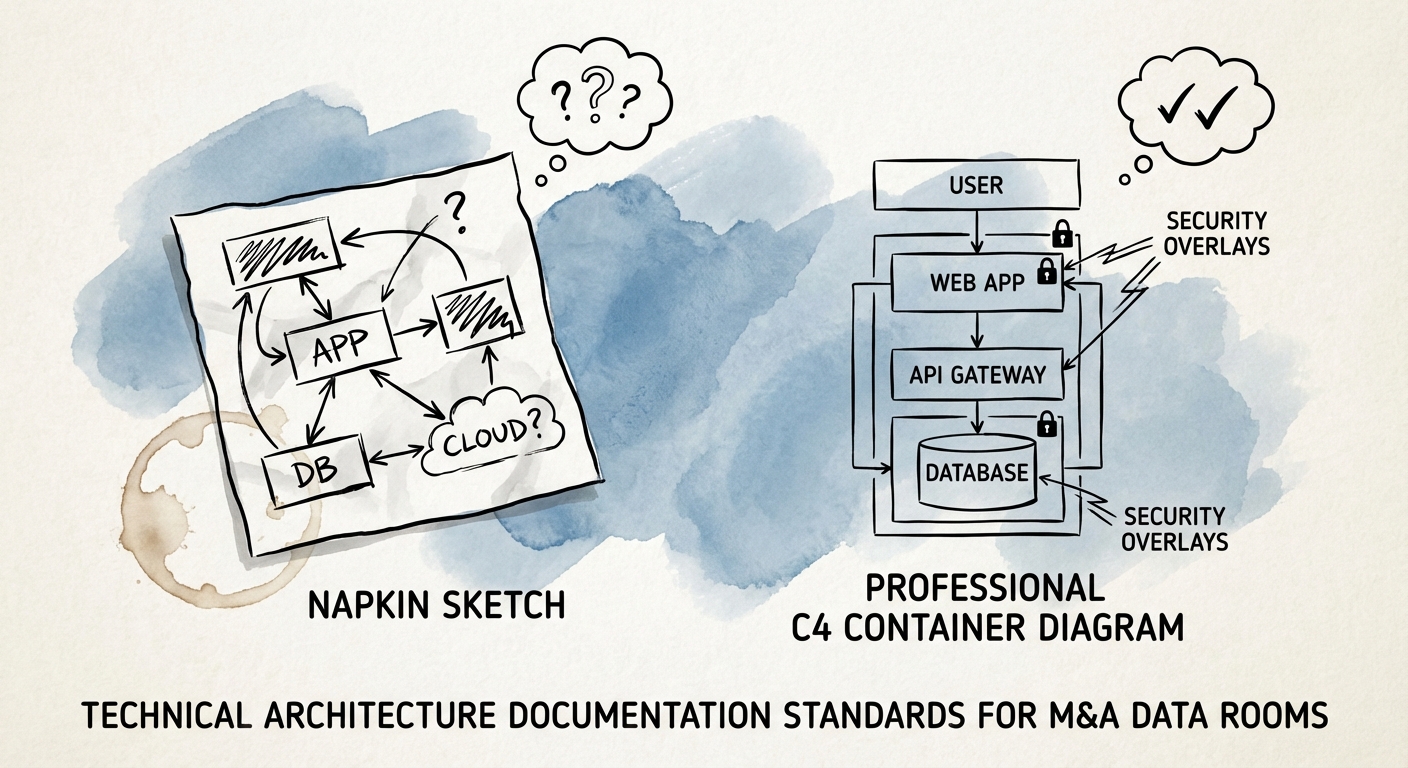
Stop uploading photos of whiteboards or outdated Confluence PDFs to your Virtual Data Room (VDR). The standard for high-maturity technical documentation in 2026 is the C4 Model. This hierarchical approach bridges the gap between the investment committee (who need the big picture) and the technical auditors (who need the grit).
Level 1: System Context (For the Deal Team)
This diagram must show your system in the center, surrounded by its users and external dependencies (e.g., Stripe, Salesforce, AWS). It answers the question: "What does this business actually do?" In due diligence, this proves you understand your ecosystem boundaries and integration points. Without it, non-technical buyers cannot validate your commercial claims.
Level 2: Container Diagram (For the Operating Partner)
This is the most critical artifact for valuation. It zooms in to show the high-level technical building blocks: the Single Page Application, the API Application, the Database, and the Microservices. It must specify the technology choices (e.g., React, Go, PostgreSQL) and how they communicate. This diagram defends against the "Legacy Code" label by proving your stack is modern, modular, and scalable.
Level 3: Component Diagram (For the Auditor)
While often optional for the initial data room, having Level 3 diagrams for your "Crown Jewel" IP (e.g., your proprietary matching algorithm or billing engine) is a massive trust signal. It shows the internal structure of a container—controllers, services, repositories—proving that your intellectual property is well-structured and decoupled from generic boilerplate code.
Retrofitting Readiness: The 30-Day Sprint
If you are eyeing an exit in the next 12 months, you likely have a documentation gap. You cannot document everything, so you must prioritize the artifacts that protect valuation. We recommend a "Documentation Sprint" focused on three specific deliverables that auditors prioritize.
First, produce a Level 2 Container Diagram that includes data flows. Auditors track data to find risk. Show them exactly how PII (Personally Identifiable Information) moves through your system. If you can't map your data flow, you will fail the security compliance audit, regardless of your SOC 2 status.
Second, compile an Architecture Decision Record (ADR) Log. You don't need to document every decision from day one, but document the last six months of major architectural choices. Why did you choose DynamoDB over Postgres? Why did you split that monolith? ADRs prove to buyers that your engineering culture is intentional, not accidental. This is a leading indicator of a high-functioning team that can survive the founder's exit.
Finally, ensure your technical due diligence checklist includes a "Third-Party Dependency Graph." In a world where process transferability commands a premium, hiding dependency risks (like a reliance on a deprecated library) is a deal-killer. Transparency here builds the trust required to defend a premium multiple. Treat your documentation as a product; its customer is the acquirer.