The practical answer
- Short answer
- Stop the 6-month slip. This diagnostic reveals why 61% of deals stall in indecision and provides a 90-day compression playbook for VPs of Sales.
- Best fit
- Industry: B2B Technology. Function: Sales Leadership
- Operating path
- Revenue Architecture → Commercial Performance → Office of the CFO
- Key metric
- 61% Of lost B2B deals are now attributed to "buyer indecision" rather than competitors (Ebsta x Pavilion).
The "Indecision" Epidemic: Why Deals Are Stalling at Stage 4
If your pipeline feels heavier than it did two years ago, you aren't imagining it. The average B2B tech sales cycle for deals over $100k ACV has calcified at roughly 180 to 240 days (6-8 months), with regulated industries like healthcare and fintech pushing even longer. But the most alarming statistic isn't the length; it's the cause of failure.
According to recent benchmarking data from Ebsta and Pavilion, 61% of lost deals are now attributed to "buyer indecision" rather than competitive losses. You aren't losing to a better product; you are losing to the status quo. The modern buying committee has expanded to an average of seven stakeholders, each wielding veto power, while CFO scrutiny has intensified to the point where "efficient growth" mandates discourage any purchase that doesn't promise immediate, hard-dollar ROI.
For founders and sales leaders tasked with doubling ARR—this stall is existential. A 6-month sales cycle creates a cash flow gap that Series B and C runways cannot support. The traditional "relationship selling" playbook is failing because buyers don't need more friends; they need a bulletproof business case to survive their own internal audits.
You aren't losing to a better product; you are losing to the status quo. The modern buying committee has expanded to seven stakeholders, and 'no decision' is now your biggest competitor.
The Compression Architecture: Breaking the 90-Day Barrier
Compressing a 6-month cycle to 90 days requires a fundamental architectural shift from "facilitating a purchase" to "managing a project." Top-performing revenue organizations are achieving this compression by deploying three specific mechanisms that force momentum.
1. The CFO-Ready Business Case (Day 1, Not Day 60)
Waiting until the proposal stage to discuss ROI creates serious deal risk. Compression requires introducing the "Cost of Inaction" (COI) in the first discovery call. Sales engineering and value consulting must be front-loaded. If a rep cannot quantify the daily cost of not buying your solution by Day 15, the deal is already slipping. Data shows that deals with a verified COI move 34% faster through the pipeline.
2. The Digital Sales Room (DSR) as the Single Source of Truth
Email threads are where momentum goes to die. High-velocity teams have moved to Digital Sales Rooms (DSRs)—centralized portals that host decks, mutual action plans (MAPs), and legal docs. Recent data indicates that using DSRs can shorten sales cycles by approximately 28%. Why? Because when a champion needs to sell internally to the CFO, they don't forward a messy chain of 15 emails; they share a single link that frames the narrative perfectly.
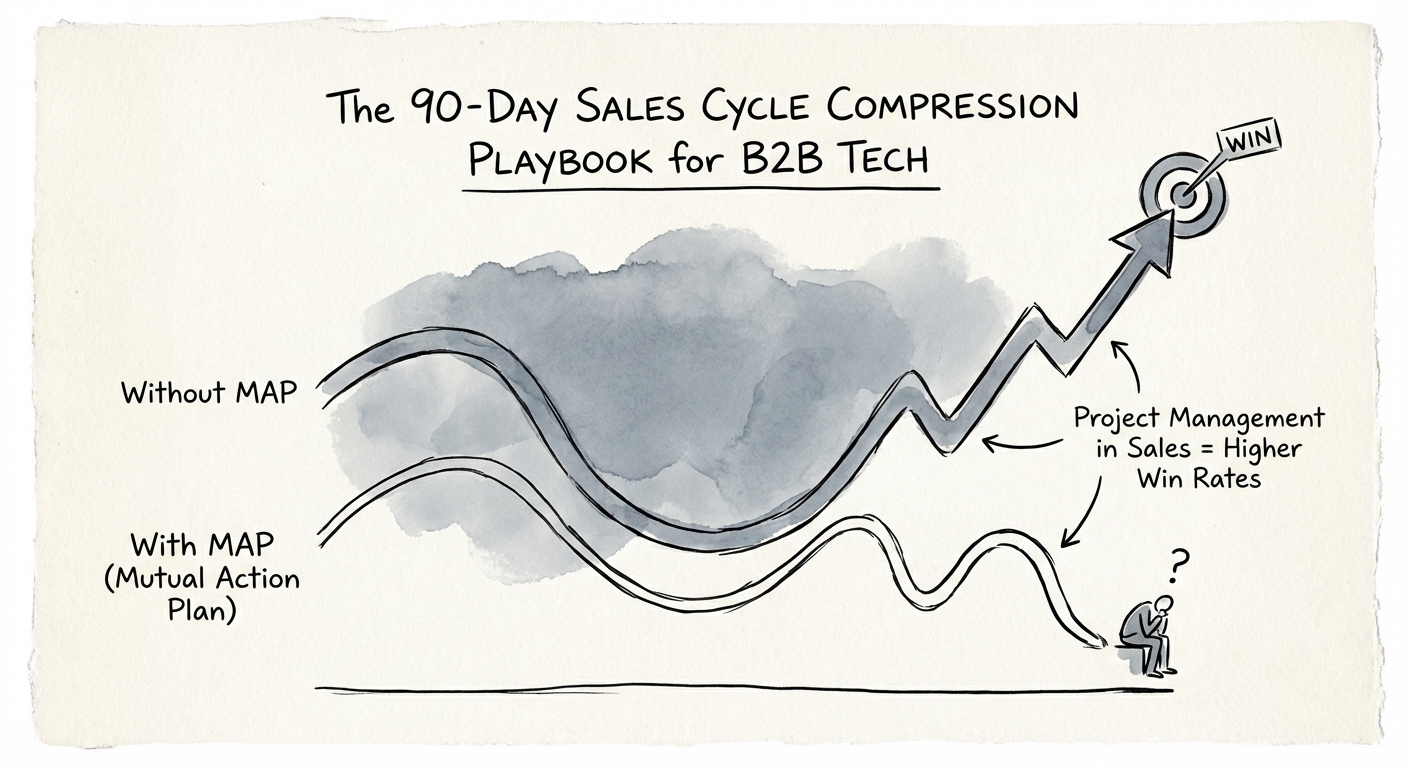
3. The Mutual Action Plan (MAP) Mandate
A 90-day close isn't a hope; it's a scheduled project. A MAP reverses the timeline from the client's desired "value realization date" back to the signature date. If the client wants to go live by Q3, the MAP mathematically proves they must sign by May 15th. This transforms the "closing pressure" from a sales tactic into a project management reality.
Execution: The "Give-Get" Rigor
Strategy is useless without enforcement. To operationalize the 90-day cycle, sales leaders must implement a disciplined "Give-Get" framework in their weekly pipeline reviews. Every concession—a demo, a reference call, a discount, a legal redline—must be traded for a milestone that advances the deal.
The Disqualification Discipline: The fastest way to shorten your average sales cycle is to disqualify long-shot opportunities early. Reps often hold onto "stale deals" to pad their pipeline coverage. Leaders must audit the "Time in Stage" metric. If a deal sits in "Stage 3: Evaluation" for more than 21 days without a verified MAP, it must be purged or downgraded to nurture. This rigor hurts in the short term but clears focus for the winnable revenue.
Ultimately, sales velocity is a function of confidence. By arming your team with CFO-grade business cases and enforcing strict project management protocols, you stop begging for signatures and start leading a transformation.