The practical answer
- Short answer
- New data shows B2B win rates drop to 17% after Series B scaling. Learn why 'premature scaling' kills efficiency and how to fix your revenue architecture.
- Best fit
- Industry: B2B Technology. Function: Sales
- Operating path
- Revenue Architecture → Commercial Performance → Office of the CFO
- Key metric
- 17% Average B2B sales win rate in 2025, down from historical norms of 25-30% due to premature scaling effects.
The 'Capital Curse': Why Win Rates Plummet Post-Funding
You just raised a $30M Series B. The press release is out, the team is celebrating, and your board deck promises to triple ARR in the next 18 months. To hit that number, your financial model assumes you need to hire 20 new Account Executives immediately. You assume they will ramp in 3 months and close at the same 28% win rate your founding team achieved.
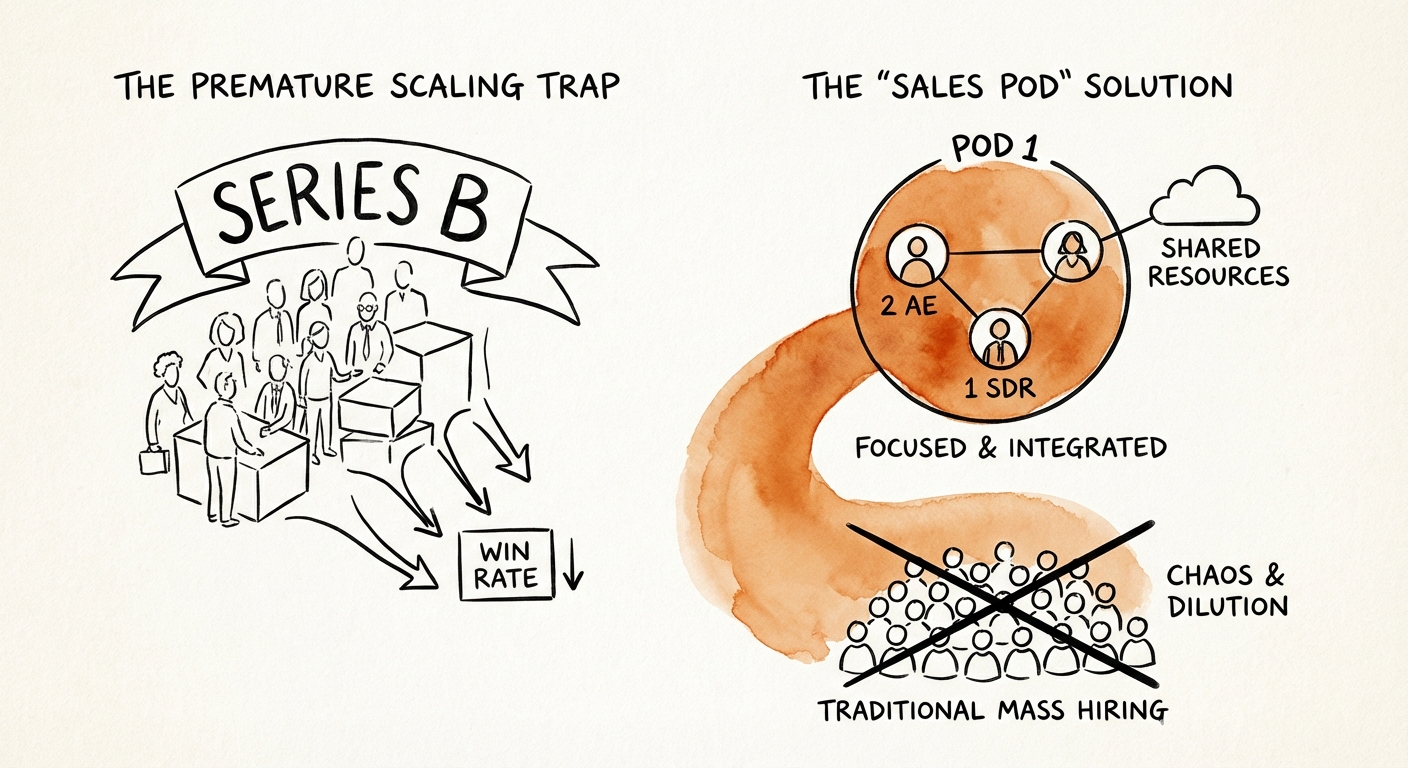
This assumption is the Premature Scaling Trap, and it is currently killing more Series B startups than product failure.
According to 2025 benchmarks, the average B2B sales win rate has collapsed to roughly 17% to 20% for scaling companies, down from the 30%+ often seen in Founder-led or early-stage sales. Even more alarming, quota attainment has dropped to just 51%. When you pour gasoline (capital) on an unoptimized engine (sales process), you don't get speed; you get an explosion.
The Dilution of 'Heroic' Selling
In the Series A phase, your win rate was artificially inflated by 'Heroic Selling.' You, the founder, or your first two senior reps (who had direct access to you) were closing deals through sheer force of will, deep product knowledge, and executive authority. You weren't winning because of a scalable process; you were winning because of talent density.
When you hire 15 reps in Q1 post-Series B, you dilute that talent density. These new reps don't have your context, your authority, or your 'founder magic.' If you haven't documented the exact winning motion—down to the specific questions to ask and the specific objection handlers to use—these new reps will revert to the mean. And right now, the market mean is a 17% win rate.
When you pour gasoline (capital) on an unoptimized engine (sales process), you don't get speed; you get an explosion.
The Mathematics of Failure: 5.7 Month Ramp Times
Your financial model likely assumes a 3-month ramp for new reps. This is a hallucination. The latest data from 2025 shows that the average sales rep ramp time has ballooned to 5.7 months—a 32% increase since 2020. For Enterprise deals ($100k+ ACV), that ramp is often 9 to 12 months.
Why This Breaks Your Model
Let's look at the math of the 'Series B Hire'.
- Hiring Lag: It takes ~3 months to find and hire a quality AE in a competitive market.
- Ramp Lag: It takes 5.7 months for them to become fully productive.
- Sales Cycle Lag: If your sales cycle is 6 months, they won't close their first self-sourced deal for nearly a year.
If you raised capital in January and hired reps in February expecting revenue impact in Q3, you have already missed your year-end target. By the time you realize the revenue isn't coming, you have burned through 40% of your new cash pile on salaries, tools, and severance for the 'mis-hires' who were actually just unsupported hires.
Furthermore, rapid hiring creates 'Lead Toxicity.' To feed 20 hungry new reps, marketing is forced to open the floodgates. They lower lead scoring thresholds to hit MQL volume targets. Your reps end up chasing low-intent prospects, which drives win rates down further and increases CAC (Customer Acquisition Cost) by roughly 14% year-over-year.
The Fix: Build 'Pods' Before You Mass Hire
To escape the Premature Scaling Trap, you must stop treating sales hiring as a capacity game and start treating it as an efficiency game. Do not hire 10 reps at once. Instead, deploy the Pod Architecture.
The Unit of Scale is the Pod, Not the Rep
A 'Pod' consists of:
- 2-3 Account Executives
- 1 Sales Development Rep (dedicated)
- 0.5 Sales Engineer / Solutions Consultant
- 1 Team Lead (Player-Coach)
You do not add a second Pod until the first Pod is profitably hitting 80%+ quota attainment for two consecutive quarters. This forces you to fix the process, the enablement, and the lead quality before you add headcount.
Strategic Calibration
Before you sign that next offer letter, audit your current state against these Series B danger signs. If your ramp time is dragging beyond 6 months, or if you hired a VP of Sales who is focused on headcount rather than efficiency, you need to pause.
Winning in the Series B stage isn't about how many reps you can hire; it's about how many reps you can make successful. A team of 10 reps closing at 30% beats a team of 30 reps closing at 10% every time—and costs half as much.