The practical answer
- Short answer
- Technical founders often fail in enterprise sales not because of their product, but their pitch. Learn how to fix the 'Translation Problem' and close more deals.
- Best fit
- Industry: B2B SaaS. Function: Sales
- Operating path
- Revenue Architecture → Commercial Performance → Office of the CFO
- Key metric
- 54.5% Average misalignment between how sellers and buyers perceive the core problem (Emblaze).
The Feature Trap: Why Your Demo is Killing the Deal
There is a specific moment in every failed founder-led sales call where the deal actually dies. It isn't when you reveal the price, and it isn't when the prospect asks about a competitor.
It is when you click on the "Settings" tab.
For a technical founder, the settings page is a triumph of engineering. It represents configurability, flexibility, and architectural elegance. To a B2B buyer, it represents work. It represents complexity, implementation headaches, and a 12-month ramp time.
This disconnect is backed by data. According to recent research by Emblaze, there is an average 54.5% misalignment between how sellers and buyers perceive the core problem to be solved. When you spend 20 minutes explaining your schemaless database architecture, you think you are proving scalability. The buyer hears, "This is going to be hard to hire for."
HubSpot reports that 82% of buyers feel overwhelmed by the amount of information in the sales process. When you lead with features—the "how"—you are contributing to that overwhelm. You are asking the buyer to do the heavy lifting of translating your technical specifications into their business outcomes. In enterprise sales, that is not their job. It is yours.
The most dangerous trap for a technical founder is the belief that the "best" product wins. In the founder-led sales phase, the best translated product wins. If you cannot bridge the gap between your code and their P&L, you will lose to an inferior product with a superior narrative.
To a technical founder, the settings page is a triumph of engineering. To a B2B buyer, it represents work, complexity, and risk. Stop selling the configuration and start selling the outcome.
The Translation Layer: Refactoring Your Sales Pitch
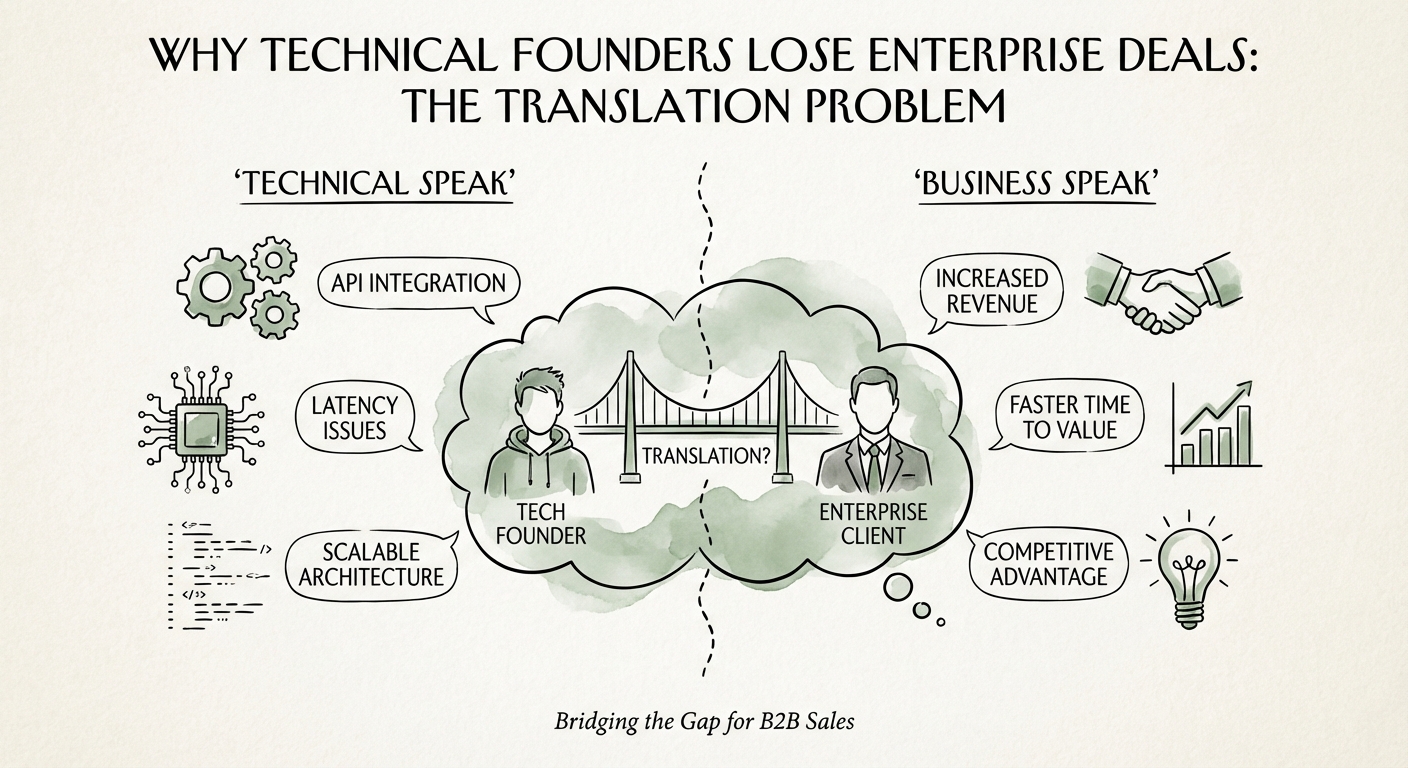
In software engineering, you refactor code to make it cleaner, more efficient, and easier to maintain without changing its external behavior. You must apply the same discipline to your sales narrative. You need a "Business Logic Layer" that sits between your product's raw code and the buyer's interface.
This requires a systematic translation of your technical vocabulary into executive-level risk and revenue language:
- Stop saying: "We reduced technical debt by refactoring the monolith into microservices."
- Start saying: "We reduced business risk and accelerated feature release velocity by 40%."
- Stop saying: "Our API has 99.999% uptime and < 50ms latency."
- Start saying: "We eliminate the revenue leakage caused by checkout failures during peak traffic."
- Stop saying: "We use AI agents to automate the ETL pipeline."
- Start saying: "We reduce the headcount required for data preparation by 3 FTEs."
The data supports this pivot. Gartner reports that 75% of B2B buyers prefer a rep-free experience, meaning they want to do their own research. If your sales conversations are just technical deep dives, you are redundant. They can read your documentation for that. Your value in the room is to connect the technical capability to a strategic priority.
This is especially critical when you are trying to transition from founder-led sales to a professional sales team. If your pitch relies on your unique ability to explain the architecture, it will never scale. You must build a narrative that a non-technical Account Executive can deliver with conviction.
The Fix: Stop Being the Chief Architecture Officer
The hardest shift for a technical founder is to stop being the smartest engineer in the room and start being the most relevant business partner. This is a "Revenue Architecture" problem. You have built a scalable technical architecture; now you need a scalable revenue architecture.
Start by auditing your slide deck. If your first three slides are about your technology stack, you have already lost the room. Your deck should follow a "Why Change, Why Now, Why Us" flow, not a "What We Built, How We Built It, Demo" flow.
Second, bring a "translator" into the meeting. This doesn't necessarily mean hiring a VP of Sales immediately—which is often a $2M mistake—but it does mean bringing someone who can play the role of the business buyer. This could be an advisor, a board member, or an early non-technical hire. Their job is to kick you under the table when you start talking about Kubernetes.
Finally, track your "Misalignment Metric." In your CRM, log the reason for closed-lost deals. If you see "No Decision" or "Went with Competitor" rising, dig deeper. Often, "No Decision" is code for "We didn't understand the business case." With B2B win rates hovering around 17-20%, you cannot afford to lose deals because you were speaking the wrong language.