
The practical answer
- Short answer
- Why Atlassian partners with Jira Service Management (JSM) specialization trade at 12x EBITDA while generalists stall at 7x. A guide for PE sponsors.
- Best fit
- Industry: IT Services. Function: Mergers & Acquisitions
- Operating path
- Exit Readiness → Operational Excellence → Transaction Advisory Services
- Key metric
- 12-14x EBITDA multiple for JSM-specialized partners, compared to 6-8x for Jira generalists.
The Valuation Bifurcation: Ticket Takers vs. Workflow Architects
For the last decade, the Atlassian partner ecosystem was a rising tide that lifted all boats. If you had a pulse and a Jira certification, you could grow at 20% annually just by servicing the developer economy. Those days are over. In 2026, private equity buyers have bifurcated the market into two distinct asset classes with radically different exit multiples.
On one side are the Generalist Agile Shops. These firms generate the bulk of their revenue from Jira Software configuration, license resale, and "agile coaching." While they often have high customer retention, their revenue is tied to headcount (seats) rather than strategic business value. In M&A, these firms are viewed as "staff augmentation with badges," typically trading at 6x to 8x EBITDA.
On the other side are the ITSM Specialists. These partners have pivoted aggressively to Jira Service Management (JSM). They aren't just setting up kanban boards for developers; they are displacing legacy BMC and ServiceNow installations in the mid-market. They are building workflows for HR, Legal, and Facilities, effectively turning Atlassian into an Enterprise Resource Planning (ERP) layer. Because they own the business process rather than just the developer tool, these firms command "ServiceNow-lite" multiples, often trading at 12x to 14x EBITDA.
The non-technical teams market represents a $14 billion opportunity. Partners who stick to the developer niche are fighting for crumbs, while ITSM specialists are eating the cake.
The PE Thesis: The "ServiceNow Displacement" Play
Why are private equity firms like Keensight Capital (backers of Valiantys) and others pouring capital into JSM-focused partners? The answer lies in the "ServiceNow Gap." ServiceNow has successfully moved up-market, focusing on the Global 2000 with seven-figure implementation costs and 12-month deployment timelines. This has left a massive vacuum in the mid-market ($50M - $2B revenue companies) that needs enterprise service management but cannot stomach the overhead of the "platform of platforms."
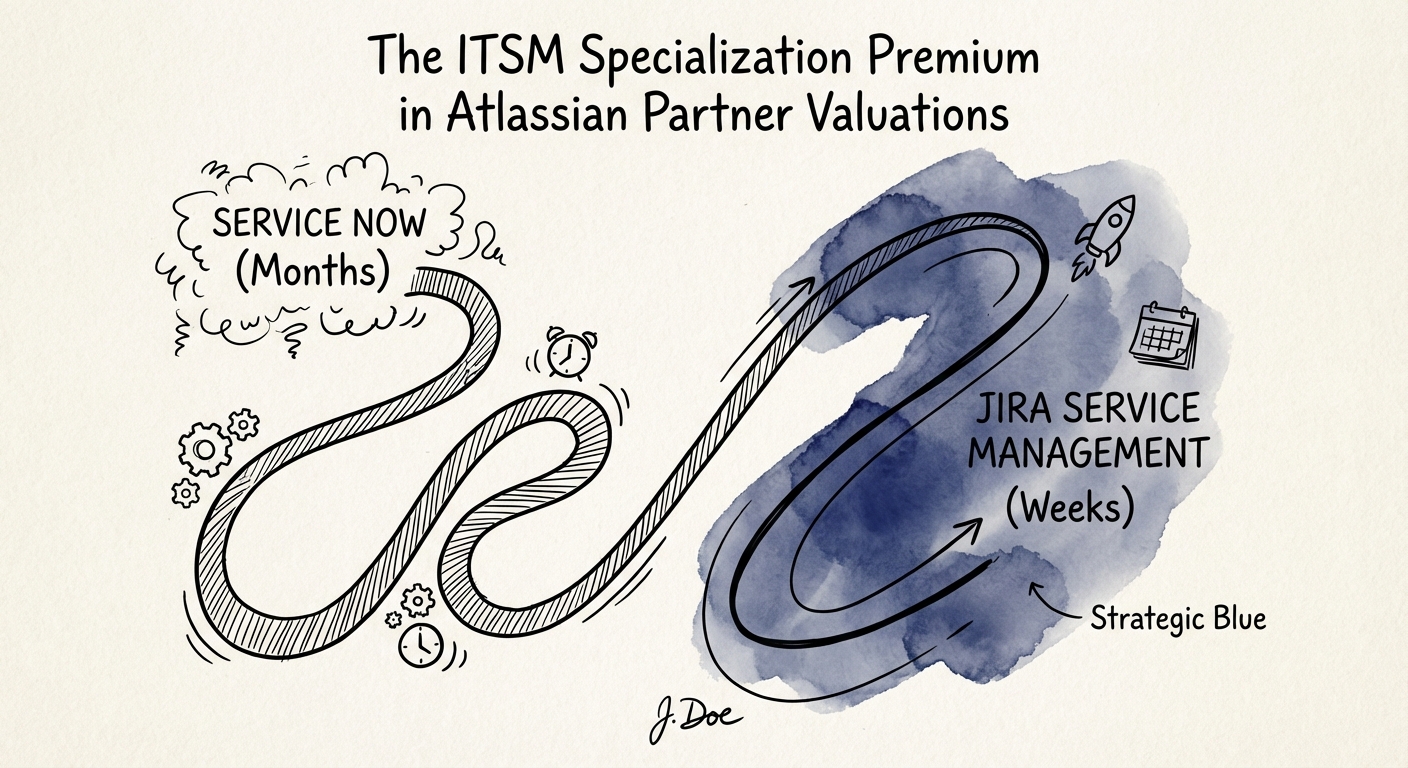
Jira Service Management has captured this wedge. With implementation timelines measured in weeks, not months, and a total cost of ownership (TCO) often 80% lower than ServiceNow, JSM is the preferred option for PE-backed portfolio companies looking to modernize IT without bloating CapEx. Consequently, partners who specialize in JSM are not just seen as IT service providers; they are viewed as efficiency accelerators for the broader PE portfolio.
The Federal Accelerator
This premium is further amplified in regulated sectors. The acquisition of Contegix by Valiantys highlights a sub-trend: the "FedRAMP Premium." Partners who can combine JSM expertise with government-grade security clearances are seeing valuation premiums that rival pure-play cybersecurity firms. In this context, the partner isn't just selling software; they are selling compliance-as-a-service through the Atlassian stack.
The "Exit-Ready" Revenue Mix
To command the 12x ITSM premium, a partner's revenue composition must tell a specific story in the Quality of Earnings (QofE) report. Buyers are scrutinizing the ratio of "Resale" to "Strategic Services." A high-value target typically exhibits the following profile:
- <20% Pure Resale: Reliance on license margin is a red flag. Atlassian's margin compression for partners means resale is a declining asset.
- >40% JSM-Linked Revenue: A significant portion of services revenue must be tied to Service Management (ITSM/ESM) projects, not just Jira Software/Confluence.
- Managed Services Attach Rate >30%: Unlike one-off agile coaching gigs, JSM implementations should naturally flow into multi-year managed support contracts for the "always-on" service desk.
If your firm is still 70% dependent on Jira Software upgrades and license renewals, you are effectively a reseller with a services arm. To exit at a premium, you must re-architect the P&L to look like a specialized consultancy that uses JSM to solve enterprise-wide workflow challenges.