
The practical answer
- Short answer
- Two Zendesk partners, same revenue, same headcount. One clears 6x EBITDA; the other clears 14x. The difference is whether you bill for tickets or for deflecting them.
- Best fit
- Industry: Private Equity. Function: Mergers & Acquisitions
- Operating path
- Exit Readiness → Operational Excellence → Transaction Advisory Services
- Key metric
- 133% Valuation premium for Zendesk partners with >40% AI/Automation revenue vs. generalist implementation shops.
The day your best client's ticket volume drops 40% — and what it does to your multiple
Here is a moment I've watched play out in three separate diligence rooms over the last year. A Zendesk partner pulls up a flagship account to show off retention. The client's been on the books four years, renews every cycle, never complains. Then the buyer's analyst asks a simple question: "What's their monthly ticket volume doing?" And it's down. Way down. The partner reads it as a problem to explain away. The buyer reads it as the entire investment thesis.
For a decade, a Zendesk partner's value was arithmetic: bill hours, stand up the Support module, resell licenses, hope for a 20% margin. More client seats meant more configuration work meant more revenue. That model is now trading at a ceiling around 6x EBITDA, because it has a structural flaw a private equity buyer can see in five minutes — your revenue grows only when your client's support problem grows. You are short your own customer's success.
Zendesk broke that model on purpose. The push into AI Agents (formerly Advanced Bots), accelerated by the Ultimate.ai and Klaus acquisitions, created a partner who profits in the opposite direction: paid to make the queue smaller. Instead of one-time setup fees, this partner runs resolution-tuning retainers — continually refining intents, training the learning loop on misrouted conversations, and tightening the human handoff so fewer tickets ever reach a person. That revenue is sticky, high-margin, and recurring, which is why acquirers price it like the SaaS-adjacent earnings it resembles: 12x to 14x EBITDA. Same Zendesk logo on the partner badge. Triple the multiple.
Every Zendesk shop I've diligenced lately tells the same story: their best clients are quietly trying to need them less. The partners who lean into that — who get paid to shrink the queue — are the only ones a PE buyer will pay a software multiple for. The rest are billing hours against a meter that's running backwards.
Two partners, identical P&Ls, an 8-turn gap in price
Picture two Zendesk partners going to market the same quarter. Both do roughly $9M in revenue, both run ~40 consultants, both show 22% EBITDA. On a spreadsheet they're twins. In a data room they're priced eight turns apart, and the entire delta comes from one line item: revenue composition by service line.
Partner A: the configuration shop (5x-7x)
Over 80% of revenue is implementation and license resale — triggers, macros, business rules, SLA setup, the occasional Sunshine integration. Honest work, and clients are happy. But growth is linearly chained to headcount: to add 20% revenue, hire 20% more admins. A buyer looks at the staffing model and applies the services discount that has always applied to body-shops, capping the deal in the 6x-8x range. The "stickiness" is a mirage — the client could re-platform their Zendesk config with any of a hundred other partners.
Partner B: the resolution architects (12x-14x)
Over 40% of revenue comes from AI and automation work, and the people doing it aren't admins — they're conversation designers and bot architects billing $250+/hour, increasingly on value-based terms (priced per automated resolution rather than per hour). Gross margins clear 55% because the marginal cost of a tuned intent is near zero. And retention is structurally different: once a client routes 40% of inbound through your trained AI Agents, turning you off doesn't mean re-configuring some macros — it means their CX operation falls over on Monday. Data from Aventis Advisors on software valuation multiples shows information-and-software-services assets reaching well above 20x in outlier cases, with a sober middle-market landing zone around 14x. Partner B isn't priced as a services firm that uses AI. It's priced as a software-like asset that happens to deliver through people.
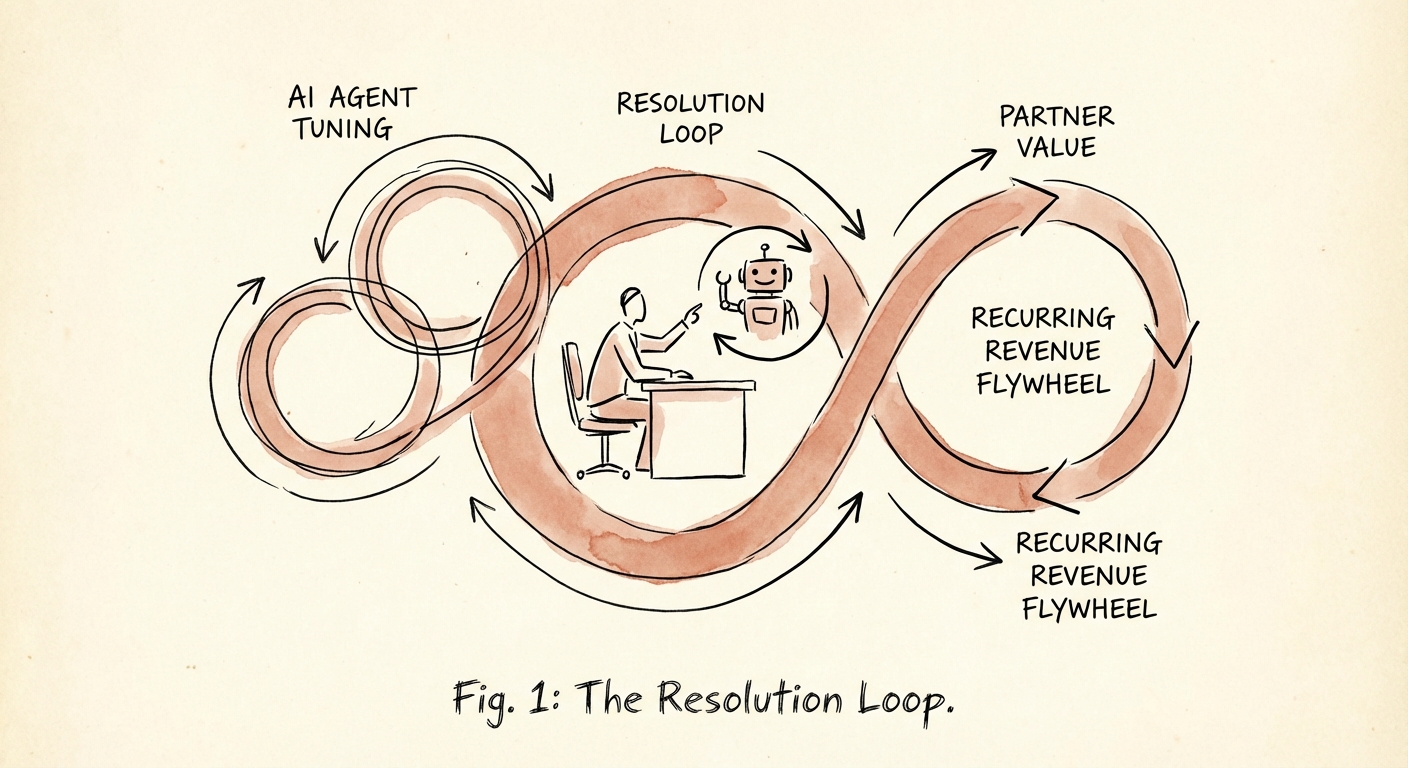
If you own Partner A and want Partner B's multiple, you have about 18 months
You cannot rebrand your way to 14x. A buyer's analyst will rebuild your revenue mix from raw invoices in an afternoon, and an "AI & Automation" line that's really repackaged macro work gets discovered and discounted hard. Restructuring delivery before you go to market is the actual work, and on a Zendesk book it comes down to owning the resolution loop in three concrete moves.
Change what you report — and prove you caused it. Stop leading with tickets closed. Lead with the lift in your clients' automated-resolution rate, attributed to your tuning. A partner who can show a documented arc — say a 60-person ecommerce client taken from 0% to 40% deflection over two quarters, with the misrouted-intent log to back it — is an asset. A partner who staffs the queue is a commodity. Buyers pay for the causal story, not the dashboard.
Productize the vertical IP that lives in your architects' heads. The reason agentic partners deploy fast is pre-trained intent libraries scoped to a domain — fintech chargeback-dispute flows, retail return-and-RMA logic, SaaS billing escalations. Package those into a named, licensable deployment kit and you've converted tribal knowledge into a platform premium that survives any single employee leaving. The 2025 IDC MarketScape rewards vendors who fold AI directly into workforce engagement; the partners who mirror that by owning the human-AI handoff become the obvious bolt-on for a larger global SI or a PE-backed CX platform trying to buy modernization rather than build it.
Re-paper your top accounts onto outcome terms before diligence opens. A retainer priced per resolution reads as recurring software-like revenue; the same dollars billed as monthly hours read as staffing. Convert even three or four flagship clients and your revenue-quality narrative shifts from "professional services" to "platform." Start the conversion now — by the time a buyer is in the room, you want a clean year of the new contract structure on the books, not a slide promising you'll get there.