
The practical answer
- Short answer
- Veeva partners specializing in Vault CRM migration trade at 14x EBITDA, while legacy Salesforce-based shops stall at 8x. Here is the diagnostic.
- Best fit
- Industry: Life Sciences Technology. Function: M&A
- Operating path
- Exit Readiness → Operational Excellence → Transaction Advisory Services
- Key metric
- 80% Global market share of Veeva Systems in Life Sciences CRM, making the Vault migration a mandatory industry event.
The Vault CRM Migration Event: The 2030 Cliff Defining Valuation
For over a decade, the Veeva partner ecosystem operated on a stable assumption: Veeva provided the industry-specific IP, and Salesforce provided the underlying platform. That assumption—and the valuation models built on it—shattered with Veeva's decision to migrate its entire CRM customer base (representing ~80% of the global life sciences market) from Salesforce to its proprietary Vault CRM platform by 2030. For PE-backed partners, this is not just a technical update; it is the single largest determinant of exit multiples in 2026.
The market has bifurcated into two distinct asset classes. Legacy CRM Shops are those still focused on administering the Salesforce-based Veeva CRM application. Their revenues are tied to a platform entering "stability mode," with a hard expiration date. Buyers view these firms as carrying significant technology risk, often discounting them to 6x-8x EBITDA because their core competency (Salesforce administration for Pharma) is becoming obsolete.
Conversely, Vault Migration Specialists—partners with the "Veeva Vault CRM Migration" certification and proven datasets for mapping Salesforce objects to Vault architecture—are trading at 12x-15x EBITDA. These firms are capturing the massive wave of migration spend that began in earnest in 2025 and will peak between 2026 and 2029. Acquirers are not just buying services capacity; they are buying the capacity to execute the migration for global pharma giants who cannot afford a single day of downtime. If your firm lacks a dedicated Vault CRM migration practice, you are effectively selling a melting ice cube.
In 2026, a Veeva CRM practice is only stable if it has a credible Vault migration path. Buyers pay for that transition plan, not legacy administration.
The "Commercial Cloud" Moat: Why Suite Density Drives Multiples
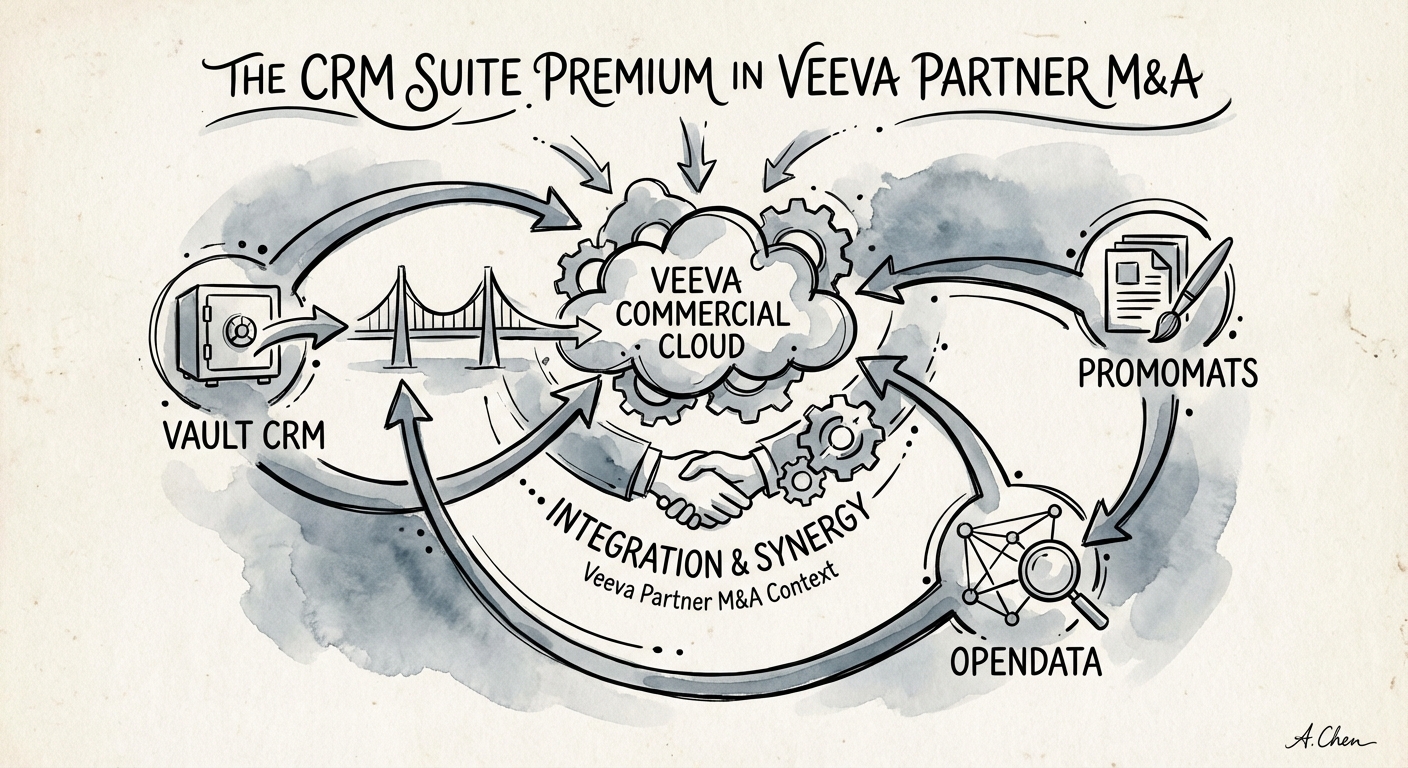
In the new Veeva economy, "CRM" is no longer a standalone service offering; it is the anchor tenant of the broader Commercial Cloud. Valuation premiums are awarded to partners who demonstrate "Suite Density"—the ability to cross-sell and integrate adjacent modules like Vault PromoMats (commercial content), Veeva OpenData, and Veeva Link. Our data indicates that partners with revenue concentrated in a single module (typically CRM implementation) trade at a 4-turn discount compared to those managing multi-module commercial ecosystems.
The economic logic is simple: churn reduction. A life sciences company using a partner solely for CRM staff augmentation can switch vendors with relative ease. A company relying on a partner to orchestrate the flow of data between their CRM, their Medical Legal Regulatory (MLR) review process in PromoMats, and their master data management in OpenData is deeply entrenched. This integration creates a defensive moat that PE buyers covet.
Specifically, we see a premium for Data-to-Action workflows. Partners who can configure Vault CRM to trigger automated content workflows in PromoMats, or use Veeva Link data to dynamically adjust sales territories, are positioning themselves as "Commercial Architects" rather than "Tool Implementers." In 2026 due diligence, expect buyers to audit your revenue mix: if >70% of your revenue comes from basic CRM configuration/admin, you are vulnerable. If you show 40%+ revenue from adjacent Commercial Cloud modules, you unlock the strategic premium.
The Valuation Gap: Staff Augmentation vs. Strategic IP
The final differentiator in Veeva partner M&A is the delivery model. The Life Sciences IT services market is flooded with "Body Shop" operators—firms that provide certified Veeva admins on a time-and-materials basis. While these firms generate cash, they lack the operating leverage and intellectual property that drive double-digit multiples. They are effectively trading on headcount, not capability.
The 14x EBITDA assets are those building "Migration IP" and "Managed Outcomes." Instead of billing hourly for a migration, these firms offer a fixed-fee Migration Factory model, utilizing proprietary scripts and validation tools to automate the Salesforce-to-Vault transition. This shifts the revenue quality from low-margin services to high-margin, tech-enabled solutions. Furthermore, they wrap these migrations in multi-year Managed Services contracts that go beyond support tickets to include quarterly release management and "white glove" user adoption programs.
For PE operating partners and PE sponsors, the diagnostic is clear: Audit your "Veeva Practice." Are you selling hours of administration for a dying platform? Or are you selling the strategic bridge to the Vault future? The difference is not just marketing; it is the difference between a distress sale and a strategic exit.