
The practical answer
- Short answer
- Veeva services partners are bifurcating. Why 'Development Cloud' specialists command 14x multiples while 'Commercial' shops stall at 8x. PE exit readiness guide.
- Best fit
- Industry: Life Sciences Technology. Function: Mergers & Acquisitions
- Operating path
- Exit Readiness → Operational Excellence → Transaction Advisory Services
- Key metric
- 27% YoY growth rate of Veeva's Development Cloud (R&D), driving the valuation premium over Commercial Cloud services.
The 'Vault Supercycle' and the Valuation Bifurcation
For the past decade, the Veeva partner ecosystem was defined by a simple arbitrage: ride the coattails of the life sciences industry's adoption of cloud CRM. If you could implement Veeva CRM (built on Salesforce), you could command a premium over generic IT services. That era is over. The separation of Veeva from Salesforce—and the migration to the proprietary Vault CRM—has created a hard bifurcation in partner valuations.
In 2026, Private Equity buyers are no longer paying premiums for generic "Commercial Cloud" implementation capacity. The market is saturated with firms that can configure field sales tools. The new valuation frontier is defined by the Vault Supercycle—the massive, industry-wide migration of CRM onto Veeva's own platform, coupled with the explosion of the Development Cloud (R&D, Clinical, Quality). Data from 2025 shows that while corporate acquirers are paying ~9.9x EBITDA for generalist capabilities, PE sponsors are paying a median of 12.8x EBITDA for specialized assets that own the "technical debt" and "data migration" complexity of this transition.
This is not just a technology shift; it is a business model shift. Partners who remain "staff augmentation" shops for Commercial Cloud are seeing multiples compress toward the 6-8x range typical of generic IT services. Conversely, partners who have built IP around Vault Migration accelerators, Clinical Data Management (CDM), and Regulatory Information Management (RIM) are trading at 12x-15x. The market is paying for domain density, not just billable hours.
The separation of Veeva from Salesforce is the single largest catalyst in Life Sciences IT. It creates a 'have' and 'have-not' market: those who can execute the Vault migration, and those who will be left maintaining legacy systems.
Commercial vs. R&D: The 6-Turn Valuation Gap
The most critical diagnostic for a Veeva partner's valuation is its revenue mix between Commercial Cloud (Sales/CRM) and Development Cloud (Clinical, Quality, Regulatory). Historical benchmarks favored Commercial because of the sheer volume of seat licenses. Today, the Development Cloud is growing at 27% YoY—more than double the rate of Commercial—and has surpassed it as Veeva's primary revenue engine. Valuation multiples follow growth.
Why does R&D command a 6-turn premium?
- Regulatory Moat: Implementing Vault Quality or Vault Clinical requires deep knowledge of GxP compliance, 21 CFR Part 11, and clinical trial phases. This talent is scarce, expensive, and sticky. A "Commercial" consultant can be trained in 3 months; a "Clinical" architect takes 3 years.
- Project Duration & Stickiness: Commercial projects are often "rip and replace" or cyclical updates. R&D implementations are multi-year transformations that touch the core intellectual property of the pharma client. Once a partner installs the system that manages clinical trial data, they are rarely displaced.
- The "Data" Multiplier: R&D projects are fundamentally data projects, not just workflow projects. Partners with expertise in Veeva Clinical Database (CDB) and data migration tools are viewed as "Data & AI" plays rather than just systems integrators.
For PE firms evaluating assets, a target with >50% revenue from Development Cloud is a strategic platform. A target with >80% revenue from Commercial CRM is a "fixer-upper" that faces significant headwinds as the Salesforce partnership unwinds.
The Asset-Based Premium: Moving Beyond 'Time and Materials'
To break the ceiling of service-based multiples (typically capped at 10-12x even for good firms), Veeva partners must demonstrate Asset-Based Consulting (ABC). In the context of Veeva, this means owning the IP that de-risks the client's most expensive problems. Buyers are scrutinizing the "IP Layer" of the P&L—specifically, revenue that is detached from linear headcount growth.
We are seeing three specific types of IP drive valuations toward the 15x mark:
1. Automated Validation Frameworks
In life sciences, "Computer System Validation" (CSV) is a massive cost center. Partners who have proprietary, automated testing suites (e.g., tailored for Vault's tri-annual releases) can convert low-margin QA hours into high-margin recurring managed services. This turns "lumpy" project revenue into predictable ARR.
2. Migration Accelerators
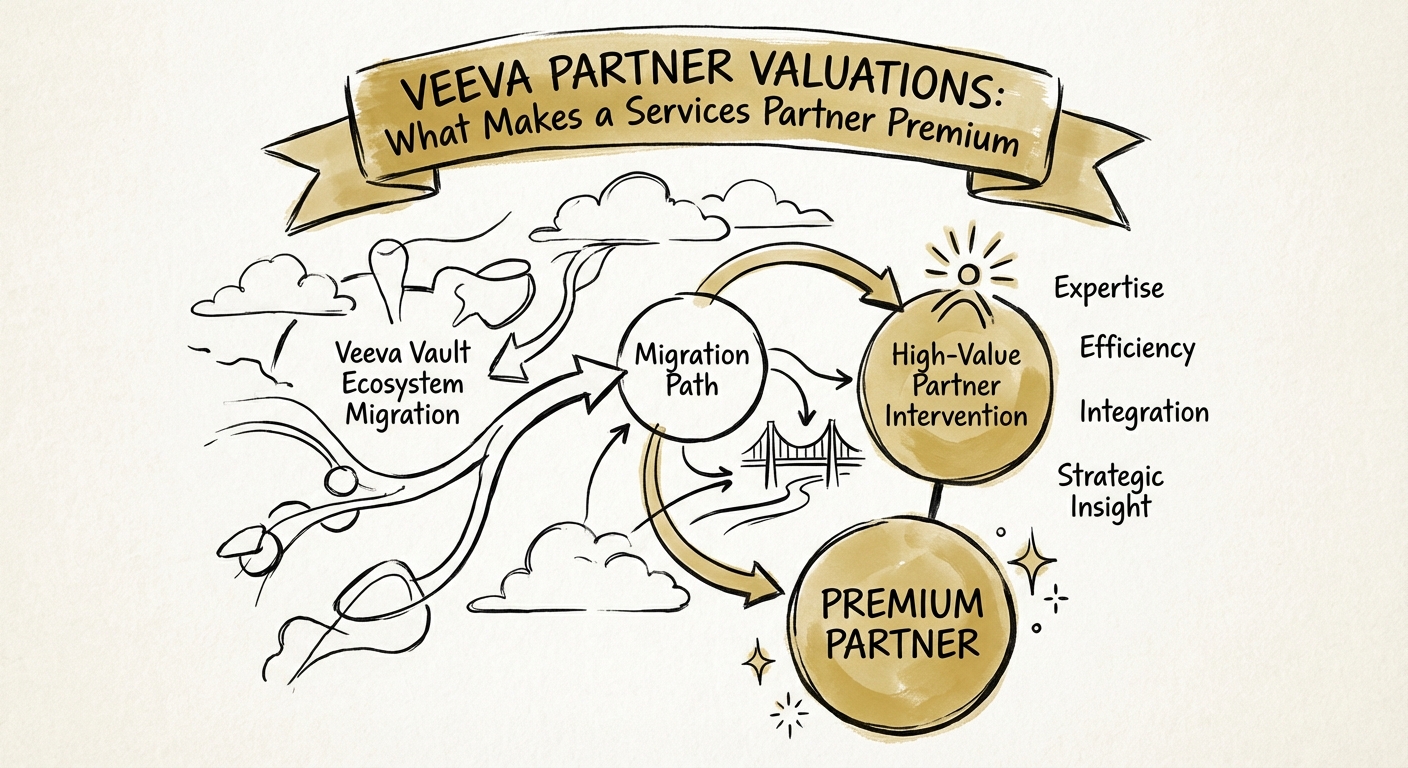
With thousands of customers needing to migrate from Veeva CRM (Salesforce) to Vault CRM by 2030, partners with pre-built extraction, transformation, and loading (ETL) connectors are winning deals at higher margins. These accelerators reduce the "services drag" of a project and increase the EBITDA margin profile.
3. Clinical Data Bridges
As Veeva competes with Medidata, partners who have built connectors between Vault EDC and legacy systems (or downstream analytics platforms like Snowflake/Databricks) are positioning themselves as critical data infrastructure. This aligns with the Healthcare Data Specialization premium we see in the broader market.