
The practical answer
- Short answer
- Stop pitching features against incumbents. Use the 'Wedge Strategy' to exploit technical debt, pricing fatigue, and support cliffs. A guide for B2B founders.
- Best fit
- Industry: B2B Technology. Function: Sales Strategy
- Operating path
- GTM Execution → Commercial Performance → Performance Improvement
- Key metric
- 59% of global businesses report 'regret' over a major software purchase made in the last 18 months.
The 'Feature Parity' Trap: Why Better Doesn't Win
In 2026, being "better" than the incumbent is no longer a competitive advantage; it is merely the entry fee to a losing game. The average B2B win rate has steadily declined to between 17% and 21% for generalist pitches, primarily because founders fundamentally misunderstand why enterprises switch software.
The incumbent you are fighting isn't winning because their product is superior. They are winning because of inertia. According to Gartner, 61% of B2B buyers now prefer a rep-free buying experience, effectively walling off challengers who rely on "consultative" sales motions to explain their feature differentiation. When you pitch a "better platform" (a Wrapper), you are asking the buyer to rip out their entire infrastructure, retrain their team, and risk operational downtime for a marginal feature gain. The CFO sees this as an unnecessary risk, not an upgrade.
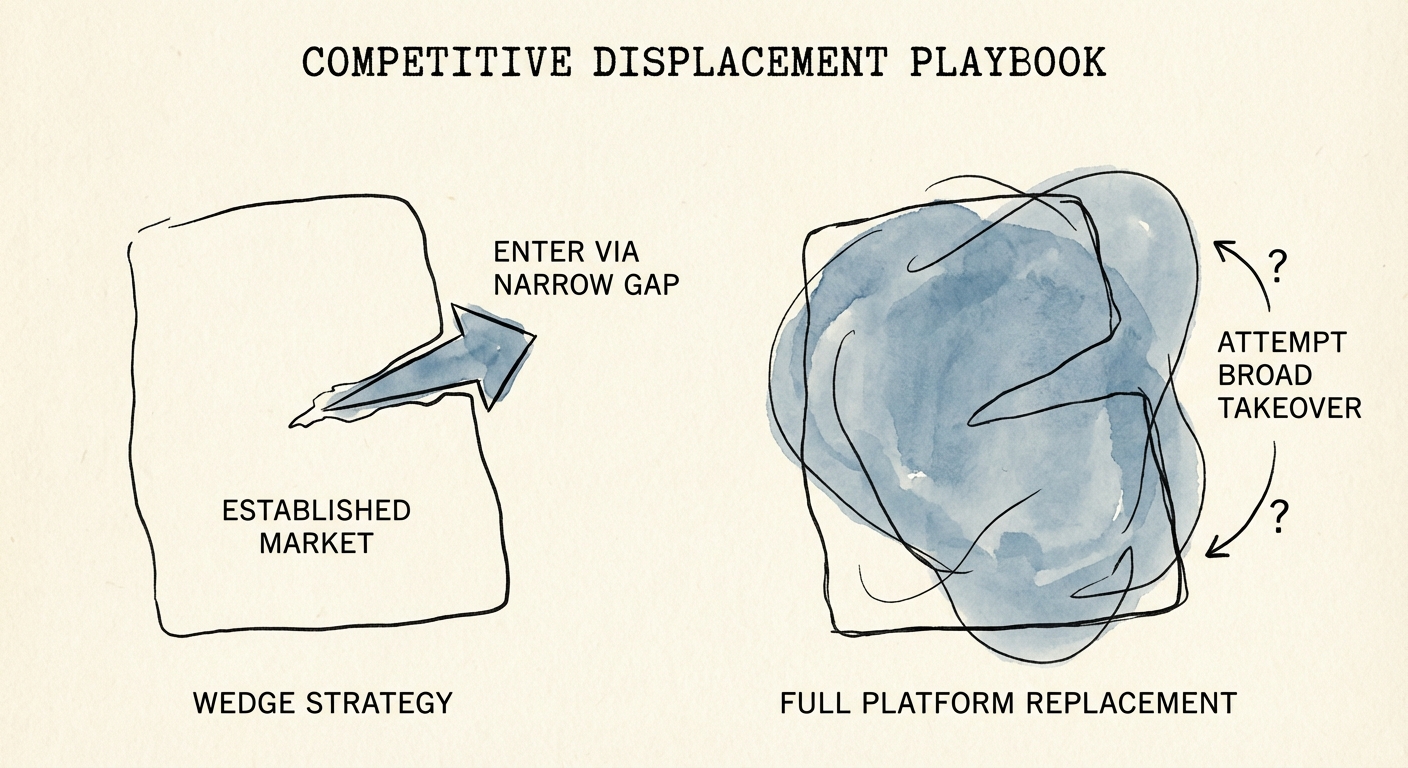
However, the incumbent has a fatal flaw: Buyer Regret. Recent data from Capterra reveals that 59% of global businesses regret at least one major software purchase from the last 18 months. This regret is rarely about missing features; it is about broken promises—specifically in support, integration, and billing. To win, you must stop selling a "better version" of the incumbent and start selling the Wedge—a specific, narrow use case that the incumbent is structurally incapable of solving due to their legacy debt.
The most dangerous competitor isn't the startup with better AI features; it's the incumbent that's 'good enough' to keep the CFO from signing a check. You don't beat 'good enough' with 'better.' You beat it with 'broken'.
The Three Wedges: Exploiting Incumbent Vulnerability
Successful displacement requires identifying where the incumbent is rotting from the inside. You do not attack their strength (their feature breadth); you attack their structural weaknesses. There are three primary "Wedges" that drive successful displacement in 2026.
1. The Technical Wedge: Integration Debt
Incumbents grow through acquisition, often resulting in a Frankenstein's monster of codebases that barely talk to each other. Inbox Insight reports that 51% of buyers cite "poor integration" as a primary trigger for switching vendors.
The Play: Do not pitch your whole platform. Pitch your connector. Find the specific workflow where the incumbent's API fails or requires expensive middleware. Offer a "sidecar" solution that solves that one data synchronization problem perfectly. Once you are installed and integrated, you have bypassed the security review and procurement hurdles, allowing you to expand laterally.
2. The Commercial Wedge: The Usage Arbitrage
With SaaS inflation running at 9%, CFOs are scrutinizing "shelfware"—seats that are paid for but unused. Incumbents love seat-based pricing because it locks in revenue regardless of value delivered.
The Play: If the incumbent charges by the seat, charge by the event (API call, report generated, active user). Show the CFO a side-by-side comparison of their "Inactive Spend" (paying for inactive users) versus your usage-based model. You aren't just cheaper; you are aligned with their utilization.
3. The Service Wedge: The Support Cliff
The most common complaint against market leaders (cited by 42% of churned customers) is the "Support Cliff." During the sales cycle, the buyer gets the 'A-Team.' Post-contract, they are routed to a generic call center.
The Play: Operationalize your support as a product feature. Offer a guaranteed SLA on engineering access, not just support tickets. When a prospect says, "We use Salesforce, we're fine," the counter is not "We are better," but "When was the last time you spoke to an engineer to fix a critical bug in under 4 hours?"
Execution: The Trojan Horse Roadmap
The goal of the Wedge Strategy is to land without triggering a "Rip and Replace" evaluation, which often stalls in the "No Decision" void. This requires a fundamental shift in your sales motion—from "Platform Sales" to "Co-existence Sales."
Start by mapping the incumbent's contract renewal dates. However, do not wait for the renewal to engage. The most effective displacement campaigns start 9 to 12 months before the contract expires. Your goal is to be installed as a "supplementary tool" (using budget from a discretionary line item, not the main IT budget) long before the renewal discussion begins.
By the time the incumbent's renewal notice arrives, your Wedge should have already:
- Captured the most critical data workflows (Technical Wedge).
- Proven a 40% cost efficiency on a per-unit basis (Commercial Wedge).
- Won the loyalty of the power users via superior support (Service Wedge).
At that point, you are not asking for a displacement. You are simply asking the CFO to stop paying for the redundant legacy tool that nobody likes anymore. This turns a high-risk "switch" into a low-risk "consolidation." For more on managing this timeline, review our 90-Day Sales Cycle Compression Playbook.