
The practical answer
- Short answer
- Why enterprise win rates are falling below 20% and how to fix it. Benchmarks, 'no decision' analysis, and the multi-threading multiplier for PE-backed CROs.
- Best fit
- Industry: B2B Technology. Function: Sales Leadership
- Operating path
- GTM Execution → Commercial Performance → Performance Improvement
- Key metric
- 3.1x Win rate multiplier for enterprise deals with 3+ engaged stakeholders vs. single-threaded deals.
The 20% Danger Zone: Separating Signal from Noise
In 2025, the "Mendoza Line" for enterprise software sales has shifted. While early-stage startups often tolerate wild fluctuations, private equity-backed portfolios demand predictability. The harsh reality of the 2025 market is that sub-20% win rates are no longer just a symptom of poor closing skills; they are a structural indictment of your qualification rigor.
According to late 2025 benchmarks, the median win rate for B2B SaaS deals between $10k and $50k ACV holds steady at 24%. However, as deal complexity rises above $100k ACV, that median drops to 15-18%. If your firm is selling mid-market solutions but converting at enterprise rates (<20%), you are not experiencing "long sales cycles"—you are experiencing a failure of GTM execution.
The mathematical implication of a sub-20% win rate is brutal for capital efficiency. To achieve $10M in new bookings at a 15% win rate, you need roughly $67M in pipeline coverage. At a 25% win rate, that requirement drops to $40M. That delta of $27M represents wasted marketing spend, exhausted SDRs, and bloated forecast reviews where "hope" replaces data. As discussed in our Pipeline Coverage Lie analysis, simply adding more top-of-funnel volume to a leaking bucket is the fastest way to burn cash.
The mathematical implication of a sub-20% win rate is brutal... To achieve $10M in new bookings at a 15% win rate, you need roughly $67M in pipeline coverage. At a 25% win rate, that requirement drops to $40M.
The "Stale Pipeline" and the "No Decision" Crisis
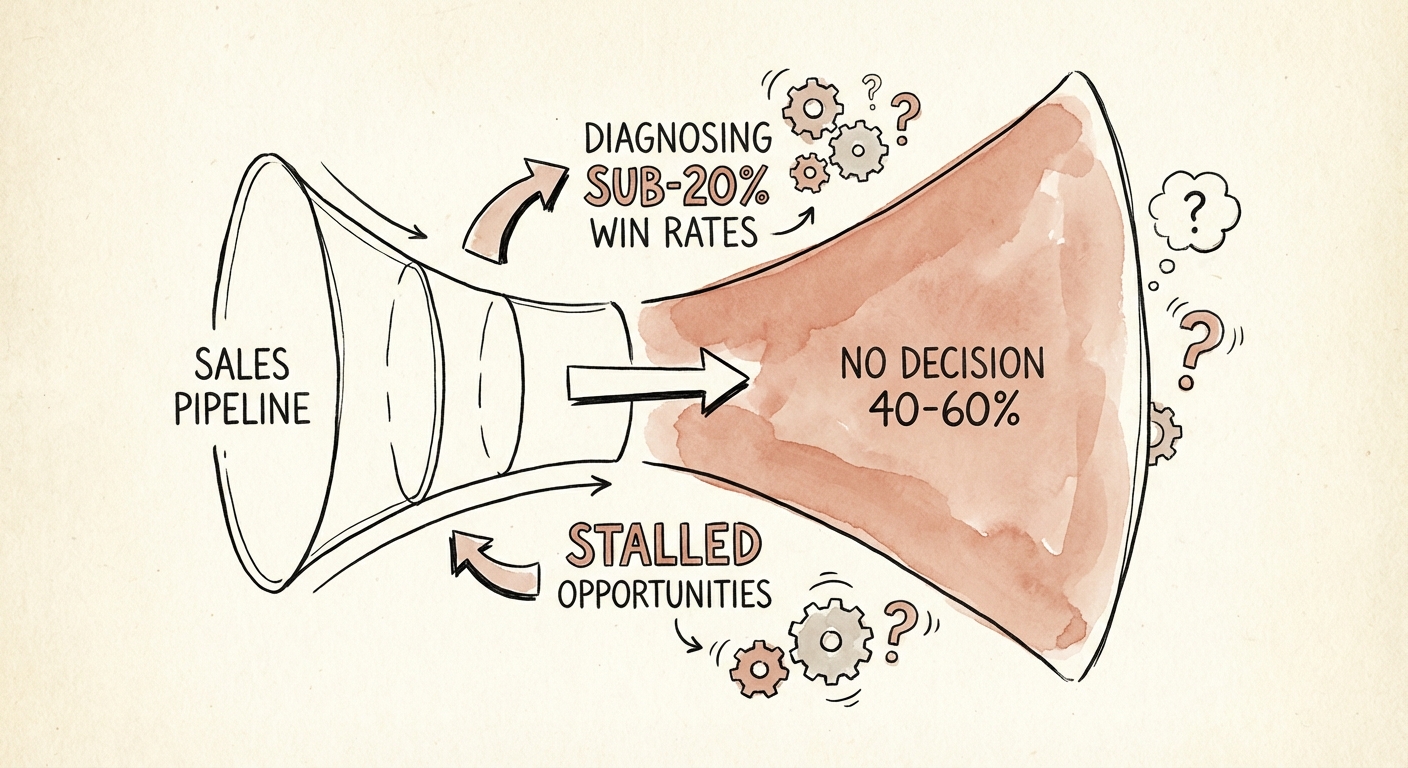
The primary driver of sub-20% win rates isn't competition; it is inertia. Recent data indicates that 40-60% of enterprise opportunities now end in "No Decision." These are the deals that linger in your CRM stage 3 (Solution Validation) for 180 days before quietly slipping into Closed-Lost.
This "Stale Pipeline" creates a false sense of security. Revenue leaders look at 4x coverage and report confidence to the Board, ignoring the fact that 50% of that pipeline is effectively dead. The root cause is rarely the product; it is the inability to build a consensus for change within the buying committee. In 2025, the average enterprise buying group has expanded to 6-10 stakeholders, each with veto power.
The Multi-Threading Deficit
Our diagnostic data shows a direct correlation between single-threading and sub-20% win rates. Deals where sales reps engage only one point of contact have a win probability plummeting below 10%. Conversely, opportunities with 3+ engaged stakeholders across different departments close at 2.4x to 3.1x that rate.
If your win rate is languishing, audit your "Stage 2" exit criteria. Are you allowing deals to progress based on a single champion's enthusiasm? As outlined in our guide to the Multi-Threading Deficit, you must enforce a "No Access, No Advance" policy. If a rep cannot secure a meeting with a second stakeholder by the third week, the probability of a "No Decision" outcome spikes to nearly 80%.
The Fix: Rigorous Disqualification and the "Kill Early" Discipline
Turning around a sub-20% win rate requires a counter-intuitive strategy: shrink the pipeline to grow the revenue. High-performing revenue organizations are disciplined about disqualification. They do not celebrate "pipeline add"; they celebrate "pipeline velocity."
To exit the danger zone, implement these three immediate changes:
- Define "No Decision" Triggers: If a deal pushes its close date more than twice without a material change in the buying committee (e.g., a new stakeholder entering), it must be moved to a nurture campaign.
- Mandate Multi-Threading for Forecast Inclusion: No deal above $50k enters "Commit" or "Best Case" without documented engagement from at least three unique personas (e.g., Technical Buyer, Economic Buyer, User Champion).
- Audit the "Why Now?": In every QBR, ask not "Why us?" but "Why now?" If the rep cannot articulate the specific negative consequence of the prospect doing nothing, the deal is a "No Decision" candidate.
For a structured approach to reversing this trend, refer to our 60-Day Win Rate Turnaround Playbook. The goal is not to win every deal; it is to lose the bad deals fast, so your best resources are focused on the 17-25% that can actually close.