
The practical answer
- Short answer
- A deal with one champion isn't a commit, it's a coin flip. Why 78% of reps are single-threaded, what it does to your forecast, and the grid that fixes it.
- Best fit
- Industry: B2B Technology. Function: Sales Leadership
- Operating path
- GTM Execution → Commercial Performance → Performance Improvement
- Key metric
- 78% of B2B sales reps remain single-threaded in most deals, despite rising buying committee sizes.
Read me the names on the deal
Here is a test you can run on your pipeline this afternoon. Pull your top five "commit" deals for the quarter and, for each one, ask the rep to name every person on the buyer's side they've actually spoken to. Not "the account." The humans. First and last name.
On a healthy enterprise deal you'll hear four, five, sometimes seven names spanning IT, finance, security, and the business owner. On the deals that are about to slip, you'll hear one name. Maybe two, and the second one is the first person's assistant. That single name is the whole forecast, and it's standing on one leg.
This isn't a rare failure mode. LinkedIn's own sales research puts it bluntly: roughly 78% of B2B reps are single-threaded in most of their deals. Meanwhile the thing they're trying to close has gotten dramatically more crowded. Buying-committee data compiled by 6Sense and Thunderbit puts the average committee at 10 to 11 stakeholders, and north of 15 on genuinely complex enterprise purchases. Do the arithmetic the rep won't: one relationship out of eleven votes is about 9% coverage. You are forecasting a yes from a room you've never been in.
That's where "slippage" actually comes from. The deal didn't die because "legal got involved" or "the CFO had a question." Those people were always there. They were the silent majority of the committee, and your rep simply never met them until the moment they exercised a veto. Single-threading doesn't make a deal risky in some abstract sense. In a market where Gartner's view of digital-first B2B buying assumes a sprawling, self-directed committee, it makes the deal a coin flip you've mislabeled as a commit.
A deal riding on one champion isn't qualified, it's borrowed. You're renting access to a buying decision from someone who has a 1-in-5 chance of changing jobs before you sign.
The two ways one thread snaps
Single-threaded deals don't fail gradually. They fail in one of two abrupt ways, and both are measurable.
The first is the veto you didn't see coming, which is just the inverse of a stat from Outreach's analysis of billions of buyer interactions: deals with multiple engaged stakeholders are about 37% more likely to close. Read that backwards. The single-threaded deal is structurally carrying a 37% closing penalty before anyone has objected to your price, your security posture, or your roadmap. You're losing margin on the org chart, not the product.
The second way is uglier because it has nothing to do with your solution at all: your champion leaves. About 1 in 5 B2B buyers change jobs within twelve months. When your entire deal rides on one person, you've accepted a flat 20% chance that the human holding it walks out the door before the contract does. New person inherits your "active opportunity," has no memory of why it started, and quietly reverts it to "evaluating options." That isn't a lost deal in your CRM yet. It's a ghost that will haunt your forecast for two more quarters.
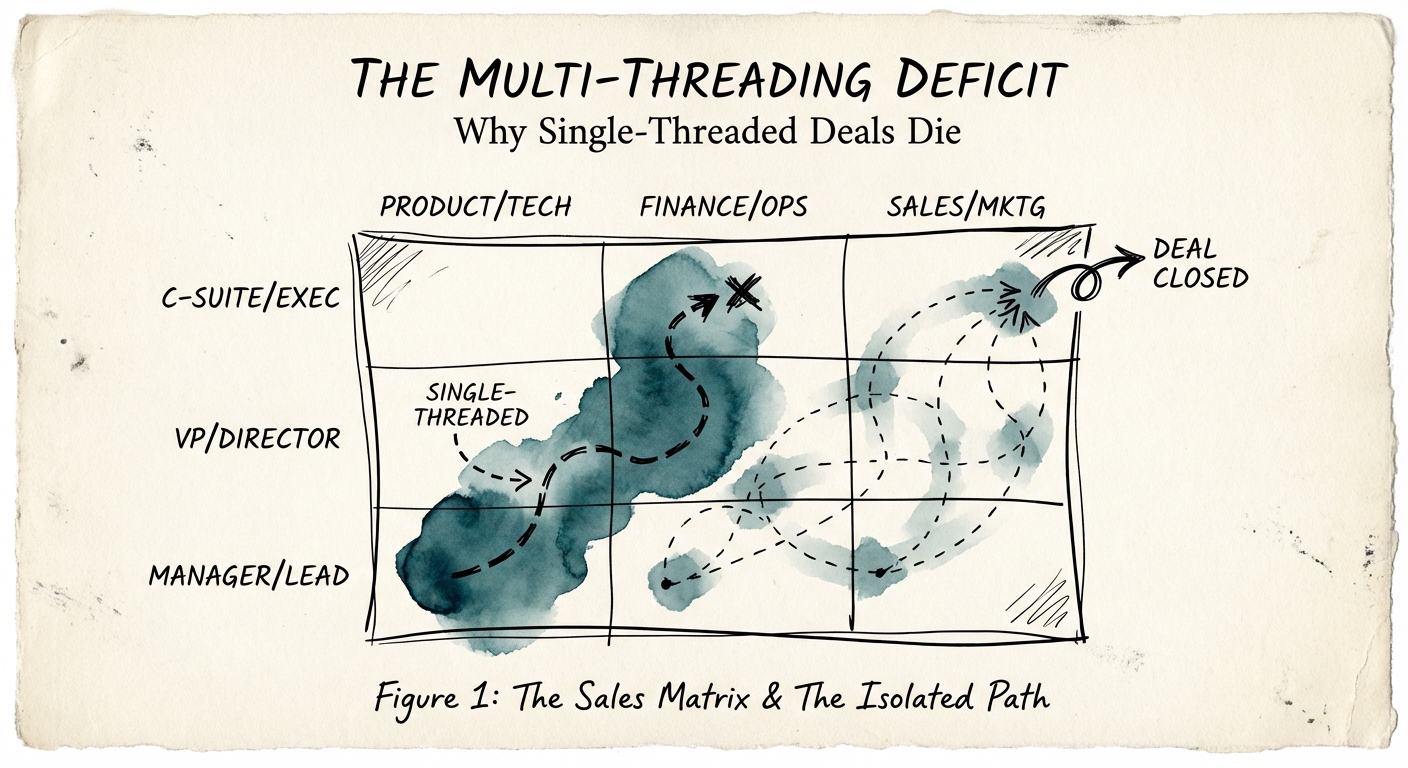
And breadth alone isn't the whole story, depth across functions is. Outreach's cross-department data is the part most teams skip: deals that engage three or more departments win 44% of the time, against just 28% when the conversation stays inside a single department. That 16-point swing is the real cost of the comfortable relationship. A rep who's friendly with one mid-level manager in one function feels productive, files optimistic notes, and is actively distorting your numbers. Comfort is not coverage.
Make the grid an exit criterion, not a coaching tip
You will not multi-thread your way out of this with a pep talk, because reps don't single-thread out of laziness. They do it out of fear, the very real fear that going wider will annoy the one person who likes them. The fix has to be structural: turn coverage into a gate the deal cannot pass through, not advice it can ignore.
Make 3x3 the price of admission to "Proposal"
Before any enterprise deal moves into Proposal or Negotiation, the rep has to show engagement with three distinct stakeholders across three levels of seniority: a user, a manager, and an executive. Not "has their email." Has had a conversation. If the grid has holes, the deal is flagged At Risk in the forecast regardless of how confident the rep sounds on the call. The grid is the qualifier. Optimism is not.
Recruit the champion instead of going around them
The reason reps stay single-threaded is they imagine multi-threading as a betrayal of their champion. Reframe it as helping the champion win their own internal fight. The line that works: "To get this through your CFO, we usually need to walk someone through the capitalize-versus-expense treatment. Who on the finance side should I prep that for, so it's not a surprise when it lands on their desk?" Now the rep is the champion's co-pilot through the approval, not a seller sneaking past them. The champion opens the door because you've made their job easier.
Define your Minimum Viable Committee from won deals
Look at your last ten closed-won enterprise deals and write down who was actually in the room: a budget owner, a security reviewer, a legal redline, a technical user. That recurring cast is your Minimum Viable Buying Committee. Any deal missing a seat from it is not a commit, it's a hope with a close date. Bake that committee into your stage definitions so threading becomes a literal exit criterion for early stages, the same discipline behind the 60-day win-rate turnaround. And if you want to stop being surprised by deals that looked perfect in the system, start with the gap between what your reps log and what's true: most of it traces back to a CRM that's been quietly lying to you about pipeline health. Coverage, logged honestly, is the cure.