
The practical answer
- Short answer
- Stop treating sales objections as isolated hurdles. Learn how to diagnose systemic GTM failures using objection patterns like 'No Decision' and 'Price' vs. Value.
- Best fit
- Industry: B2B Technology. Function: Sales Leadership
- Operating path
- GTM Execution → Commercial Performance → Performance Improvement
- Key metric
- 58% Increase in win rate when 4+ stakeholders are involved in the deal (Gong, 2025)
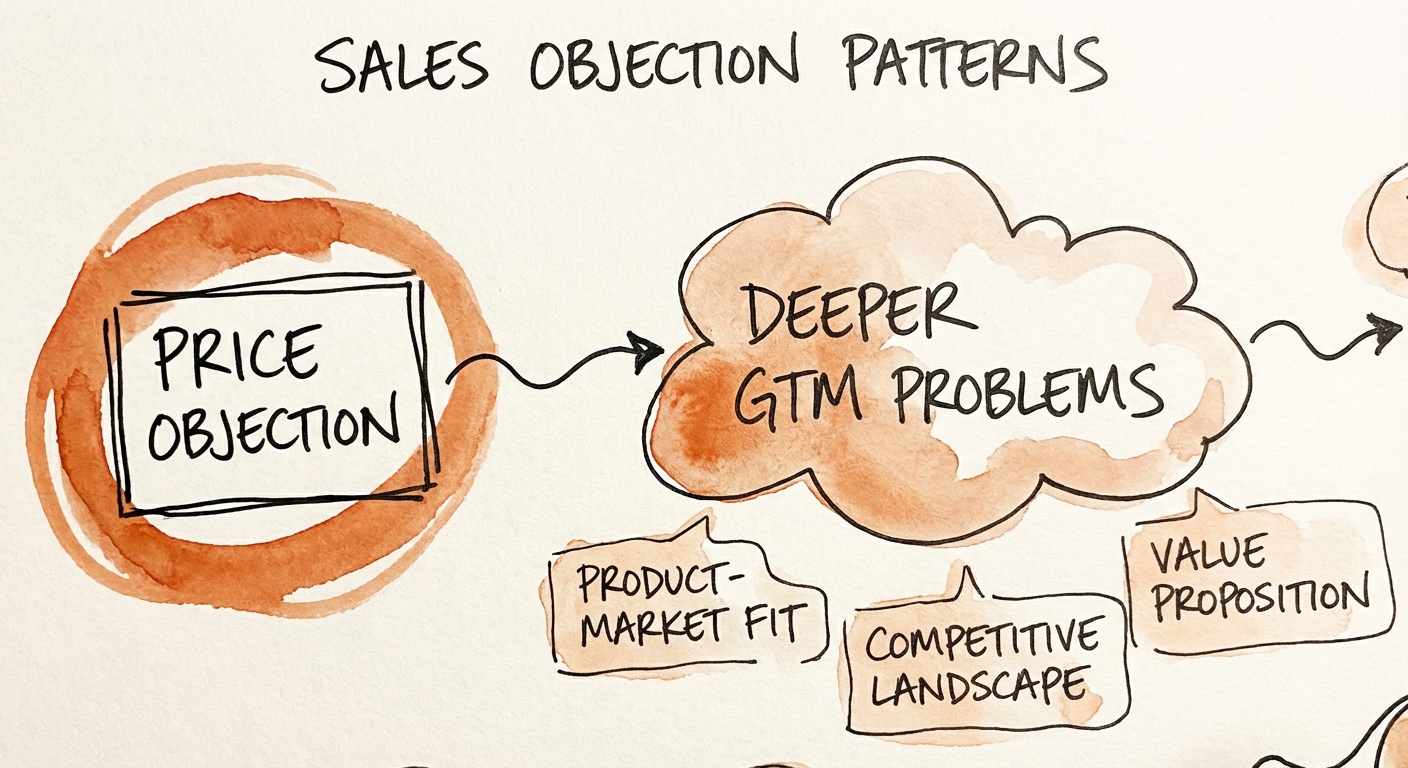
The 'Price' Objection is a Targeting Signal
If your CRM reports that 42.6% of your lost deals are due to 'Price' or 'Budget,' you do not have a pricing problem. You have a targeting problem. In 2025, data from Gong indicates that while 'situational' objections like budget are the most common recorded reason for loss, they are frequently a mask for a failure in value quantification or stakeholder alignment.
When a prospect says 'it's too expensive,' they are often communicating one of two deeper realities:
- You are selling to a user, not a buyer. Users care about features and cost; buyers care about ROI and risk. If you haven't multi-threaded to a P&L owner, price is the default rejection because the person you're talking to literally cannot authorize the spend.
- You haven't established the 'Cost of Inaction.' If the cost of your solution is higher than the perceived pain of the status quo, you will lose to price every time.
Our research into win/loss analysis frameworks suggests that true pricing failures usually manifest as low win rates even when the champion is fully bought-in. If you are losing early or mid-funnel to price, your GTM motion is targeting segments that cannot support your unit economics.
In calls with high levels of customer indecision, win rates drop from 30% to just 6%. Your biggest competitor isn't another vendor; it's the status quo.
The 'Feature Gap' Fallacy
Sales teams love to blame product gaps for missed quotas. It is the perfect external excuse: 'We would have won if we just had that one integration.' However, 2025 data suggests that while innovation gaps do cost deals, they are rarely the primary cause of systemic revenue failure. IcebergIQ found that while buyers cite UI/UX and feature gaps, these often serve as rationalizations for a lack of trust in the vendor's roadmap or stability.
When a pattern of 'Feature Gap' objections emerges, it typically signals a Product-Market Fit drift. You are likely attempting to move up-market into enterprise segments without the necessary compliance, security, or governance features, effectively trying to sell a SMB tool to a Fortune 500 buyer. Alternatively, your reps are 'feature selling' rather than 'outcome selling,' allowing prospects to commoditize your solution based on a checklist rather than a strategic result.
Before you overhaul your engineering roadmap, audit your CRM pipeline data. Are these 'feature gaps' actual blockers, or are they 'nice-to-haves' used by prospects to politely decline a solution that didn't demonstrate sufficient business impact?
The 'No Decision' Black Hole
The most dangerous objection pattern in 2025 isn't 'No,' it's 'Nothing.' According to research from DCM Insights (The JOLT Effect), between 40% and 60% of qualified opportunities are now lost to 'No Decision.' This is not a failure of persuasion; it is a failure of risk mitigation.
In an economic environment where only 25% of B2B reps are hitting quota, buyers are paralyzed by the fear of making a wrong decision. They aren't rejecting your product; they are choosing the safety of the status quo. If your 'No Decision' rate exceeds 40%, your sales enablement strategy is fundamentally broken. You are likely equipping reps to sell the 'upside' (ROI) when you should be equipping them to sell the 'safety' (risk reduction).
Diagnosing Indecision vs. Disinterest
To fix this, you must distinguish between prospects who are uninterested and those who are overwhelmed. The latter requires a specific GTM pivot: Prescriptive Selling. Instead of offering three tiers and endless configuration options (which increase cognitive load), successful teams are now presenting a single, recommended path forward. Furthermore, multi-threading is no longer optional; Gong data shows win rates increase by 58% when at least four contacts are involved, as consensus reduces the personal risk for any single decision-maker.