The practical answer
- Short answer
- Stop buying 'Release Theater.' Learn why elite DevOps teams recover 2,293x faster and how to spot the 'Hero Deployment' trap in due diligence.
- Best fit
- Industry: Private Equity. Function: Engineering
- Operating path
- Technical Debt → Turnaround & Restructuring → Transaction Advisory Services
- Key metric
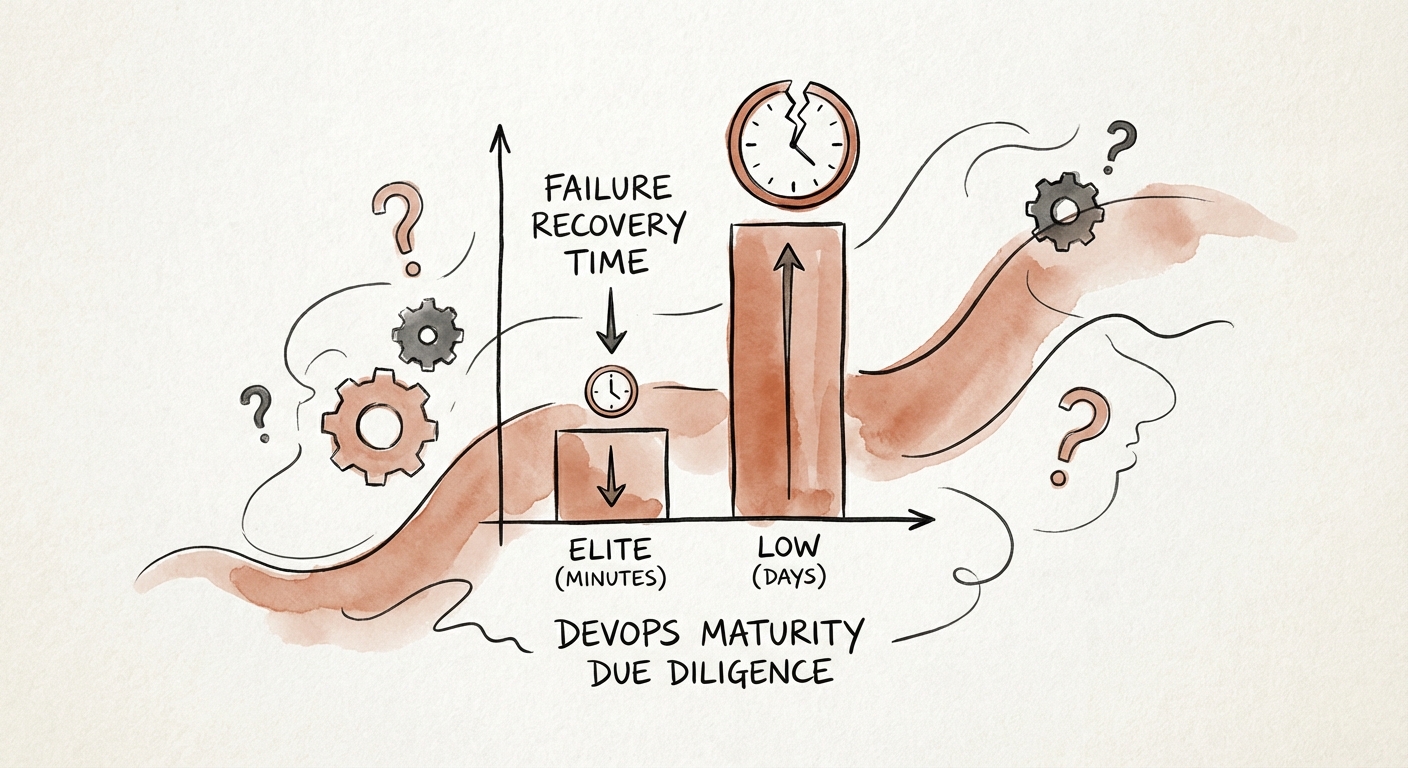
- 2,293x Faster recovery time from failure for Elite DevOps teams vs. Low Performers.
The 'Paper DevOps' Illusion: Why the Gap is Widening
In 2026, every software company claims to be 'Agile' and 'DevOps-native.' They all have Jira, they all have GitHub, and they all claim to deploy continuously. But for Private Equity buyers, the reality is often what I call 'Release Theater': a performative display of modern tooling masking a manual, fragile, and hero-dependent delivery process.
The 2025 DORA State of DevOps data reveals a terrifying trend for acquirers: the gap between 'Elite' and 'Low' performers isn't closing—it's exploding. While Elite performers deploy 182x more frequently than their low-performing peers, the 'Low' performance cluster has actually grown from 17% to 25% of the market. This means 1 in 4 targets you evaluate are statistically likely to have a deployment process that is not just slow, but actively decaying.
Furthermore, the rush to adopt AI coding tools has created a new risk vector: the 'Velocity Trap.' 2025 data shows that while AI adoption correlates with higher throughput (more code written), it also correlates with higher instability and change failure rates in immature organizations. If your target is using Copilot but hasn't automated their testing pipeline, they aren't shipping features faster—they are shipping bugs faster. In due diligence, you must look past the 'commit volume' and interrogate the 'clean build' percentage.
If your target's 'Senior Architect' is the only person who knows how to deploy to production, you haven't bought a software company. You've bought a single point of operational failure.
The Hidden CapEx of 'Hero-Based' Deployments
When you acquire a software company, you aren't just buying code; you are buying the machine that produces the code. If that machine requires a specific 'Hero Engineer' to manually massage a release into production every Friday night, you have acquired a liability, not an asset. This is the 'Key Person Dependency' of DevOps, and it is a leading indicator of post-close value destruction.
The financial impact of this immaturity is quantifiable. Data shows that 'Low' performers have a Change Failure Rate that is 8x higher than Elite teams, but the real killer is the Time to Restore Service. Elite teams recover from a failure 2,293x faster than low performers. Translating this to EBITDA: if an Elite platform goes down, it's up in minutes. If your 'Low' performing target goes down post-integration, you are looking at days of downtime, SLA penalties, and customer churn.
This becomes an integration tax on your budget. Without a mature Platform Engineering approach, your '100-Day Plan' can be consumed by keeping the lights on rather than shipping the new features that justified your investment thesis. If the target doesn't have a self-service platform for developers, every minor update requires a ticket, a meeting, and manual coordination.
The 5-Day DevOps Audit for Due Diligence
Stop accepting 'we use Jenkins' as an answer. To uncover the truth about DevOps maturity in a 5-day technical diligence window, you need to audit the process, not just the toolchain. Here is the diagnostic framework:
1. The 'Friday Deployment' Test
Ask for the deployment logs for the last 6 months. If you see zero deployments on Fridays or near holidays, you are looking at a fragile system. Elite teams deploy on demand, confident in their automated safety nets. 'Fear of Fridays' is a proxy for manual testing and low confidence.
2. The Config Drift Audit
Request a comparison between the infrastructure-as-code (Terraform/Ansible) repo and the actual running production environment. If they don't match, or if the target admits to 'hot-fixing' servers manually, assess a $500k remediation penalty immediately. This 'Config Drift' ensures that your first attempt to scale the platform post-close will fail.
3. The Rollback Drill
Ask the CTO: 'If the next deployment fails, exactly how long does it take to revert to the previous version?' If the answer involves 're-deploying the old build' or takes more than 5 minutes, mark the asset as high-risk. Mature DevOps maturity means instant, automated rollbacks (e.g., blue/green deployments). Anything less is an operational landmine waiting for your Operating Partner to step on it.