
The practical answer
- Short answer
- Stop choosing your Dynamics practice based on features. Learn the unit economics, valuation multiples, and capital requirements of F&O vs. Business Central.
- Best fit
- Industry: Microsoft Partner Ecosystem. Function: Executive Strategy
- Operating path
- GTM Execution → Commercial Performance → Performance Improvement
- Key metric
- 18mo Average F&O Implementation Timeline vs. 4-7 Months for BC
The Generalist Trap: Why 'Doing Both' Kills EBITDA
In the Microsoft ecosystem, I see a recurring tragedy among partners hovering between $10M and $20M in revenue. They start as a Business Central (BC) shop, graduate to a few larger clients, and suddenly decide they are a "full-service Dynamics shop." They hire two expensive F&O architects, bid on a global manufacturing deal, and win it.
Six months later, their cash flow is destroyed.
The unit economics of Dynamics 365 Finance & Operations (F&O) and Business Central (BC) are not just different; they are contradictory. Trying to run both under one P&L without distinct business units is like trying to run a Ferrari dealership and a Honda dealership from the same showroom, with the same sales team.
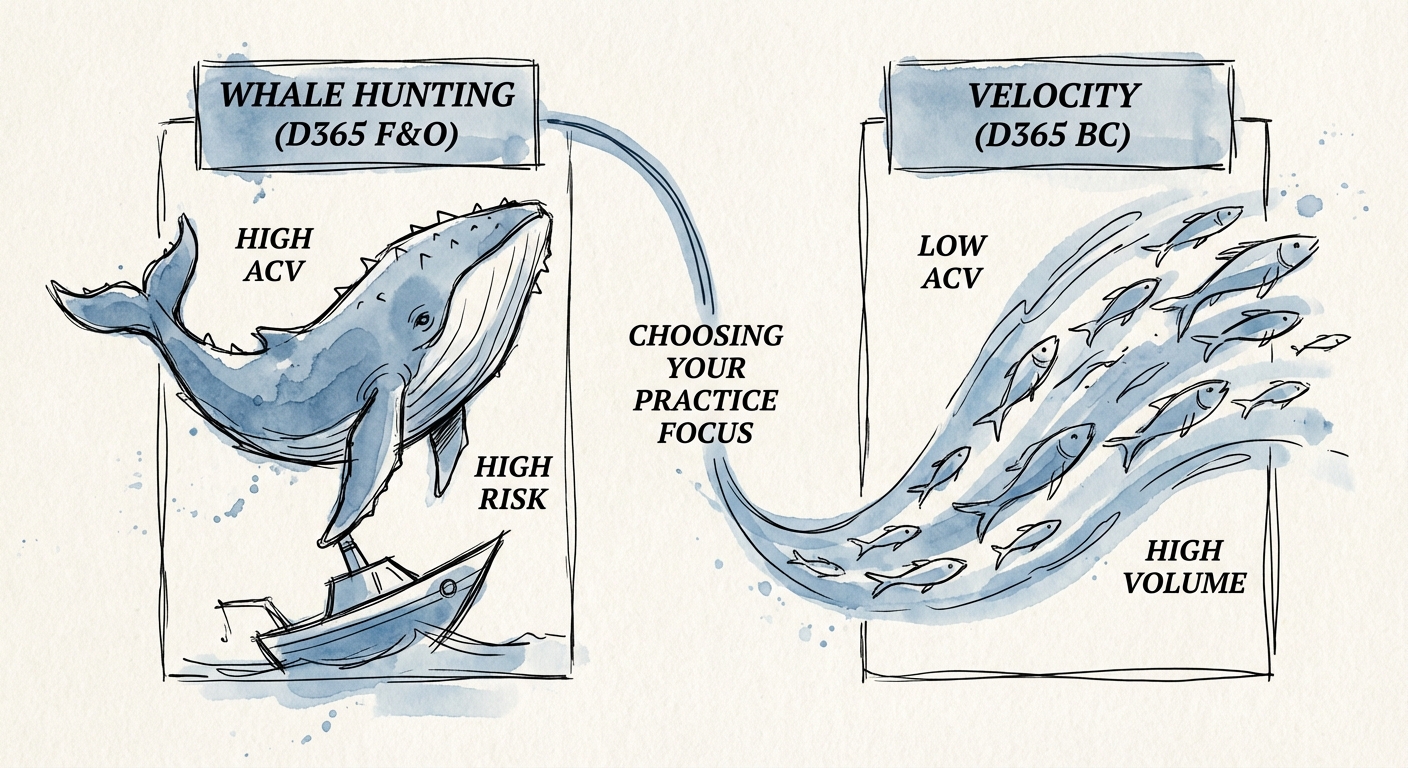
The market data from 2025 is unforgiving. F&O implementations now average 12 to 18 months with ACVs exceeding $1M. Conversely, a healthy BC practice runs on velocity: 4 to 7-month cycles with ACVs between $50k and $150k. When you mix these, your resource allocation breaks. Your BC consultants get pulled into F&O fires, destroying your velocity. Your F&O architects sit on the bench waiting for the "big deal" to close, destroying your utilization.
The Valuation Impact: PE buyers pay premiums for specialization. A pure-play F&O firm with deep vertical expertise (e.g., Pharma Manufacturing) trades at a premium for its moat. A pure-play BC firm trades at a premium for its velocity and IP. A "hybrid" firm typically trades at a discount because the buyer sees customer concentration risk on the F&O side and margin erosion on the BC side.
You don't buy F&O for the features, you buy it for the governance. You don't buy BC for the complexity, you buy it for the velocity. Mixing them destroys both.
The Economics of F&O: Whale Hunting
Building a Finance & Supply Chain Management (F&O) practice is an exercise in capital efficiency and risk management. You are not selling software; you are selling governance.
The Metrics That Matter
- Deal Size: $1M - $5M+ Services Revenue.
- Sales Cycle: 9 - 18 Months.
- Talent Cost: Senior Solution Architects command $200k+ base salaries in 2025.
- Risk Profile: Binary. One stalled project can wipe out your quarterly EBITDA.
F&O is a high-stakes game. The "moat" here is complexity. Enterprises choosing F&O have global supply chains, multi-entity consolidations, and heavy compliance needs (SOX, FDA). If you can solve these problems, you become sticky. The churn is non-existent because the cost of ripping out F&O is astronomical.
However, the capital requirements are massive. You need a balance sheet that can sustain a team of expensive architects through a 6-month sales delay. If you are bootstrapping, F&O is a material risk. You will run out of cash before the first milestone payment hits.
Strategic Advice: Only pivot to F&O if you have a specific vertical wedge (e.g., "F&O for Aerospace Defense Contractors") and at least $5M in cash reserves or backing. Do not compete with Avanade or HCL on generalist implementations. You will lose on rate and bench depth.
The Economics of BC: The Velocity Game
Business Central is a different beast. It is the "volume" play. The 2025 market for BC is exploding as legacy on-prem ERPs (GP, NAV, SL) finally reach end-of-life and SMBs migrate to the cloud. But volume brings competition.
The Metrics That Matter
- Deal Size: $30k - $200k Services Revenue.
- Sales Cycle: 2 - 5 Months.
- Talent: Harder to find than F&O talent due to volume of demand, but lower cost per head.
- Valuation Driver: Intellectual Property (IP).
Because BC services margins are tighter (due to competition and lower complexity), the only way to scale EBITDA is through IP and Verticalization. If you are billing time-and-materials for generic BC implementations, you are racing to the bottom. The winners in 2025 are building "BC for Non-Profits" or "BC for Breweries" with pre-packaged IP that reduces implementation time by 40%.
Buyers love BC practices that have broken the linear relationship between revenue and headcount. If you can deploy a $100k project in 3 months using 50% automated configuration, your gross margins hit 60%+. That is where the multiple expansion happens.
The Diagnostic: Which One Are You?
Stop looking at the software features. Look at your CFO's dashboard.
- Choose F&O if: You have high risk tolerance, deep pockets, and specific enterprise industry expertise. You are building for a 10x exit based on 3-5 massive, sticky clients.
- Choose BC if: You want predictable cash flow, faster sales cycles, and have the discipline to build IP. You are building for a strategic exit to a platform acquirer looking for customer volume.
Whatever you do, don't try to be "The Dynamics 365 Partner for Everyone." In 2026, that is a strategy for bankruptcy.