
The practical answer
- Short answer
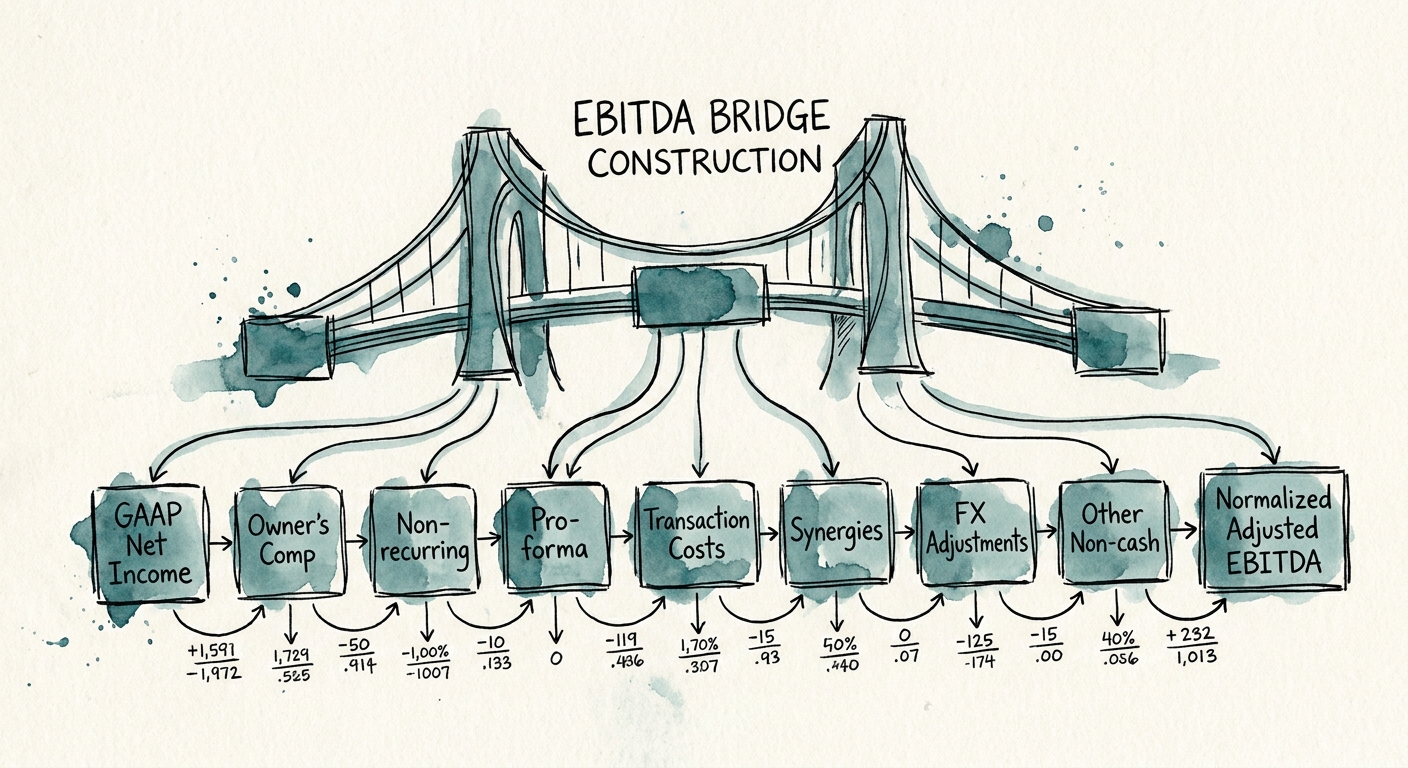
- A $40M tech-services seller's EBITDA bridge, line by line. The 8 normalization adjustments PE diligence attacks first, and how to make each one survive QofE.
- Best fit
- Industry: B2B Technology & Services. Function: Corporate Finance
- Operating path
- Financial Infrastructure → Commercial Performance → Valuations
- Key metric
- 29% of marketed EBITDA figures in modern M&A are composed of aggressive adjustments, triggering intense buyer scrutiny.
The CFO had buried a year of normal spend in "exceptional"
The model showed a healthy adjusted EBITDA. By the time the buyer's diligence team was done, they had underwritten roughly thirty percent less. Almost a third, gone between the Letter of Intent and the second draft of the Quality of Earnings report. The founder thought he was being attacked. He wasn't. He was being corrected, because almost every add-back on his schedule was something a competent engineering organization does every quarter.
This was a $40M-revenue tech-enabled services firm, the kind that runs a managed platform plus a services arm, and I was hired to fix the bridge before it cost the seller the deal. The incumbent CFO had taken a year of cloud spend, a chunk of recurring technical-debt remediation, and a routine ERP tune-up, and stacked all of it under "one-time exceptional costs." To a buyer's advisors, that line read as a confession: this team doesn't know what its own business costs to run. And once a buyer stops trusting your add-backs, they stop trusting your forecast, your churn math, your everything. That's how a clean Quality of Earnings review turns into a re-trade and a fatter escrow.
We rebuilt it. We pulled out the spend that wasn't really one-time, market-rate-corrected what was inflated, and defended a lower number that didn't move a dollar through the rest of diligence. A defensible figure that holds beats an aspirational one that gets shredded in front of the lender. Here are the three adjustments that get attacked first in a software-heavy bridge.
1. "One-time" infrastructure that recurs every 18 months
Founders love to flag the $500K AWS re-platform or the ERP cutover as non-recurring. In a tech-enabled business, continuous infrastructure modernization is the operating model, not an event. The buyer flags it as run-rate OPEX and the add-back evaporates. The only version that survives is genuinely structural and provably finite: integrating the systems of a company you acquired two years ago, on a stated finish date, with the run-rate steady-state cost shown right next to it. If you can't point to the line where spend returns to normal, it isn't one-time.
2. The replacement-CEO salary you'll lowball
Owner comp, distributions, the spouse on payroll, the lease on the truck. You zero those out and insert a fully burdened market salary for the executive who replaces the founder. The mistake is putting a thin number in that slot to protect the add-back. A buyer benchmarks the real loaded cost of running a $40M services operation, lands well above your figure, and adjusts you down anyway, now with a credibility tax attached. Price the replacement honestly the first time and the line stops being a fight.
3. Dead-deal and advisory fees, itemized to the invoice
Aborted acquisitions, sponsor monitoring fees, the banker you hired for a process that died. Legitimately non-recurring, and buyers expect to see them stripped. But a bucket labeled "legal — transaction" with no detail is a red flag, not an add-back. Tag every invoice to the specific dead deal so the line reads as event-driven. Document it and your EBITDA add-backs hold under audit; lump it and the whole bucket gets challenged.
A bridge isn't where you argue for a higher number. It's where you prove you already saw every place the buyer was going to push, and got there first.
Where forensic accountants actually dig
The middle of the bridge is where buyers stopped accepting the seller's story and started reading the artifacts. A March 2026 PitchBook analysis of 700 transactions found adjustments running as high as 29% of marketed EBITDA, and private-credit lenders have lost patience. They are now sending people to audit the work behind the number, not just the number. Three places they reliably dig in a software-driven business.
4. Capitalized software, checked against your commit history
This is the one that trips a tech-enabled seller hardest. To inflate EBITDA, engineering OPEX gets shifted into capitalized development under ASC 350-40. The problem is that most teams never tracked time at the precision the standard requires, so the split is a guess. Buyers don't argue about your policy; they pull your Jira tickets, your GitHub commit log, and your sprint boards, and they match the capitalized dollars to what the work actually was. Bug fixes, refactors, keeping the lights on, and maintenance are not capitalizable, no matter how the journal entry reads. If the tickets say "patch," the dollars go back to OPEX and your EBITDA drops. Run that reconciliation yourself before they do, with the time data attached, or accept that an outside accountant will reclassify the entire block on terms you don't control.
5. Related-party rent, settled by appraisal
The founder owns the building and the operating company pays him rent. Below market to inflate earnings, the buyer marks rent up to fair value and EBITDA falls. Above market to pull cash out, it gets marked down. Under ASC 842 either way, the lease is now on the balance sheet and visible. You don't win this by asserting a number; you win it by walking in with a third-party commercial appraisal that sets the baseline. That single document removes the buyer's leverage on the line before they can open it.
6. Bad debt as a reserve, not an apology
Every write-off gets pitched as a freak event, never to recur. Buyers treat bad debt as a cost of doing business and won't let you add it back as an anomaly. Pull the trailing write-off rate, say it runs 1.5% of revenue, and bake that as a standing reserve into normalized EBITDA, regardless of which quarter the specific defaults landed. Modeling the run rate yourself reads as financial maturity; calling each one a surprise reads as someone who doesn't know their own collections.
The two that detonate in the last two weeks
The final layer is where accounting and operational debt collide, and where re-trades tend to land late — close enough to the finish line that the seller is too committed to walk.
7. ASC 606 and the deferred-revenue haircut
If you sell the managed platform on annual prepaid contracts but deliver across twelve months, cash-basis earnings flatter you. Move to ASC 606 accrual recognition and the revenue spreads out, taking perceived earnings with it. A 2025 analysis by Sapling Financial Consultants identifies deferred-revenue alignment as a leading trigger of purchase-price disputes. Bridge cash collections to GAAP recognition yourself, contract by contract, and you avoid the revenue recognition trap erasing a fifth of your earnings days before signing.
8. Security and compliance debt, priced as a liability
This is the adjustment most advisors don't see coming, and it's specific to businesses selling software to enterprise buyers. If you have no SOC 2 Type II, or your cloud architecture needs a rebuild to clear enterprise security review, buyers no longer wave it off. They quantify it: a dollar-for-dollar purchase-price reduction for the remediation, or a permanent EBITDA deduct for the run-rate cost of the CISO and tooling you'll need to maintain. As E78 Partners notes in their exit-readiness research, teams that can't document and defend their forward-looking compliance costs leave real enterprise value on the table. Model that run-rate yourself and the line is yours; ignore it and it becomes a lever against your multiple.
What to do Monday
Open last year's add-back schedule and run one test on every line: if the buyer's accountant pulled the source documents tomorrow, would this survive? For each one, name the artifact that proves it — the appraisal, the commit log, the dead-deal invoice, the contract waterfall. The lines with an artifact stay. The lines without one come out now, on your terms, while you still control the narrative. A bridge built that way doesn't beg for a higher number. It removes every place the buyer was planning to push, and that is what lets you set the terms instead of defending them.