The practical answer
- Short answer
- PE buyers don't read your three-statement model — they break it. The exact sensitivities they run on growth, margin, and DSO, and where the cash goes negative.
- Best fit
- Industry: Private Equity & SaaS. Function: Corporate Finance
- Operating path
- Financial Infrastructure → Commercial Performance → Valuations
- Key metric
- 15% Standard PE downside sensitivity applied to NRR and gross margin assumptions.
The first thing a buyer does is delete your base case
I've sat on the buy side of a virtual data room and watched a QofE analyst do something founders never see coming: she didn't read the sell-side three-statement model. She rebuilt the input tab, dragged the revenue growth assumption from 40% down to 25%, and then just leaned back and watched the rest of the model react. Eighteen months out, the cash line went red. The revolver drew. Interest expense ticked up. The leverage ratio crept past the covenant line — and the model announced its own technical default without anyone touching the debt schedule. That whole sequence took her four minutes. The founder had spent six weeks building the thing.
That is the entire game with a linked three-statement model. A single-tab P&L can hide a fragile assumption forever — you just don't carry the consequence anywhere. But the moment your income statement, balance sheet, and cash flow are mechanically connected, a buyer doesn't have to argue with your growth rate. They sensitize one cell and let the plumbing convict you. PitchBook's Q1 2026 Global M&A Report on growth assumption sensitivities shows institutional buyers haircutting target growth rates 15% to 20% before a deal even reaches their investment committee. So if your model only survives at the number you typed in, you haven't built a model — you've built a single point of failure with three tabs.
The retention assumption is where this bites hardest, because NRR compounds through every year of the hold. Bain & Company's 2026 Global Private Equity Report on revenue retention volatility found that a 5% drop in NRR over a standard five-year hold erases roughly 22% of terminal enterprise value. Here's the test before you ever send the file out: shock NRR down five points and trace where the cash flow statement lands in the worst quarter. If the only thing keeping the cash line positive is a manual override you typed in to plug the hole, a buyer will find that override in minutes — and they'll assume everything else in the model is propped up the same way. For the build discipline underneath this, see How to Build a Financial Model That PE Firms Will Actually Believe.
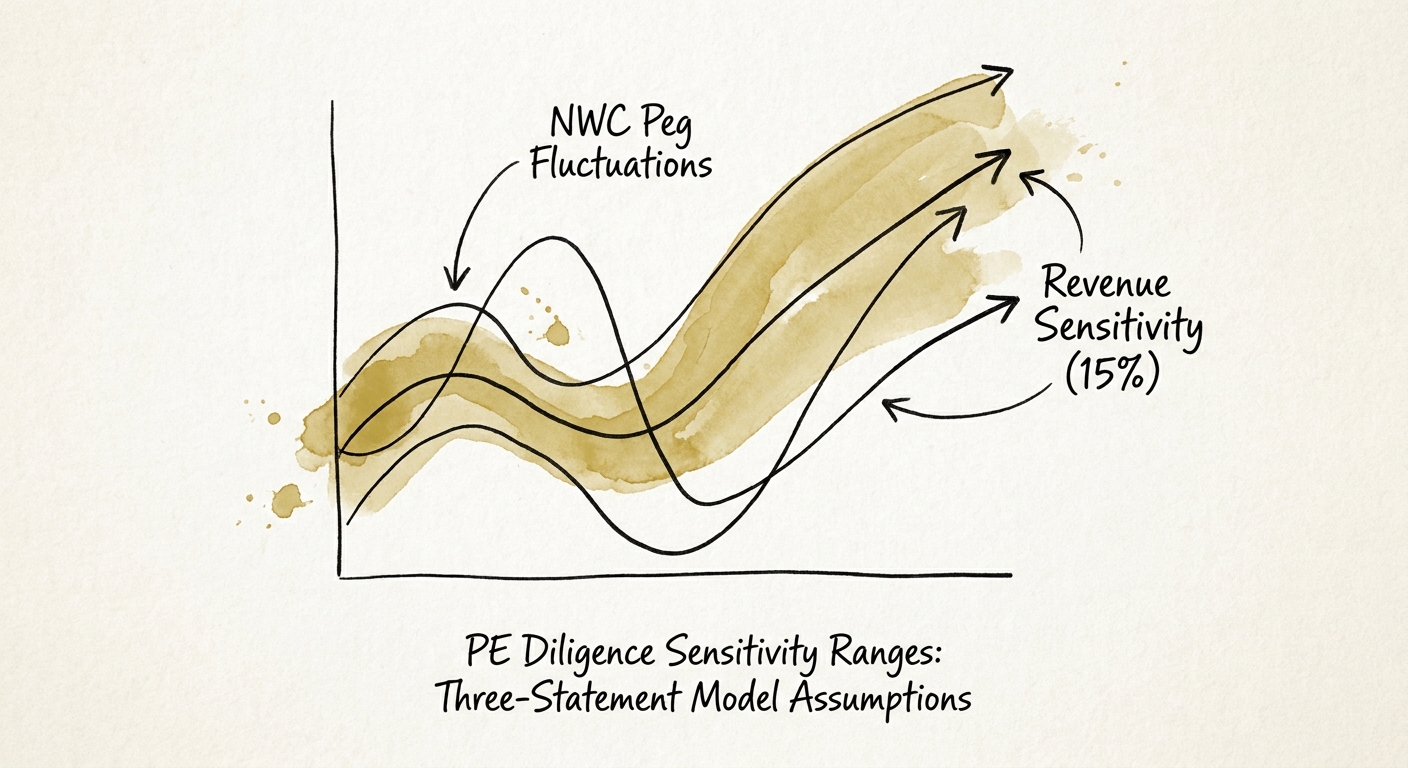
A single-tab P&L hides the damage. A linked three-statement model can't — drop revenue 15%, and you watch the revolver draw, the interest tick up, and the covenant breach announce itself.
Flat margins are the tell that you've never linked the model
The second failure is more subtle and more revealing: a gross margin line that holds perfectly flat across five forecast years. To an experienced buyer, that flat line isn't an aggressive assumption — it's a confession that the cost side of your model is hardcoded, not driven. Real infrastructure costs don't track revenue in a clean ratio. Gartner's 2026 IT Spending Forecast regarding cloud cost inflation puts baseline infrastructure software inflation at 11.4% a year across the mid-market. If your COGS line absorbs that automatically while your margin stays pinned, the buyer knows you've plugged the percentage, and they'll re-derive it themselves.
When they do, the gross margin sensitivity is rarely subtle. A QofE team will knock 300 to 400 basis points off the margin line on hosting and vendor cost alone — and in a three-statement model, that doesn't stay on the income statement. The lost margin drains operating cash, which thins the cash balance, which can force a draw, which adds interest, which depresses net income again the following year. One assumption, four downstream consequences. KPMG's 2026 Deal Advisory M&A Report on EBITDA bridge adjustments notes buyers routinely apply a 10% to 15% haircut to assumed operating leverage — meaning they price in that your cost to win the next dollar of ARR runs higher than your model claims.
The one that actually moves the multiple is capitalized software development. If your model parks a heavy share of engineering spend on the balance sheet to lift reported EBITDA, expect a buyer to run a sensitivity that pushes a chunk of it — call it half — back through the income statement as OpEx. I have watched that single reclassification take several million dollars off trailing EBITDA in an afternoon, and because the purchase price is a multiple of that number, the headline valuation moved with it before lunch. The model didn't break. The story it was telling did. To see which adjustments survive scrutiny and which don't, read What Are EBITDA Add-Backs? The Complete List.
The balance sheet keeps the receipts
Founders obsess over the income statement and treat the balance sheet like furniture. Buyers do the opposite, because the balance sheet is where the income statement's optimism gets reconciled against cash that actually moves. The usual crack is collections. Most sell-side models forecast cash off accounts-receivable assumptions that have never once held in the company's own history — pristine 45-day collections projected forward as if the customer base suddenly got religious about paying on time. PwC's 2026 Working Capital Study showing DSO deterioration found mid-market tech DSO stretched 14 days over the trailing year as customers hoard their own treasury. Stretch your collections by those 14 days and watch what the cash flow statement does with the gap.
What it does is mechanical and unforgiving. Slower collections shrink operating cash, the cash balance dips toward your minimum, the revolver draws to cover it, interest expense climbs, net income falls, and the leverage ratio drifts toward the covenant line. None of that is a judgment call — it's the model doing arithmetic you authored. A single working capital sensitivity can trip a technical default inside the forecast period, which is exactly why the working-capital peg negotiated at close so often ends up costing more than the price haircut itself.
So run the trifecta yourself, before a stranger runs it for you. Stack three downsides at once: drop bookings 15%, stretch DSO by 15 days, and assume vendors pull payment terms in by 10 days so accounts payable accelerates against you. Layer in a deferred-revenue haircut on top — that's its own trap, walked through in The 15% Valuation Haircut: ASC 606 Traps in Subscription Businesses. Then look at the worst month. If the model holds without an emergency equity injection to make payroll, you walk into diligence with a base case that defends itself. If cash goes negative, you found the crack before a buyer did — and that is the only version of this discovery that doesn't cost you millions at the closing table. Fix it now, while it's still a modeling exercise on your own laptop and not a repricing on theirs.