
The practical answer
- Short answer
- Private Equity buyers are scrutinizing Atlassian partners. Learn why resale revenue is valued at 0x, why JSM specialization drives 12x multiples, and how to survive the 2026 due diligence process.
- Best fit
- Industry: IT Services / Private Equity. Function: M&A / Corporate Development
- Operating path
- Exit Readiness → Operational Excellence → Transaction Advisory Services
- Key metric
- 12x EBITDA multiple for 'Specialized' Atlassian partners (JSM/Cloud) vs. 4x for Resellers.
The 'Gross Revenue' Hallucination: Why Your $50M Top Line is Worth $5M
If you are an Atlassian Solution Partner with $50M in revenue, you likely believe you are a mid-market platform asset. If $40M of that revenue is license resale, a Private Equity buyer sees you as a $10M small business with a bloated back office.
In 2026, the valuation bifurcation in the Atlassian ecosystem is absolute. PE firms have stopped paying for resale. The "Pass-Through Discount" is real, and it is brutal. Buyers are performing a "Net Revenue" adjustment in the first 48 hours of diligence, stripping out 100% of license margin to isolate the professional services EBITDA.
The Valuation Gap
Our analysis of recent ecosystem transactions reveals a stark multiple divergence:
- Generic Resellers (License-Heavy): Trade at 4x-5x EBITDA (often structured as an earnout). Buyers view resale margin as a commodity that Atlassian could compress with a single program change.
- Specialized Consultancies (Services-Heavy): Trade at 10x-12x EBITDA. These firms use licenses merely as a wedge to sell high-margin implementation, migration, and managed services.
If your "Growth Story" is based on upgrading server licenses to Data Center or Cloud without attached services, you are not building a company; you are building a commission stream. Revenue multiples are a lie, and nowhere is that more evident than in the Atlassian channel.
The days of trading on 'Gross Revenue' are over. If you can't strip out your license pass-through and show me a healthy 20% EBITDA margin on pure services, you aren't an acquisition target—you're a lifestyle business with a good commission plan.
The 'Jira Admin' is Dead: The JSM Specialization Premium
For a decade, you could build a profitable lifestyle business just by configuring Jira Software workflows for engineering teams. That era ended when Atlassian declared war on ServiceNow.
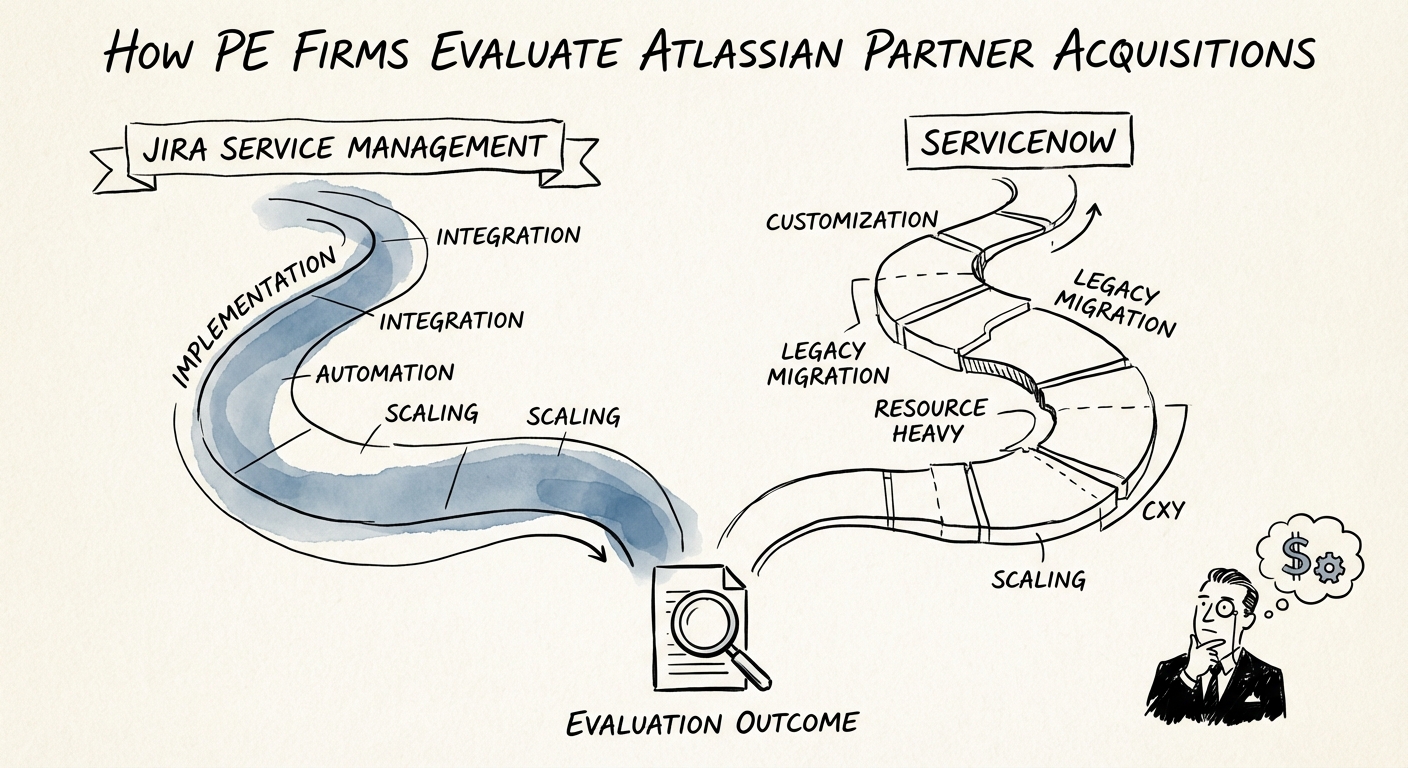
PE investors are currently hunting for "ServiceNow Killers." They are aggressively acquiring partners who specialize in Jira Service Management (JSM) and can demonstrate wins against ServiceNow in the Enterprise segment. Why? Because JSM implementation cycles are measured in weeks, not months, offering a faster Time-to-Value that resonates in a tight economy.
The "System of Work" Multiplier
To command a premium multiple in 2026, your practice must pivot from "Ticket Management" to "Enterprise Service Management" (ESM). This means expanding beyond IT into HR, Legal, and Finance.
Partners who can demonstrate that >30% of their revenue comes from non-IT business units trade at a premium because they have achieved "Organizational Stickiness." They are no longer a discretionary IT expense; they are the operating system of the business. Conversely, if your team is still just "cleaning up Jira instances," you are facing the same commoditization risks as generalist ServiceNow partners.
The 2026 Cliff: Post-Migration Retention
The Server End-of-Life (February 2024) created a massive, artificial revenue spike for the entire ecosystem. Partners gorged on migration projects. Now, PE firms are asking the uncomfortable question: "What happens next?"
We are seeing a "Migration Hangover" in Quality of Earnings (QofE) reports. Investors are aggressively normalizing EBITDA to exclude one-time migration spikes. If you migrated a customer to the Cloud but failed to attach a Managed Services (AMS) contract, that revenue is treated as low-quality "non-recurring" income.
The Metric That Matters: Attach Rate
The most scrutinized metric in 2026 diligence is your Migration-to-AMS Attach Rate. Best-in-class partners convert 40% of migration projects into long-term managed services contracts. If you are below 15%, you are a project shop, and your valuation will reflect that instability. You must prove that you can monetize the Project Trap and turn technical debt remediation into recurring revenue.