
The practical answer
- Short answer
- Stop paying the 'Complexity Tax.' A 2026 diagnostic comparing HubSpot vs. Salesforce implementation costs, partner incentives, and Total Cost of Ownership for Series B/C scale-ups.
- Best fit
- Industry: B2B SaaS & Services. Function: Revenue Operations
- Operating path
- GTM Execution → Commercial Performance → Performance Improvement
- Key metric
- $115k Average 3-Year TCO Savings utilizing HubSpot vs. Salesforce for a 50-person commercial team.
The "Safe Bet" That Costs 3x More: Diagnosing the Complexity Tax
For decades, the axiom in the enterprise was "nobody gets fired for buying Salesforce." In 2026, for a Series B or C CEO, that axiom has inverted: buying Salesforce is the fastest way to light 15% of your EBITDA on fire without moving your revenue needle.
The market data is unambiguous. Recent 2025 benchmarks indicate that 70% of Salesforce implementations fail to meet their defined business objectives. The failure isn't software capability; it is software suitability. The platform is designed for Fortune 500 complexity, yet it is sold to $20M revenue scale-ups that need velocity, not infinite customization.
We call this the Complexity Tax. It appears in your P&L as "Professional Services," but it functions as a drag coefficient on your growth. While Salesforce pushes its new AgentForce AI at a significant $125/user/month premium, HubSpot has integrated comparative AI utility (Breeze) directly into the core seat price. For a 50-person revenue team, that AI premium alone is a $75,000 annual variance—before you even touch implementation fees.
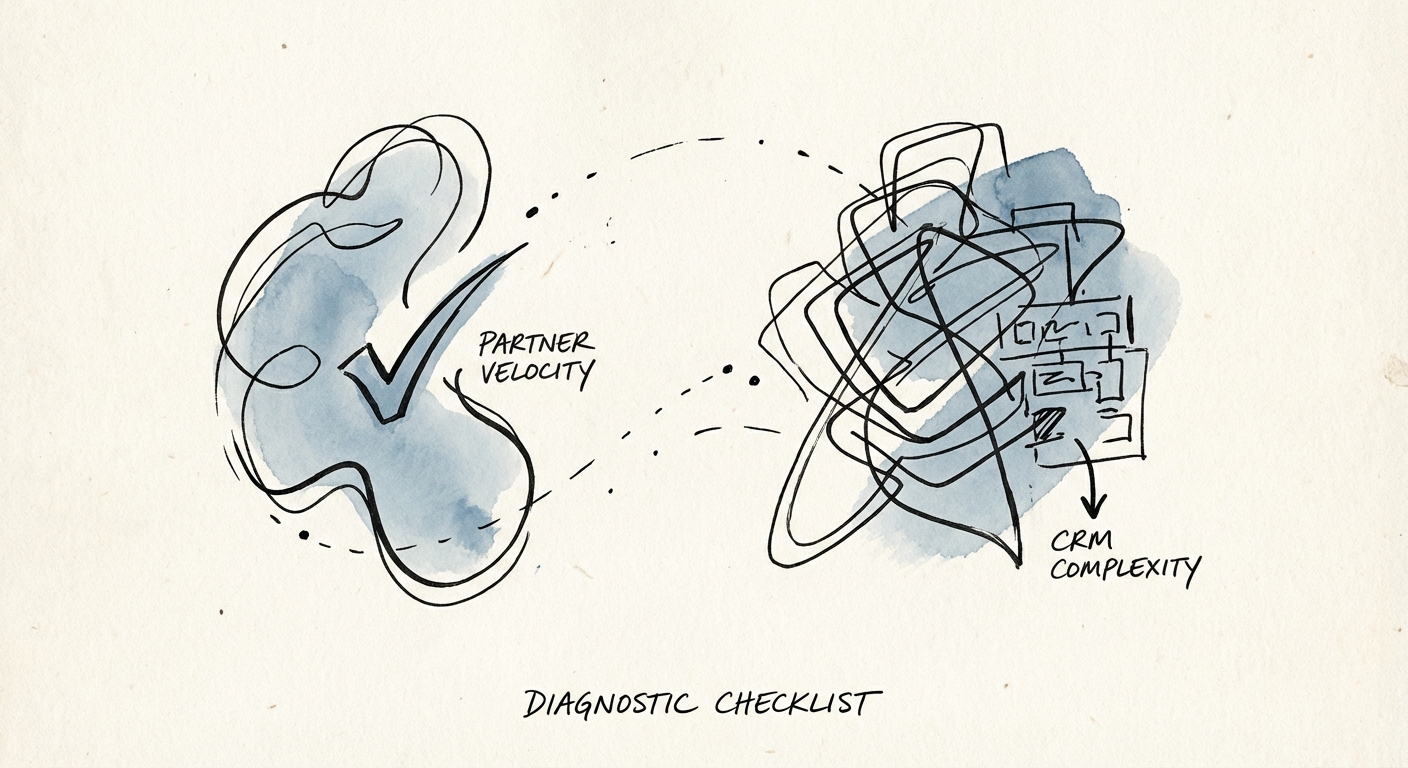
The 5-Point CRM Health Diagnostic
If you are currently evaluating a renewal or a migration, run this 5-point diagnostic on your current CRM environment. If you answer "Yes" to more than two, you are over-paying for a legacy architecture:
- The Admin Moat: Does changing a simple lead routing rule require a certified administrator or an external consultant?
- The "Cloud" Silo: Are your Marketing automation (e.g., Pardot/Marketing Cloud) and Sales CRM effectively two different databases that sync poorly?
- The Shelfware Ratio: Are you utilizing less than 60% of the features you pay for? (Most Series B firms use ~20% of Salesforce capabilities).
- The Add-On Iceberg: Do third-party add-ons (Dialers, CPQ, Analytics) comprise more than 30% of your total license cost?
- The Velocity Drag: Does it take more than 10 business days to launch a new sales funnel or reporting dashboard?
The floor is higher with HubSpot, but the 'ceiling' argument is dead. Unless you are building a custom ERP inside your CRM, Salesforce is just a tax on your velocity.
Partner Incentives: The "Billable Hour" vs. The "Revenue Outcome"
The most critical differentiator between the two ecosystems isn't the code; it's the incentive structure of the partners implementing them. Understanding this explains why your Salesforce projects always seem to expand in scope, while modern RevOps deployments focus on speed-to-value.
The Salesforce SI (System Integrator) Model is built on the "Complexity Arbitrage." These firms trade on hourly billing and long-duration projects. Their margin comes from the difficulty of the implementation. If the software is easy to use, their business model collapses. Therefore, they are financially incentivized to over-engineer solutions, recommending custom Apex code where a standard workflow would suffice. This is why the average Salesforce implementation for a mid-market firm hovers around $150,000.
The HubSpot Partner Model is increasingly shifting toward "Revenue Operations as a Service." Because the software requires significantly less technical configuration (average mid-market implementation: $35,000 - $60,000), the partner must justify their value through strategy and outcomes. They don't bill you for 200 hours of custom coding; they bill you for building a pipeline generation engine.
The Total Cost of Ownership (TCO) Cliff
When you stack these costs over a 3-year period, the variance is not marginal—it is structural. A RevOps implementation on HubSpot typically achieves ROI in months, whereas legacy CRM projects often face an 18-month payback period (if they don't fail first).
- Salesforce TCO: High License Fees + Expensive Add-ons (Data Storage, Sandbox, Premier Support) + Full-Time Admin ($140k/yr) + Ongoing Consultant Retainer.
- HubSpot TCO: Consolidated License Fees (Marketing+Sales+Service) + Minimal Add-ons + Fractional Admin/RevOps Partner.
For a company scaling from $10M to $50M, the "Enterprise Grade" choice often costs 3x more over three years while delivering slower execution speed.
The "Enterprise Myth" in 2026
The final defense of the legacy consulting firm is the "Enterprise Ceiling" argument: "HubSpot is fine for SMBs, but you'll outgrow it." In 2020, this was a valid concern. In 2026, it is a sales tactic used to protect consulting revenues.
HubSpot's upmarket growth tells a different story. In Q3 2025, deals with over $5,000 in Monthly Recurring Revenue (MRR) grew by 35% year-over-year. Public companies, sophisticated FinTechs, and manufacturing conglomerates are moving off Salesforce to escape the technical debt trap. They are finding that the "ceiling" in HubSpot is far higher than their actual operational complexity requires.
Strategic Recommendation: Audit Before You Renew
If you are a Founder or PE Operating Partner, do not auto-renew your CRM contract. Challenge your technical leadership or external partners with the Cost-Per-Outcome metric.
If your "Enterprise" CRM requires a $200,000 annual support team just to keep the lights on, you aren't buying software; you're funding a job works program. The competitive advantage in 2026 belongs to the agile. Position your technology stack to enable true Revenue Operations—where data flows freely between marketing, sales, and success without a toll booth at every integration point.
The Verdict: Unless you have a specific, immovable requirement for highly complex, custom object architecture (e.g., specialized healthcare patient management or multi-layer manufacturing ERP replication), the "safe" choice of Salesforce is likely the risky choice for your margins.