
The practical answer
- Short answer
- HubSpot's ecosystem is shifting. With AI driving 40% of future growth, partners must pivot from content retainers to technical implementation. Here is the diagnostic guide.
- Best fit
- Industry: MarTech / Professional Services. Function: Revenue Operations
- Operating path
- GTM Execution → Commercial Performance → Performance Improvement
- Key metric
- 43.8% Median revenue growth for HubSpot partners actively monetizing AI services in 2025.
The 'Inbound' Retainer Model Is Dead
For the last decade, the HubSpot Partner playbook was simple: sell a license, then sell a labor-intensive retainer for blog posts, social media management, and email sequences. That model is now actively decaying.
According to September 2025 data from IDC and HubSpot, the partner ecosystem is projecting to reach $36 billion by 2029. But here is the critical bifurcation: 40% of that growth ($15.2 billion) will come exclusively from AI-powered solutions. Yet, our diagnostic data shows a dangerous lag: only 13% of partners currently generate more than 20% of their revenue from AI services.
This creates an arbitrage opportunity for the agile agency founder. While 'Generalist' partners fight over shrinking margins in commoditized content creation (which clients now do internally with LLMs), 'Specialist' partners are pivoting to high-margin technical implementation. The market has flipped: Technical Services (AI implementation, integrations) now account for 32% of partner revenue, overtaking traditional Marketing Services (18%) for the first time in history.
The math is compelling—but most partners haven't cracked the code yet. This gap between market potential and current performance represents the biggest opportunity in the HubSpot ecosystem's history.
The New Product: 'Intelligence' as a Service
If you are still selling 'hours of writing' or 'hours of admin,' your valuation is capped at 1x revenue. The pivot required is to sell outcomes powered by AI infrastructure. This is not about using ChatGPT to write faster; it is about deploying HubSpot’s Breeze AI and agentic workflows to permanently reduce client OpEx.
The Three High-Value AI Service Lines
- Service Automation Architecture: Deploying AI agents to handle Tier 1 support. Case studies show Breeze AI reducing support tickets by 77%. The partner opportunity is not the software resale; it is the $15k-$30k setup fee to map, train, and validate the agent's logic.
- Data Hygiene & Enrichment: Using Operations Hub AI to clean dirty CRM data automatically. This solves the #1 reason for sales CRM abandonment without requiring an army of interns.
- Predictive GTM Orchestration: shifting from 'spray and pray' email blasts to AI-driven signal selling. Partners who implement these systems are seeing median revenue increases of 43.8% in 2025.
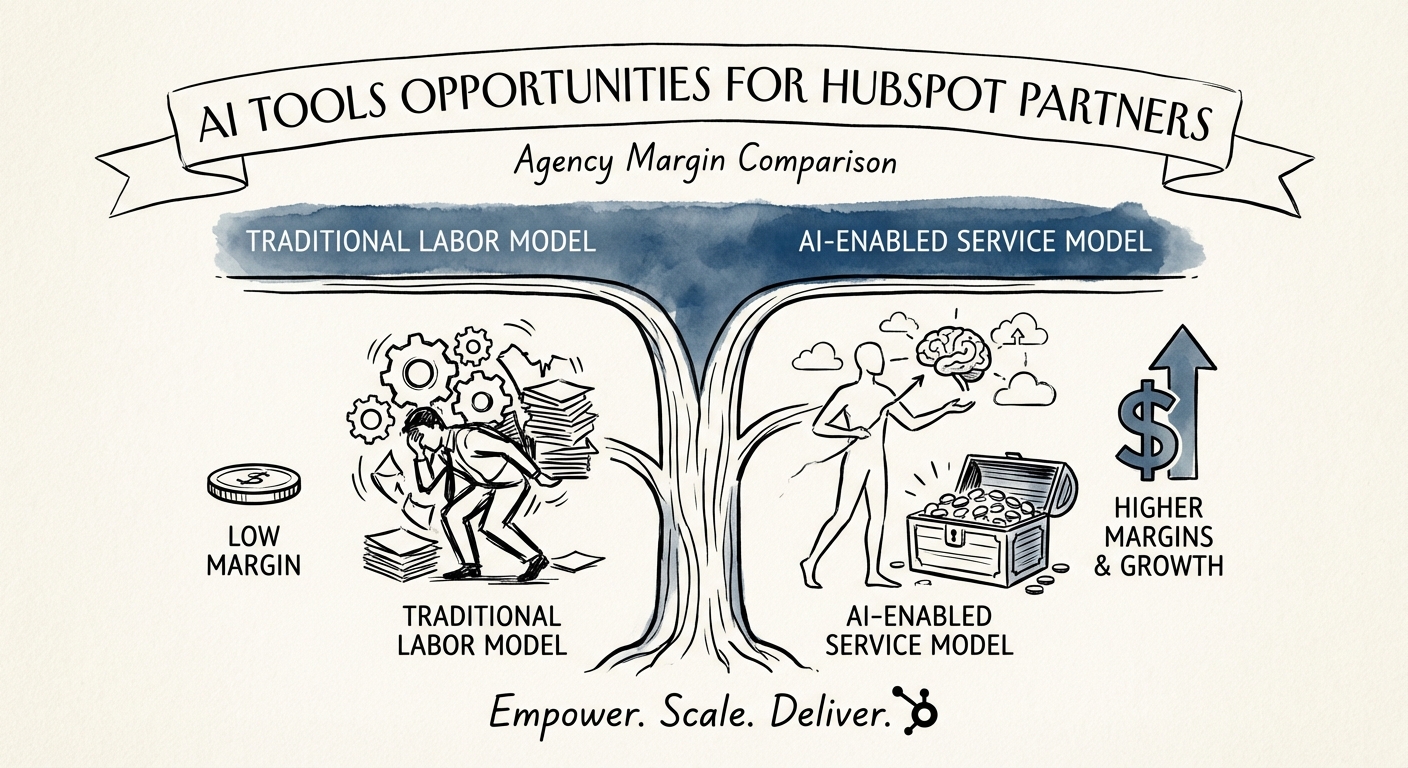
The Margin Multiplier: Why AI Shops Trade Higher
Traditional agencies run on the 'Body Shop' model: to grow revenue, you must grow headcount. Margins are perpetually squeezed between rising salaries and client procurement teams. The AI-First Partner model breaks this linear relationship.
By billing on value (e.g., "We will reduce your support costs by 40%") while using AI agents to execute the work, you decouple revenue from labor hours. This drives EBITDA margins from the agency standard of 15% toward the SaaS-like realm of 30%+. Investors and acquirers are noticing. As detailed in our analysis of marketing agency valuations, firms with proprietary technical IP and high leverage multiples trade at 10x-12x EBITDA, while labor-based shops struggle to fetch 4x.
The window to establish this positioning is narrowing. With the enterprise opportunity (companies >200 employees) set to exceed $7 billion by 2028, the partners who master 'fluent AI' today will own the mid-market tomorrow. Those who don't will be left competing on hourly rates for blog posts that nobody reads.