
The practical answer
- Short answer
- Why Workday partners building Prism Analytics practices command 35% higher bill rates and 12x exit multiples. A diagnostic for scaling CEOs.
- Best fit
- Industry: Professional Services. Function: Revenue Operations
- Operating path
- GTM Execution → Commercial Performance → Performance Improvement
- Key metric
- 35% Bill rate premium for Prism/Data consultants vs. standard HCM functional consultants.
The 'Lift and Shift' Era Is Dead
If you run a Workday practice between $10M and $50M in revenue, you are likely feeling the walls close in. The market has shifted violently in the last 18 months. According to 2026 ecosystem data, the number of Workday services partners has surged by nearly 50%, with the vast majority being small, generalist firms competing for the same mid-market HCM implementations.
The result? Rate compression. The "on-time, on-budget" go-live is no longer a differentiator; it is table stakes. If your primary value proposition is deploying Core HCM and Benefits, you are now in a commodity business. We see generalist functional consultants billing at $175-$200/hour, while margins erode under the weight of bench costs and increased competition from global systems integrators (GSIs) who can scale cheaper.
As a founder, you don't have a sales problem; you have a product problem. You are selling a commodity service in a crowded market. The partners breaking through the $20M ceiling in 2026 aren't doing more implementations; they are doing different implementations. They are pivoting from "System of Record" deployers to "System of Intelligence" architects.
The Data Wedge
The highest-value real estate in the Workday ecosystem right now is not the HR user interface—it is the CFO's dashboard. Workday's strategic push into the "Office of the CFO" (Workday Financials, Accounting Center, and Adaptive Planning) has created a massive vacuum for partners who understand data, not just configuration.
This is where Workday Prism Analytics becomes your strategic wedge. It allows you to ingest external data—CRM records, legacy ERP history, point-of-sale data—into Workday, turning the platform into a centralized data hub. This shifts your engagement from a 6-month implementation project to a multi-year data stewardship role. Our data shows that partners with established Prism & Analytics practices command bill rates 35% higher than pure functional shops.
The partners breaking through the $20M ceiling in 2026 aren't doing 'more' implementations. They are pivoting from 'System of Record' deployers to 'System of Intelligence' architects.
The Economics of Intelligence vs. Implementation
Why does Prism Analytics change your valuation multiple? Because it changes your revenue quality. Traditional implementation revenue is episodic: you eat what you kill. Once the client goes live, you might retain a small AMS (Application Management Services) contract, but the bulk of the revenue vanishes.
Prism engagements are sticky. When you build the data pipelines that power a CFO's monthly board reporting, you become essential. You are no longer just fixing a business process configuration; you are maintaining the truth of the business. This stickiness drives Net Revenue Retention (NRR), the single most important metric for your exit valuation.
Valuation Arbitrage
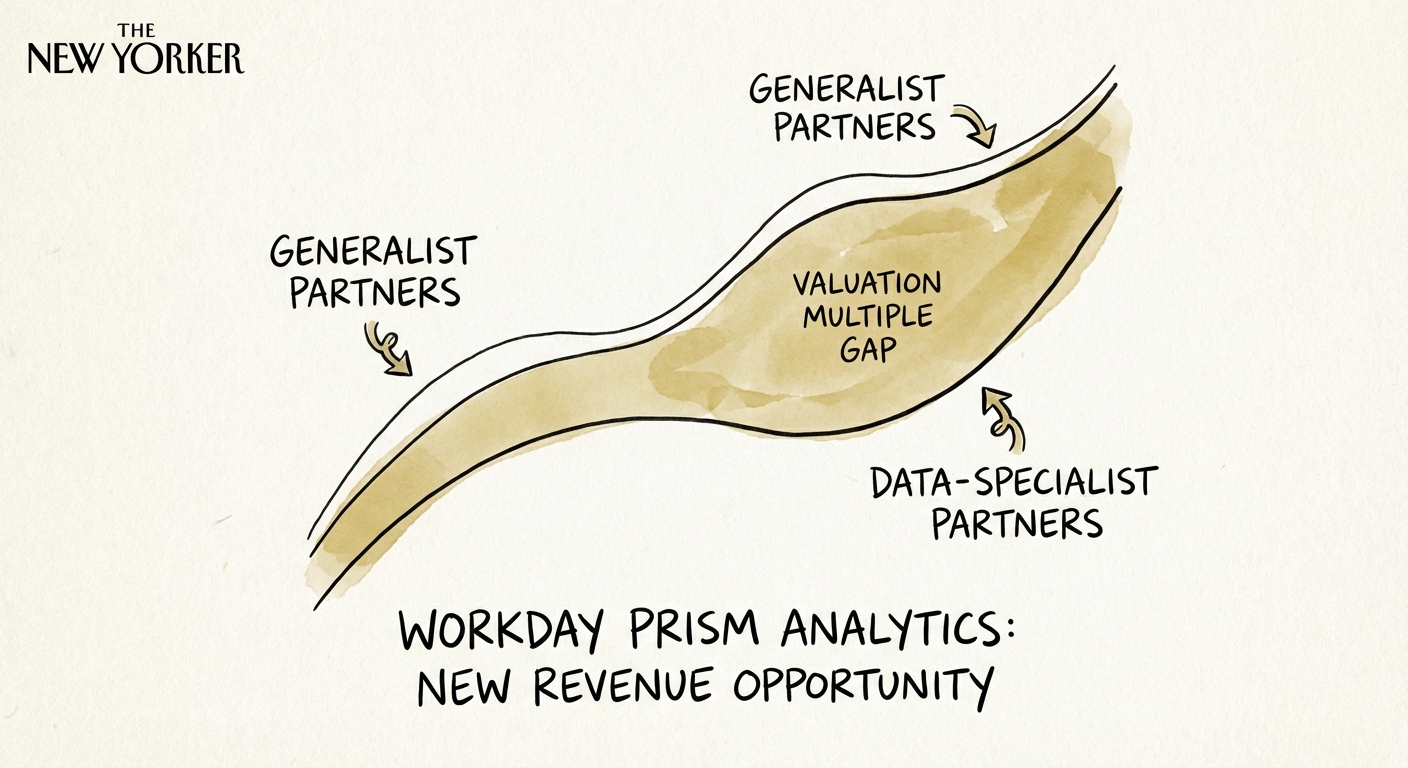
We typically see generalist Workday partners trading at 6x-8x EBITDA. Buyers view them as staffing firms with a software badge. However, partners with specialized "Data & Intelligence" practices—where at least 30% of revenue comes from Prism, Adaptive, or proprietary analytics IP—are trading at 10x-12x EBITDA.
Why the premium? Because the "Data Wedge" creates an integration moat. A client can easily switch AMS vendors for functional support. They rarely switch vendors who understand the complex SQL transformations and security schemas inside their Prism instance. You are building intellectual property (IP) in the form of industry-specific data models, even if it's services-based IP.
We analyzed the Workday Partner Program Economics and found that 'boutique' partners who specialize in Financials and Analytics are outperforming 'generic' Elite partners in profitability per head. The utilization trap is real; generalists run at 75% utilization to break even, while specialists can run at 65% and generate higher gross margins due to the rate premium.
The Execution Playbook
You cannot just "cross-train" your existing HCM consultants to deliver this. That is the mistake that stalls growth. Prism is built on a Spark engine; it requires a data engineering mindset, not just a functional HR mindset.
1. Change Your Hiring Profile
Stop hiring more functional HCM leads. To build this practice, you need to hire for SQL fluency and data architecture. The talent shortage is acute; as noted in our analysis of the Workday Talent Shortage, the "niche" skills of Prism and Accounting Center are where the wage inflation is happening—but that's also where the margin is.
2. The "Trojan Horse" Assessment
Don't pitch "Prism Implementation." Pitch a "CFO Data Readiness Assessment." Most mid-market CFOs are frustrated that their Workday investment hasn't replaced their Excel hell. Go in, map their external data sources, and show them how Prism can automate their board deck. This is a small, paid diagnostic that leads to a large implementation.
3. Verticalize Your Data Models
Do not be a "Prism Generalist." Be the "Healthcare Clinical Data on Workday" expert, or the "Retail Point-of-Sale Integration" expert. Specialization is the only way to escape the Specialist's Dilemma. If you can walk into a PE-backed healthcare firm and say, "We have pre-built Prism templates to merge your Epic EMR data with Workday Labor Costing," you will win the deal at a premium, with zero competition.
The window to own this space is closing. The GSIs are too slow to deploy nimble data teams, and the small generalists are too scared to invest in technical talent. This is your $20M unlock.