The practical answer
- Short answer
- At $10-50M ARR, the choice between cheaper seats and a targeted price raise decides your margin. Here's the utilization test that tells you which lever to pull.
- Best fit
- Industry: Software & Technology. Function: Revenue Operations
- Operating path
- GTM Execution → Commercial Performance → Performance Improvement
- Key metric
- 4x Efficiency rate of monetization optimization over pure seat acquisition.
The deal sitting on your renewal table right now
Picture the renewal you're about to sign. A 600-person customer, currently on 120 seats, says they'll commit for two years if you take 18% off the per-seat price and let them add 80 more logins. Your head of sales wants to take it. The logo grows, the seat count grows, the board slide looks great. Sign it, and here's what you've actually bought: 80 users who will log in twice, a support and infrastructure cost that scales with headcount instead of revenue, and a renewal conversation in 24 months where procurement points at your own utilization dashboard and asks why they're paying for licenses nobody touches.
For B2B SaaS in the $10M-$50M ARR band, this is the single decision that quietly sets your margin trajectory. The instinct to discount per-seat pricing to capture volume feels like growth, but it's usually the moment you start subsidizing a customer's headcount with your own gross margin. You add customer success coverage and cloud spend for users paying a fraction of list, and net revenue retention stalls because the marginal seat carries no real engagement behind it. The Paddle data is blunt about where the leverage actually is: per their 2025 SaaS Monetization Benchmark Report, sharpening monetization is roughly 4x more efficient at driving durable revenue than chasing new seats. You cannot outrun thin unit economics with logins.
The reason founders default to the seat discount is that it feels safer than the alternative — asking an engaged account to pay more. But the discount is the riskier move, because it loads your book with renewal-fragile licenses. If you find yourself unable to close without cutting price, the problem isn't that your software is too expensive. It's the trap laid out in The Discounting Death Spiral: every cut trains the next buyer to expect one.
If you can't close without cutting the per-seat price, you don't have a volume problem. You have a value communication problem, and more seats will only make the next renewal worse.
The utilization line that tells you which lever to pull
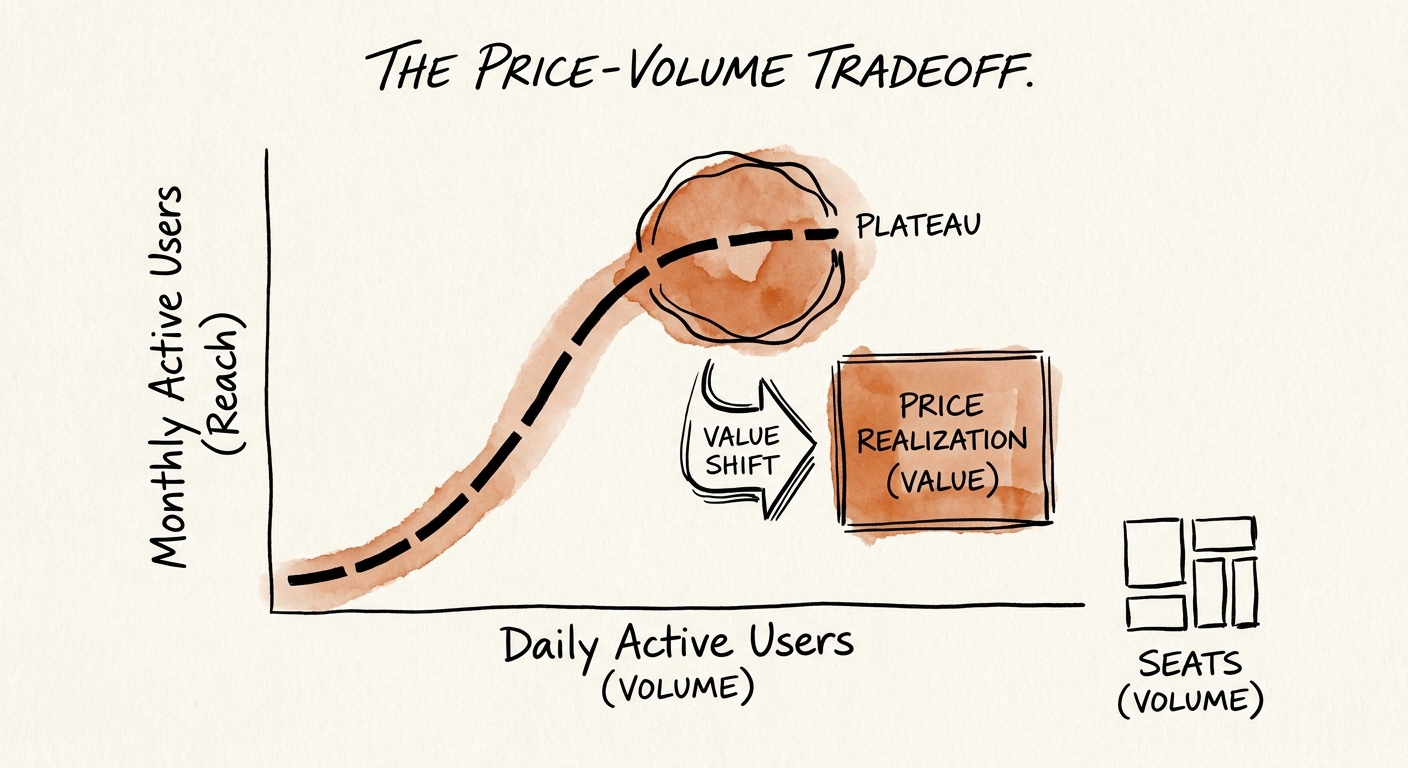
You don't guess which way to go — you read the account. The signal that the seat-expansion lever is dead is engagement decay inside a single deployment. When the share of licensed users actually active each day collapses relative to the monthly count, you've hit saturation: every additional seat from here becomes shelfware, and shelfware is exactly what gets cut. Gartner reports that 45% of enterprise B2B buyers are now consolidating applications and auditing license utilization to recover budget. Offering that buyer another 100 seats at a discount doesn't help you; they don't want cheaper unused software, they want to stop paying for the seats they already aren't using.
So at saturation you stop selling seats and start selling realized price — but only to the cohort that has earned the raise. Segment the base by actual feature utilization, not contract size. The accounts logging in daily and leaning on your premium surface — advanced compliance reporting, granular role-based access, the analytics they'd have to rebuild internally — are the ones who absorb a 12-20% increase at renewal without flinching, because the alternative is rebuilding what you've already become. The math is why this beats volume every time: McKinsey's classic pricing analysis found a 1% improvement in price realization lifts operating profit by 8.7%, and on an already-engaged cohort that increase flows almost entirely to the bottom line — no new CS hire, no new infrastructure to support it.
The mechanic that makes the raise stick is tying it to something shipping, not to a calendar. You don't email a customer "prices are going up." You raise the price into a release — the new SSO tier, the audit-log retention they asked for, the model-based analytics — so the increase reads as access to value rather than a tax. Watch your SaaS Quick Ratio in the two quarters after; targeted realization shows up there before it shows up anywhere a buyer can argue with it.
The one case where you should actually discount for volume
There's a real exception, and it's narrow. Discount per-seat price for volume only when your product gets measurably better for everyone as more of the org joins it — genuine intra-company network effects. Collaborative, multi-player tools qualify: cross-functional planning, shared architecture or modeling environments, anything where user A's experience improves because user B is also inside it. In those products, seats aren't a cost center, they're a retention engine, and the discount buys you stickiness.
But you don't get to assume that — you have to prove it in the telemetry before you give anything away. The test is whether high-seat accounts demonstrably churn less. Bain & Company's 2025 B2B Pricing Strategy Report found that companies actively managing their price-to-volume mix against real product usage post 15% higher net revenue retention than peers. If your data shows 100-seat accounts retaining far better than 20-seat accounts, you have the justification to trade short-term revenue per user for long-term retention. If it doesn't, the discount is just margin you set on fire.
And even where the exception holds, cap it structurally so a sales rep can't blow it up on a Tuesday. Set a hard ceiling — list-price discounts that stop at a fixed percentage no matter the seat count — and route anything beyond it into a different model rather than a deeper cut. Say a 40-person agency wants enterprise-wide access at half off: that's not a discount conversation, it's a packaging one. Move them to a flat platform fee with usage tiers, or step them up to an enterprise tier that carries a higher base and bundles premium support, so volume forces a richer contract instead of a cheaper one. The shape of this lives in The Consumption Premium. The point Monday morning: pull the renewal you're about to discount, check whether the account is saturated or networked, and price the decision — don't negotiate it.