
The practical answer
- Short answer
- A blended 3x coverage ratio hides where deals die. The 2026 stage math: 5x at discovery, 3–4x mid-funnel, ~1.2x at contract — and why flat 3x misses quota.
- Best fit
- Industry: Enterprise SaaS. Function: Revenue Operations
- Operating path
- GTM Execution → Commercial Performance → Performance Improvement
- Key metric
- 5.5x Top-of-funnel pipeline coverage multiplier required to hit quota in a sub-20% win-rate market.
The number that looked healthy was the number lying to you
A $50M enterprise SaaS company I worked with showed the board a clean 3.2x at the start of the quarter. Coverage looked fine. The forecast called for $10M; the pipeline carried $32M. Then we unstacked it by stage and the whole thing fell apart in about twenty minutes. Of that $32M, more than half sat in two early stages that were converting at 18%, while the late-stage layer was thin enough that you could close every open proposal at full price and still land short. The blended 3.2x wasn't healthy. It was a top-heavy pile of discovery-stage optimism wearing a respectable-looking average.
That is the structural problem with any single coverage multiplier: it treats every dollar of pipeline as interchangeable. A Stage 1 discovery call and a Stage 4 legal redline get the same weight in the ratio, even though one closes maybe one time in five and the other closes four times in five. Roll them into one number and you've built an average that describes none of your actual deals. The board hears "3x" and pictures safety. What's really there is a coverage ratio that's far too low where deals are fragile and far too high where they're already won.
The market makes this worse than it used to be. Per Gartner's 2025 B2B Buying Behavior Benchmark, an enterprise software deal now clears roughly 11 stakeholders and stretches sales cycles past eight months, with aggregate win rates landing under 20%. Sit with that math for a second. If you win one deal in five and you carry "3x coverage," you are planning to close a third of your pipeline in a market that closes a fifth of it. A flat 3x doesn't fail because reps are lazy. It fails on arithmetic, before a single call happens. I unpacked the forecasting version of this trap in The Pipeline Lie: Why 3x Coverage Still Means You'll Miss the Quarter.
A single blended coverage number tells you nothing useful. It averages a discovery call you'll lose 80% of the time with a redline you'll close 80% of the time, then reports the mush as one reassuring ratio.
What the multiplier should actually be at each stage
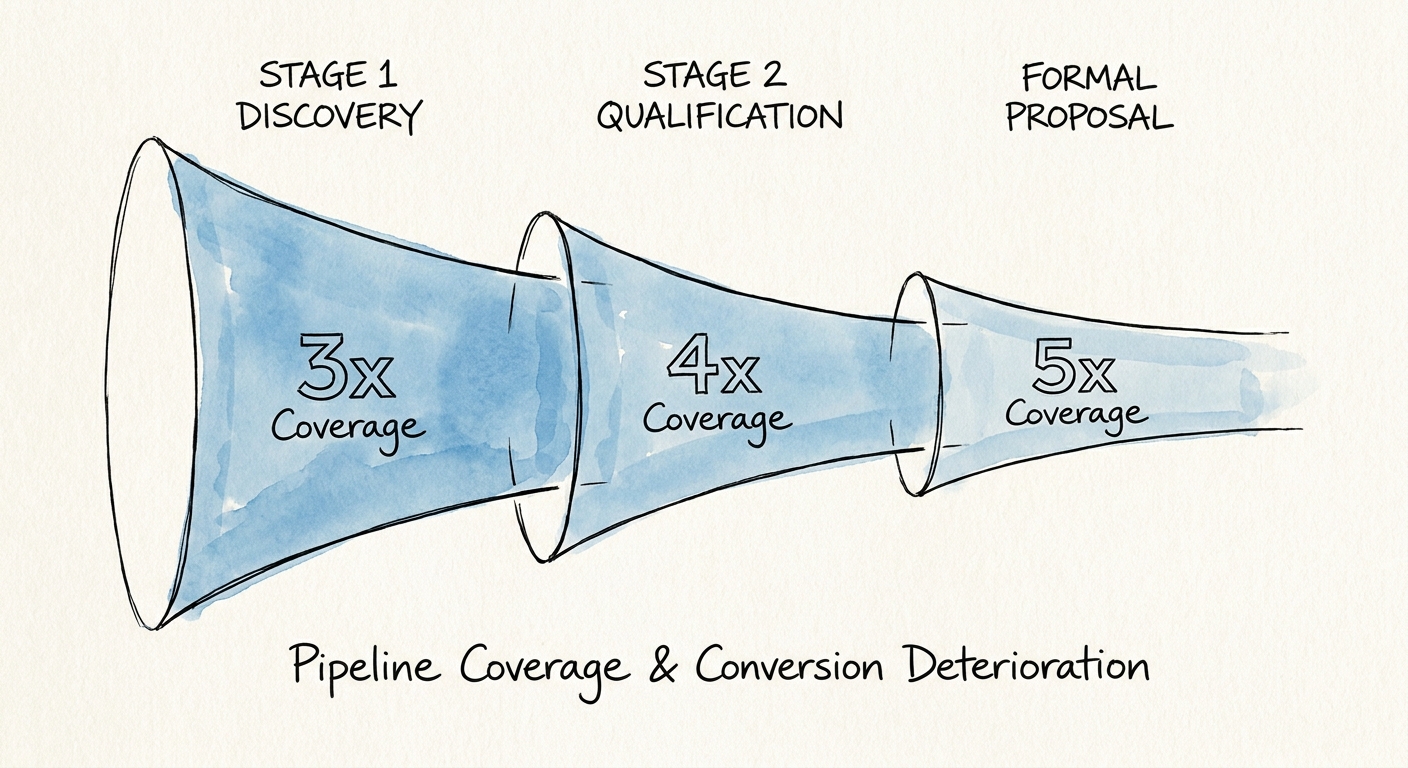
Coverage is a conversion problem in disguise. The right multiplier at any stage is just the inverse of how often deals survive from that stage to close. If 20% of qualified deals close, you need 5x at qualification. If 80% of redlines close, you need a hair over 1x at contract. So the number is never "3x" or "4x" — it's a curve that tightens as deals mature. Here's where the curve actually sits in enterprise SaaS right now.
Early stage (discovery and qualification): you need 5x, not 3x
This is where the bleeding happens, and it's mostly self-inflicted. Bain & Company's 2025 B2B Sales Conversion Report finds that roughly 42% of enterprise software opportunities die in qualification — and the cause is usually "no decision," not a competitor winning. The deal doesn't get lost; it never coheres into a real evaluation. Carry 3x into a stage that loses 42% to indecision and you start the quarter already behind the curve. Top early-stage coverage runs 5x to 5.5x precisely to absorb that attrition. The tell that you're under-covered isn't a low ratio on the dashboard — it's a slow-quarter scramble where reps suddenly "find" deals in week ten that were never qualified.
Mid stage (demo to proposal): the 3x–4x band, and the CFO gate
Once a deal survives qualification and reaches technical validation and pricing, the multiplier tightens to 3x–4x. But this is where a new failure mode appears: the CFO review. McKinsey's 2025 B2B Pulse Analysis puts proposal-stage conversion at about 28.5% — well below the 33% that the old 3x rule quietly assumes. So even your "good" mid-stage pipeline needs more than 3x to clear quota, because a chunk of it is going to stall at budget sign-off, not at the technical fit. The deals that look closest to done are often the ones a finance team is about to defer a quarter. Before you trust any mid-stage number, run a Sales Forecasting Accuracy Audit to surface the proposals that have gone quiet on the economic buyer.
Late stage (negotiation to contract): roughly 1.2x–1.5x
At the bottom of the funnel the math flips entirely. Survivors here close most of the time, so you need barely more than 1x. The danger isn't under-coverage — it's a late stage that's suspiciously empty, which means your early-stage 5x was fiction and nothing real ever made it down.
Three moves to rebuild the ratio by Monday
First, collapse your stages until each one has a verifiable exit criterion. Most stalled engines I see run six or eight stages defined by rep sentiment — "showing interest," "warming up." Cut to four, and define each by buyer evidence the rep cannot fake: a signed mutual action plan, an explicit architecture sign-off, a scheduled procurement review, a redline returned. Once a stage means something objective, its conversion rate becomes measurable, and only then can you set an honest multiplier for it. You can't weight a stage you can't define.
Second, put a hard age limit on every stage. A coverage ratio is worthless if it's counting deals that have sat untouched for 180 days — those aren't pipeline, they're CRM landfill inflating your number. PwC's 2026 Revenue Operations Transformation Study finds that companies which auto-purge deals aged past about 2.5x their average sales cycle see forecast accuracy improve materially. The instinct to protect a fat pipeline is exactly backwards: a scrutinized 4x made of live deals forecasts far better than a bloated 6x stuffed with ghosts. We run this purge as part of a RevOps Implementation Timeline that moves companies from forecast chaos to roughly 90% accuracy inside 120 days.
Third, pay your revenue leaders on forecast accuracy, not just bookings. Right now most comp plans reward the number, not the honesty of the number — so reps hoard dead deals to hit a coverage target their VP set, and the data rots from the inside. Harvard Business Review's 2025 analysis on sales forecasting math shows that when CRO bonuses are tied to forecasting within a 5% margin of error, pipeline hygiene improves inside a single quarter. The fastest way to fix coverage is to make accuracy something people get paid for. Define your stages by evidence, set the multiplier stage by stage off real conversion, purge what's aged out, and the blended number stops being a story you tell the board and starts being one you can trust. If your coverage looks healthy but your quarters keep missing, that's the gap to close — start with Performance Improvement.