
The practical answer
- Short answer
- Enterprise AEs don't ramp in 90 days — they ramp in 5.3 months, and your comp plan ends at day 90. Here's the certification-gated ramp that fixes the cliff.
- Best fit
- Industry: B2B Software & Tech Services. Function: Revenue Operations
- Operating path
- GTM Execution → Commercial Performance → Performance Improvement
- Key metric
- 43% Failure rate of enterprise AEs forced onto a strict 90-day ramp timeline.
Count backward from the close date, not forward from the start date
Here is the math nobody runs before they build the comp plan. An enterprise software deal with an eleven-person buying committee, a security review, and a procurement cycle closes in roughly six to nine months. The non-recoverable draw on most enterprise AE offers runs out at day 90. So the rep's first legitimate, self-sourced deal — the one that proves they can actually do the job — lands its commission check four to five months after their guaranteed income disappears. You have engineered a financial cliff and then act surprised when reps either panic-discount to force an early close or update their LinkedIn.
The 90-day ramp survives because it's convenient for the spreadsheet, not because it's true. According to The Bridge Group's SaaS AE metrics research, the average ramp time for enterprise reps has stretched to 5.3 months. When an operating plan models a new cohort hitting full quota in Q2, every dollar of that projection is fiction — and it's the kind of fiction that gets a sales leader fired at the next board meeting and forces the company to eat the cost to replace a VP of Sales on top of the cohort that already washed out.
Say a 40-rep org hires twelve AEs against a forced 90-day model. If even a third of them stall out — entirely predictable when the comp structure punishes the real sales cycle — you have burned base, draw, and a year of territory potential on people who were never equipped to win a complex deal in three months. The fix isn't to ramp faster. It's to stop pretending day 90 is a revenue milestone at all, and to define what days 30, 60, and 90 are actually for.
A new AE who hasn't sourced their own meeting by day 45 isn't slow — they're a leading indicator you're about to lose. I'd rather know in week six than find out in month six during a board call.
Replace tenure gates with certification gates
A rep who has sat through 30 days of slide decks is not ready to talk to a CIO. They've consumed; they haven't proven anything. The most expensive mistake in enterprise onboarding is letting calendar time stand in for verified competency, because an uncertified rep doesn't just fail — they burn named accounts in your total addressable market with messaging that teaches your best prospects that your category is noise. You don't get those accounts back for eighteen months. So at each gate, the rep either certifies or stays out of live pipeline. No exceptions, no "they're close."
Day 30 — earn the right to a discovery call
The day-30 deliverable is not a closed deal; it's a clean discovery call run live against the CEO or CRO playing a skeptical economic buyer. The rep has to articulate the wedge — the single sharpest entry point into a target account — name the economic drivers that make a buyer move, and run discovery without pitching. Fail the roleplay, and the rep remediates for a week and touches zero live accounts until they pass. This is cheaper than the alternative every time.
Day 60 — prove you can multi-thread, not just charm a champion
Most programs teach a rep to befriend one enthusiastic contact and call it pipeline. That contact has no budget and changes jobs in fourteen months. Gartner's research on the B2B buying journey identifies navigating the buying group as the single biggest drag on deal velocity, and an eleven-stakeholder committee does not move on the word of one champion. By day 60 the rep must show a mapped account: the economic buyer, the technical evaluator, the security and legal blockers, and live relationships across at least three of them. A rep who is still single-threaded at day 60 is carrying a multi-threading deficit that will quietly kill their best deal in the final stage, after you've already booked it in the forecast.
Day 90 — advance a deal through the ugly stages
Day 90 is not "100% of quota." It's proof the rep can move a real opportunity through the parts of the cycle that eat enterprise deals alive: the mutual action plan, the procurement gauntlet, the security questionnaire, the redlined MSA. They should be running their own proof-of-concept without a Sales Engineer holding their hand, and — this is the actual benchmark — forecasting their own close dates with enough accuracy that you'd stake the board number on it. Booked revenue at day 90 is luck. Forecast discipline at day 90 is a hire who's going to make it.
Three leading indicators and a draw that matches reality
If your real ramp is 5.3 months, then everything you can measure in the first 90 days is a leading indicator — a prediction, not a result. The point is to know who's failing in week six, not to discover it in month six during a board call when there's no runway left to fix it. Three signals do the predicting.
Time to First Self-Sourced Meeting. A competent enterprise rep books a meeting through their own outbound inside 45 days, with zero help from marketing or an SDR. Past day 45 with nothing they sourced themselves, and you have a problem the comp plan won't fix. Time to First Stage-3 Opportunity. Booking a meeting is table stakes; advancing one into active evaluation proves the discovery actually landed. Win rate on the first five deals. You expect it to run below a fully ramped rep — that's fine. But if it drops under 15%, intervene with intensive coaching that week. Wait, and you're managing by autopsy.
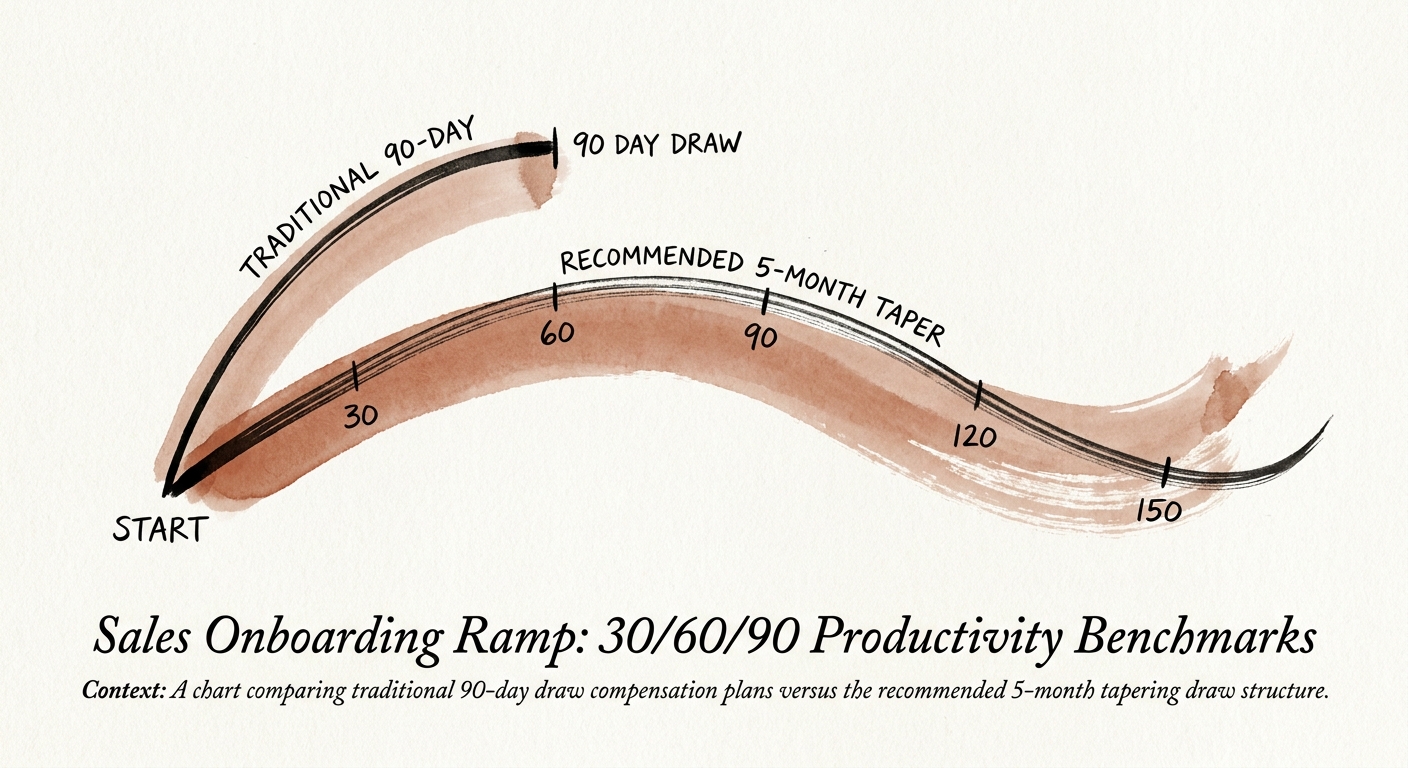
The signals only matter if the money behind them is honest, which is why this is fundamentally a question of how you design the B2B SaaS sales compensation plan. A 3-month non-recoverable draw against a 6-month sales cycle is a turnover machine. We use a 5-month tapering draw for enterprise teams: months 1–3 fully guaranteed, month 4 stepping down to 75%, month 5 to 50%. That curve tracks the actual cycle, so the rep isn't forced to discount a half-baked deal in month three just to eat — the single most common source of margin leakage in a portfolio company's GTM motion.
So before your next hiring cohort: open the comp plan, find the day the draw ends, and put it next to your real median sales-cycle length. If the second number is bigger than the first — and for enterprise it always is — you don't have an onboarding program, you have a countdown timer on every rep you hire. Onboarding is a revenue operations function, not an HR formality. Build the certification gates, fix the draw curve, and stop spending EBITDA on reps the system set up to fail. The companion view, HBR's work on restructuring sales onboarding for faster time-to-revenue, lands in the same place from the people side.