The practical answer
- Short answer
- Founders focus on valuation, but indemnification caps determine what you keep. New 2026 data on RWI, baskets, and the 'No-Recourse' deal structure.
- Best fit
- Industry: B2B Technology. Function: M&A Negotiation
- Operating path
- Exit Readiness → Operational Excellence → Transaction Advisory Services
- Key metric
- 0.5% Median indemnity cap in RWI-backed deals (vs. 10-15% in non-insured deals).
The 'Headline Price' Mirage
Most founders negotiate the LOI with a single number in mind: the Enterprise Value. You fight for a $50M exit, high-five your co-founders when the number hits the term sheet, and assume the hard work is done. You are wrong. In the fine print of the Purchase Agreement lies a mechanism that can silently Claw back 10% to 15% of that value years after the wire transfer clears: the Indemnification Cap.
The concept is simple: you promise the buyer that your company is clean—no undisclosed lawsuits, no broken IP, no unpaid taxes. If you are wrong, you pay them back. But how much you pay them back is the difference between a clean exit and a financial nightmare.
The Trap: The 'Market Standard' Lie
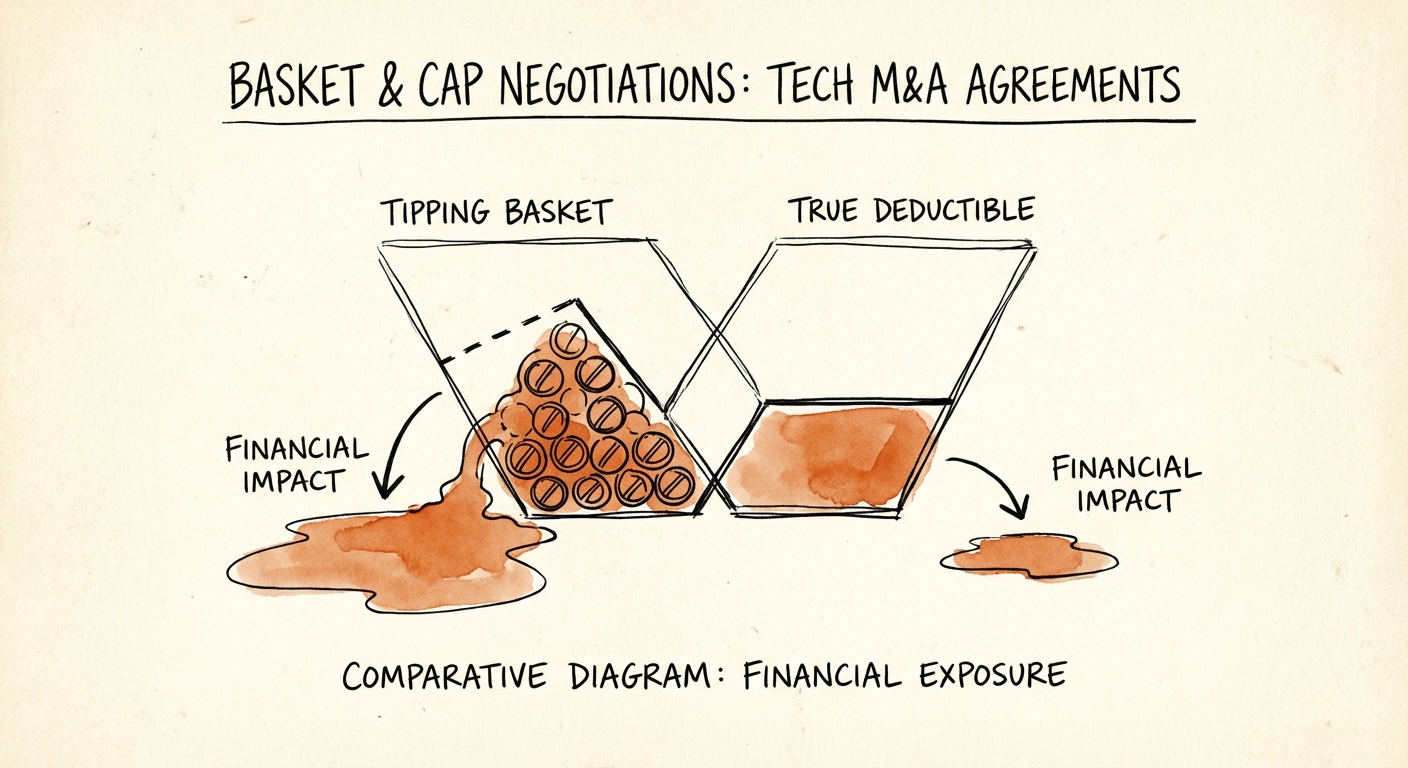
In lower middle-market tech deals ($20M - $100M), buyers will often present a 'standard' indemnification package: a 10-15% General Indemnity Cap and a Tipping Basket of 0.5%. On a $50M deal, this means you are personally on the hook for up to $7.5M in post-closing liabilities. If a $300,000 tax issue arises and you have a $250,000 tipping basket, you don't owe $50,000—you owe the full $300,000.
This isn't just 'legal cleanup'; it is a structural valuation haircut. You haven't sold the company for $50M; you have sold it for $42.5M plus a high-risk option on the remaining $7.5M. Sophisticated sellers in 2026 do not accept this risk profile. They shift it to the insurance market.
You haven't sold the company for $50M if $7.5M is tied up in indemnity risk. You've sold it for $42.5M plus a liability option.
The 2026 Data: The 'No-Recourse' Shift
Significant research from the 2025 SRS Acquiom M&A Deal Terms Study and the ABA 2025 Private Target Deal Points Study reveals a massive bifurcation in the market. There are now two types of deals: those with Representations and Warranties Insurance (RWI) and those without.
The RWI Arbitrage
In deals without insurance, the median general indemnity cap hovers between 10% and 15% of deal value. However, in deals with RWI—which now constituted 42% of private transactions in 2024—the cap drops precipitously to 0.5% of deal value. This 0.5% represents the 'retention' (deductible) under the insurance policy.
By purchasing an RWI policy (typically costing 2.5% - 3.5% of the limit, not the deal value), you effectively transfer 99% of your general indemnity risk to an insurer. On a $50M exit, the difference is stark:
- Scenario A (No RWI): You carry $7.5M in liability risk (15% cap).
- Scenario B (With RWI): You carry $250k in liability risk (0.5% retention).
The ABA 2025 Study also highlights a critical trend in 'Materiality Scrapes'. In 82% of deals, buyers are now successfully negotiating 'Double Scrapes'—meaning they can ignore 'materiality' qualifiers both for determining if a breach occurred and for calculating damages. This makes a tight Basket (deductible) your only line of defense against nickel-and-dime claims.
The Playbook: Negotiating Protective Terms
You cannot win this negotiation during the legal drafting phase; you must win it at the LOI stage. If you wait until the Purchase Agreement arrives to discuss caps and baskets, you have already lost leverage.
1. Mandate RWI in the LOI
Don't ask; require it. Specify that the transaction will utilize RWI and that the seller's liability for general representations will be limited to the policy retention (typically 0.5% - 1.0% of Enterprise Value). Offer to split the premium cost 50/50. It is the best money you will ever spend.
2. Kill the 'Tipping Basket'
Buyers love 'Tipping Baskets' (also called 'First Dollar' baskets). Once damages exceed the threshold (e.g., $250k), they tip back to zero, and you owe the full amount. You want a 'True Deductible'. If the threshold is $250k and damages are $300k, you only pay $50k. According to the ABA, 100% of RWI deals now use a True Deductible structure for the retention.
3. Cap the 'Fundamental' Reps
Buyers will try to leave Fundamental Representations (ownership, capitalization, due authority) uncapped. While these are low-risk, an uncapped liability is a non-starter for many funds and family offices. Push to cap Fundamental Reps at the Purchase Price (100% of deal value). Never let liability exceed what you actually got paid.
For more on structuring your exit to avoid valuation traps, review our guide on The LOI Decoder and protect your downside with the Founder's Defensive Playbook.