
The practical answer
- Short answer
- The gap between signing and closing is where deal value can move. Learn how to negotiate tech-specific closing conditions, MAE clauses, and bring-down certificates to protect your exit.
- Best fit
- Industry: B2B Technology. Function: Legal & Finance
- Operating path
- Exit Readiness → Operational Excellence → Transaction Advisory Services
- Key metric
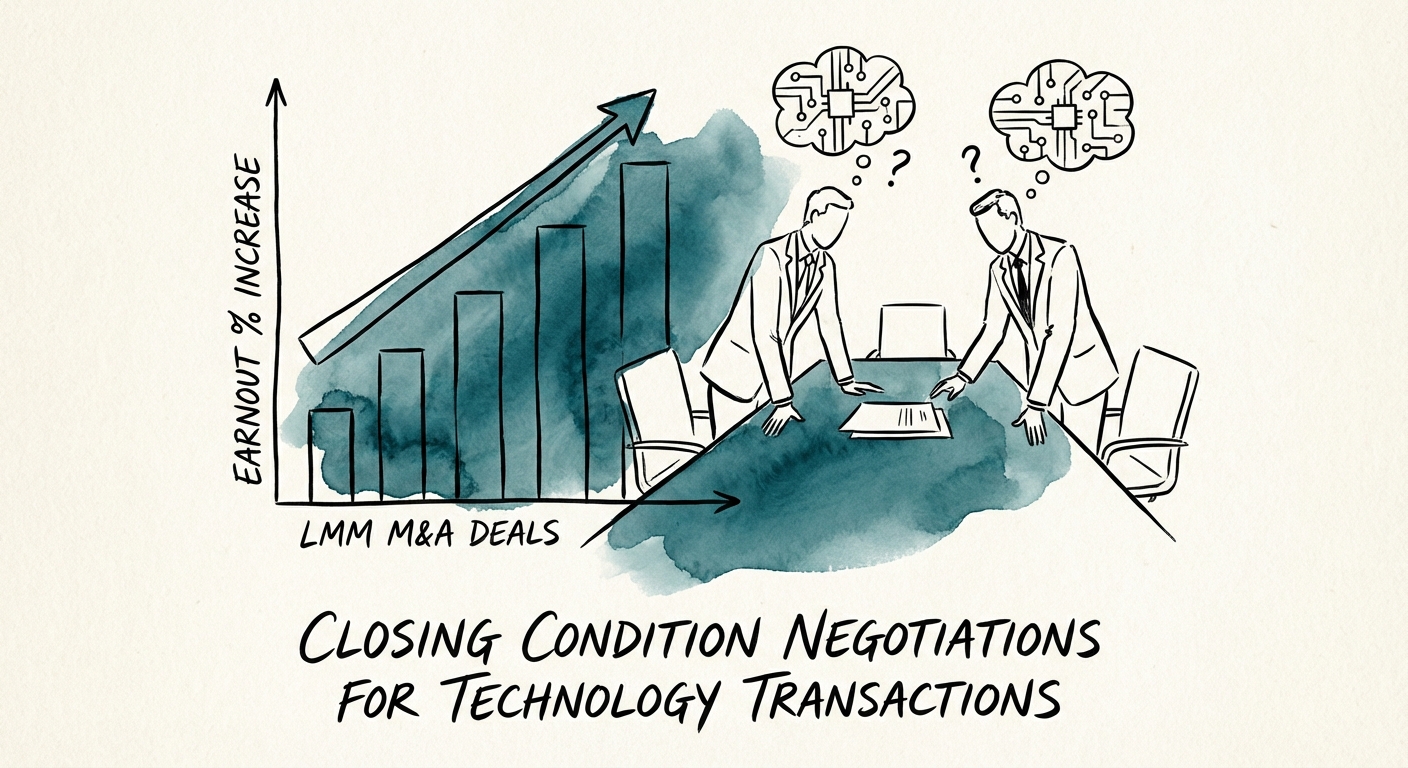
- 50% Increase in Earnout size (as % of closing payment) in LMM deals in 2025.
The Signing-to-Closing Gap: Where Value Can Move
For most founders, the signing of the Definitive Agreement (DA) feels like the finish line. The champagne is chilled, the press release is drafted, and the 'deal fatigue' finally starts to lift. But in 2026, the signing ceremony is merely halftime. The real game—the fight to preserve your valuation—happens in the 45 to 90 days between signing and closing.
We are seeing a disturbing trend in lower-middle market (LMM) technology transactions: aggressive use of closing conditions to force a 're-trade' (price reduction) or to convert guaranteed cash into contingent earnouts. According to the 2025 SRS Acquiom M&A Deal Terms Study, earnouts in LMM deals are now 50% larger as a percentage of the closing payment compared to the broader market. This signals a profound shift: buyers are no longer pricing risk into the valuation; they are shifting it entirely to the post-closing period, often using the 'closing gap' to create leverage.
The Rise of the 'Regulatory' Delay
The gap between signing and closing is a moving target. HSR filing requirements changed in 2025, and as of 2026 the FTC says filers may use the form and instructions that were in place before the February 10, 2025 effective date of the expanded rule. The practical lesson is not to rely on stale timing assumptions: confirm current HSR filing requirements with counsel before treating the closing calendar as fixed. In Europe, the EU AI Act can also create a new layer of compliance diligence for relevant technology assets.
Savvy private equity buyers use this extended timeline to re-open diligence. They treat the 'Bring Down' certificate—the document that confirms your representations are still true at closing—not as a formality, but as a second negotiation. If your 'Key Employee' list changes, or a new open-source vulnerability is discovered during this window, they may ask for remediation, escrow, or a purchase-price adjustment.
If you have not locked down your closing conditions, you have not fully protected the economics you negotiated.
The Three 'Silent Killers' in Tech Closing Conditions
While standard M&A advice focuses on 'Material Adverse Effect' (MAE) clauses, technology transactions face specific closing traps that are far more likely to trigger a deal failure or re-trade.
1. The 'Satisfactory Remediation' Trap
In 2026, buyers are increasingly moving technical due diligence findings from 'Post-Closing Covenants' (things you promise to fix later) to 'Closing Conditions' (things you must fix before they pay you).
The common tactic is the Open Source Software (OSS) audit. Buyers will use tools like Synopsys Black Duck to scan your codebase. If they find 'Copyleft' code (e.g., GPL v3) mixed with proprietary IP, they may demand full remediation before closing. Rewriting core libraries takes weeks, pushing you past your exclusivity window and giving the buyer the right to walk away—or offer a lower price to 'take on the risk.' Never agree to open-ended remediation as a closing condition. Cap the remediation cost or agree to a specific holdback amount instead.
2. The '90% Retention' Threshold
Buyers know that in a tech deal, the assets walk out the door every evening. Consequently, 'Key Employee' closing conditions have tightened. A standard clause might require that '90% of Key Employees have signed offer letters.'
The trap lies in the definition of 'Key Employee' and the threshold. If you have a 10-person engineering team and the buyer names all of them 'Key,' a single departure allows the buyer to terminate the deal. We have seen engineers hold deals stuck for equity kickers once they realize they are the 'closing condition.' Negotiate a 'commercially reasonable efforts' standard rather than a strict percentage, or define 'Key Employees' narrowly (e.g., only the CTO and VP of Engineering).
3. The 'Third-Party Consent' Landmine
If your business relies on major platforms—Salesforce, AWS, Atlassian—your partner agreements likely contain 'Change of Control' provisions requiring the vendor's consent to transfer the contract. Buyers often list 'Receipt of Third-Party Consents' as a closing condition.
The danger? These large vendors are slow. Waiting for a 'yes' from a hyperscaler legal department can take 60 days. If the closing condition is absolute, your deal is in limbo. Negotiate to convert this condition into a 'Post-Closing Covenant' where the buyer agrees to help secure the consent after the money has changed hands.
The 'Certainty of Close' Playbook
To protect your exit, you must negotiate the closing conditions with the same intensity as the valuation. The goal is 'Certainty of Close'—minimizing the optionality the buyer has to walk away.
Define 'Materiality' Quantitatively
Don't let the buyer define a 'Material Adverse Effect' (MAE) based on a 'feeling' that the business has deteriorated. Push for a quantitative definition in the Definitive Agreement. For example, define 'Material' as an impact exceeding 10-15% of EBITDA or 5% of Recurring Revenue. This prevents the buyer from using a minor customer churn event or a small lawsuit as a pretext to abandon the deal.
Limit the 'Bring Down' Certificate
The 'Bring Down' certificate requires you to reaffirm that all your Representations and Warranties are true at the moment of closing. In the volatile tech market of 2026, things change quickly. Negotiate a 'Materiality Scrape' for the Bring Down certificate. This means that for the purpose of closing, your reps don't have to be perfectly true; they just have to be true enough that any inaccuracies don't constitute a Material Adverse Effect.
The 'Hell or High Water' Clause
For regulatory approvals such as HSR or other regulatory reviews, consider a buyer-efforts covenant. This requires the buyer to take all necessary steps (including divesting conflicting assets or agreeing to behavioral remedies) to get the deal approved by regulators. Without this, a strategic buyer can simply shrug and say, 'The regulator said no,' and walk away with your competitive secrets in hand.
Summary: The 2026 Closing Checklist
- Remediation: Move tech debt fixes to Post-Closing Covenants, backed by a capped escrow.
- Retention: Set the 'Key Employee' threshold at 70-80%, not 100%.
- Consents: Allow for 'Deemed Consent' if a vendor doesn't respond within 30 days.
- MAE: Define strictly with dollar thresholds.
The gap between signing and closing is where leverage can shift. If you have not locked down these conditions, you have not fully protected the economics you negotiated.