
The practical answer
- Short answer
- Consumer tech acquisitions often hide $1.5M in technical debt behind a glossy UI. Here is the 2026 mobile app due diligence checklist for private equity.
- Best fit
- Industry: Consumer Technology. Function: Engineering
- Operating path
- Technical Debt → Turnaround & Restructuring → Transaction Advisory Services
- Key metric
- $1.5M Average cost of a full legacy app rewrite for enterprise-grade consumer apps.
The "Glossy UI" Trap in Consumer Tech Diligence
In consumer technology acquisitions, the user interface is often a Trojan Horse. A target company may present a sleek, high-performing app in the Confidential Information Memorandum (CIM), boasting 4.8-star App Store ratings and strong Day 1 retention metrics. However, below the surface often lies a fragmented codebase—a patchwork of React Native, legacy Objective-C, and abandoned third-party libraries that will require a $1.5M capital expenditure to stabilize post-close.
For Private Equity sponsors, the risk is not just operational; it is financial. Technical debt in mobile applications is not merely a maintenance issue; it is a direct hit to EBITDA. When an app requires a full rewrite rather than a refactor, the cost averages between $500,000 and $1.5M, with a timeline of 9 to 16 months. Furthermore, McKinsey data suggests that up to 40% of a target's technology estate value can be consumed by technical debt, creating a significant valuation gap between the perceived asset and the actual liability.
The Hybrid Architecture Warning Sign
A common red flag in 2026 is the "hybrid patchwork"—apps that began as native iOS/Android projects but bolted on React Native or Flutter screens to accelerate feature delivery. While efficient for early-stage growth, these hybrid architectures often become unmaintainable at scale, leading to performance degradation, bloated app sizes, and a "dependency hell" where updating one framework breaks the other. In due diligence, this architectural incoherence is a leading indicator of a future "rip and replace" project.
Unassessed technical debt inflates acquisition costs as it obscures the true value of the asset. Without visibility into what lies beneath the surface, investors risk overpaying for software that demands costly remediation.
The 2026 Mobile Audit Checklist: Metrics That Matter
Stop looking at vanity metrics like total downloads. To assess the true quality of a mobile asset, PE deal teams must demand granular technical performance data. The 2026 standard for stability has shifted; what was acceptable in 2023 is now a churn driver.
1. The "Five 9s" Stability Standard
In 2025, the median crash-free session rate for mobile apps reached 99.95%. Top-performing apps (the top 10%) now achieve 99.99%. If your target's app is operating at 99.7% or lower, it is not just "slightly buggy"—it is statistically likely to bleed users.
- Red Flag: Crash-free user rates below 99.8%.
- Valuation Impact: A 0.05% drop in stability correlates with a measurable decrease in Day 30 retention, directly impacting LTV models.
2. Third-Party Dependency Age
Run a software composition analysis (SCA) to check the age of third-party libraries. In the mobile ecosystem, a library that hasn't been updated in 18 months is effectively "abandonware." Taking ownership of an app that relies on deprecated libraries (e.g., old versions of Google Maps SDK or payment gateways) creates an immediate security and compliance liability.
3. The Code Churn vs. Refactor Ratio
Analyze the commit history for the last 12 months. A healthy codebase sees a balance of new feature work and refactoring. If 90% of commits are new features with zero refactoring, or conversely, if 80% of engineering time is spent on "bug fixes" (reactive maintenance), you are buying a fragile asset.
The Remediation Roadmap: CapEx vs. OpEx
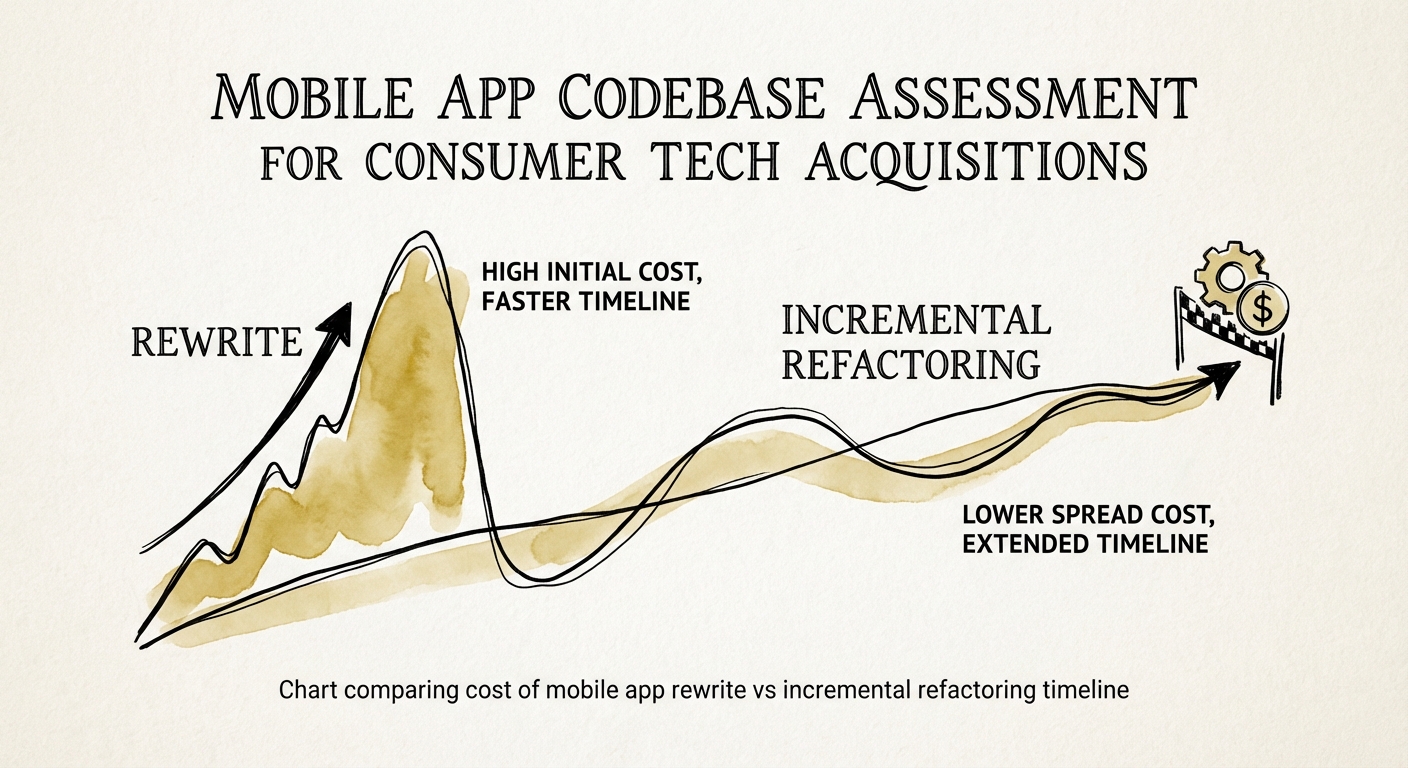
When significant mobile technical debt is identified, the remediation plan must be factored into the 100-day plan and the deal model. There are two paths, each with distinct financial implications.
Path A: The "Strangler Fig" Refactor (Preferred)
This approach involves incrementally replacing legacy code modules with modern architecture (e.g., swapping Objective-C screens for Swift or rewriting React Native bridges) while the app remains live.
Cost: $200k - $500k over 12 months.
Risk: Moderate. Requires high-skill engineering talent but preserves revenue continuity.
Path B: The "Grand Rewrite" (The Valuation Killer)
If the codebase is deemed unsalvageable (e.g., reliance on a deprecated framework like Cordova or chaotic spaghetti code), a full rewrite is necessary.
Cost: $1.5M+ (CapEx).
Risk: High. 79% of app modernization projects fail or blow their budgets. A rewrite halts feature velocity for 6-9 months, potentially stalling growth during the critical first year of the holding period.
Strategic Advice: If a rewrite is required, negotiate a specific working capital adjustment or a special indemnity in the purchase agreement to cover the $1.5M expense. Do not treat this as standard operating overhead.