The practical answer
- Short answer
- Shopify isn't always 'low code.' Discover why legacy 'checkout.liquid' files and headless architectures create $1.5M in hidden technical debt for PE buyers.
- Best fit
- Industry: Ecommerce. Function: Engineering
- Operating path
- Technical Debt → Turnaround & Restructuring → Transaction Advisory Services
- Key metric
- Aug 28 2025 deadline for Shopify Plus 'checkout.liquid' deprecation
The 'Low-Code' Lie in Private Equity
The most dangerous sentence in e-commerce due diligence is: "It's just Shopify; there's no technical risk." Private Equity investors frequently classify Shopify brands as "asset-light" marketing plays, assuming the platform handles all infrastructure complexity. This assumption is expensive.
In 2026, the reality is that mid-market Shopify Plus merchants often carry more technical debt than legacy monolithic retailers. Why? Because the ecosystem encourages "app hoarding" and unchecked customization. A $50M GMV brand doesn't just run on Shopify; it runs on a fragile web of 25+ third-party apps, deprecated checkout.liquid files, and unoptimized "headless" front-ends that require a full engineering team to maintain.
We call this the Customization Tax. It doesn't show up on the P&L as "hosting," but it bleeds EBITDA through agency retainers, broken checkout flows, and reduced conversion rates. If you are auditing a Shopify target today, confirm whether it completed Shopify's August 28, 2025 Checkout Extensibility upgrade for Thank You and Order Status pages. Shopify has already begun limiting legacy checkout.liquid, additional scripts, and script-tag customizations on those pages. If your target hasn't migrated, you aren't buying a functioning store; you're buying a mandatory, high-risk remediation project.
If a sub-$50M GMV brand is running a Headless architecture, you aren't buying a retailer. You're buying a software maintenance liability that costs $150k a year to keep the lights on.
The 'Headless' Hallucination: A $150k EBITDA Leak
In 2022-2023, agencies sold thousands of merchants on "Headless Commerce" (separating the Shopify backend from a custom frontend, often built on React/Hydrogen). The pitch was speed and flexibility. The reality for 90% of merchants is a permanent EBITDA leak.
The Maintenance Math
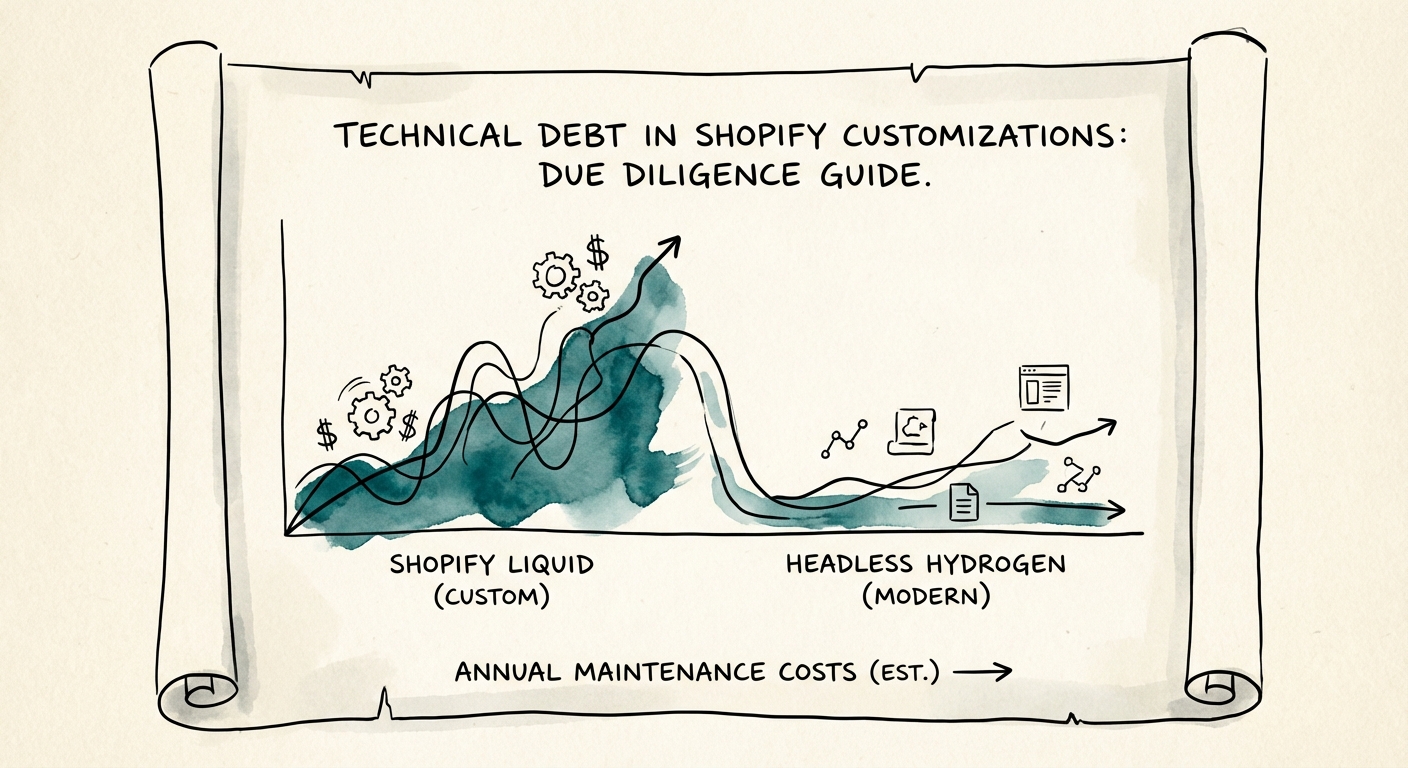
A native Shopify "Liquid" theme requires near-zero maintenance. Shopify updates the platform, and the theme works. A Headless architecture, however, requires constant engineering oversight. You are no longer renting a storefront; you are building a software company.
- Native Liquid Theme Cost: $0/year in maintenance (included in platform fee).
- Headless Maintenance Cost: $100,000 - $150,000/year (minimum one full-time developer or equivalent agency retainer).
During due diligence, request the Total Cost of Ownership (TCO) for the frontend. If the target is Headless but generating less than $50M in GMV, you are likely looking at a "vanity stack"—technology bought for the CMO's ego rather than the CFO's ROI. This architecture often degrades Core Web Vitals (CWV) rather than improving them, with data showing that 59.5% of Liquid sites pass CWV compared to significantly lower rates for poorly implemented Headless sites.
The Post-Deadline Risk: Checkout.liquid
The most immediate risk in any Shopify acquisition now is the deprecation of checkout.liquid and legacy scripts on Thank You and Order Status pages. For a decade, this was the only way for Shopify Plus merchants to customize their checkout (e.g., adding a 'free gift' script or custom address validation). That door is closing.
Shopify has mandated a migration to Checkout Extensibility. This is not a "version upgrade." It requires rewriting all checkout logic using Rust-based Shopify Functions and UI Extensions. It is a paradigm shift from "hacking the DOM" to "building apps."
The Due Diligence Checklist
When evaluating a target, execute this technical audit checklist immediately:
- Checkout File Audit: Does the store still use
checkout.liquidfor the Information, Shipping, or Payment steps? (Note: The deadline for Information/Shipping/Payment had already passed for many; the hard stop for Thank You/Order Status pages was August 2025). - App Dependency Graph: Export the installed app list. If the count exceeds 20, flag for review. Specifically, look for "Stale Apps"—apps installed years ago, paying monthly fees, but with no active usage.
- Script Tag Injection: Use a tool like BuiltWith or the Chrome Inspector to see how many external scripts are loading on the Product Page. If you see >15 external JS requests, anticipate a 15-20% mobile conversion penalty.
If the target misses the August 2025 deadline, they lose the ability to change or rely on custom logic on the Thank You page, potentially breaking analytics attribution and post-purchase upsell revenue streams that underpin your investment thesis.