
The practical answer
- Short answer
- Vendors model a 90-day automation payback. The median lands at 22 months. Here is the month-by-month math, and why your documentation gap decides which one you get.
- Best fit
- Industry: B2B Technology & IT Services. Function: Operations & Process Documentation
- Operating path
- Process Documentation → Operational Excellence → Transaction Execution Services
- Key metric
- 212% Higher ROI for companies that execute comprehensive process mining and documentation prior to automation.
The slide deck said 90 days. The bots broke on day one.
Picture a 40-person IT services firm that signs a $1.2M automation contract to take its tier-one ticket triage and monthly billing reconciliation off human hands. The vendor model shows gross margin lifting 15% inside a quarter and a clean 3x payback by month 14. Every head in the room nods along. Then the bots go live and immediately throw an 18% exception rate, because the "process" they were built to mimic wasn't actually the process. The two senior reconciliation analysts had been making dozens of micro-judgments an hour that lived nowhere except their heads. The software couldn't see any of them.
This is the gap nobody prices into the deck. You cannot automate what you have not standardized, and you cannot standardize what you have not written down. A bot executes the documented workflow with perfect fidelity. The trouble is that in most growing firms the documented workflow and the real workflow diverged a long time ago, and the delta is exactly the human judgment that made the operation work at all. Automate on top of that, and you don't get efficiency. You get the same broken process running faster, generating errors at machine scale and a maintenance bill that outruns the labor it replaced.
This is not a fringe outcome. Gartner projects that by 2027, nearly half of all RPA deployments will fail to deliver their expected ROI. The cause is almost never the tooling. It is the assumption that software can paper over a process that still depends on undocumented exception-handling and a couple of irreplaceable people. The bot is fine. The thing you pointed it at was never ready to be copied.
A bot does exactly what the written process says. The problem is that your best people stopped following the written process two years ago, and nobody wrote down the new one.
What the real 22-month curve looks like, month by month
If the 90-day payback is fiction, here is the timeline that actually clears. For a firm scaling past $20M ARR, a durable 3x return on process automation runs on an 18-to-24-month horizon, and the shape of that curve is the whole point. Treat it as four distinct stretches, because the money behaves completely differently in each one.
Months 1-3 — no code, just discovery. You write zero automation script. You map the happy path and, far more important, you count the variance. Ask one question: how many different ways does your team currently run a single customer onboarding or a single billing close? If the honest answer is more than one, you are not ready. Skip this and you walk straight into the fragile-bot trap, where keeping the automation alive costs more engineering time than the manual task ever did. The fragile-bot diagnostic spells out how that failure mode compounds.
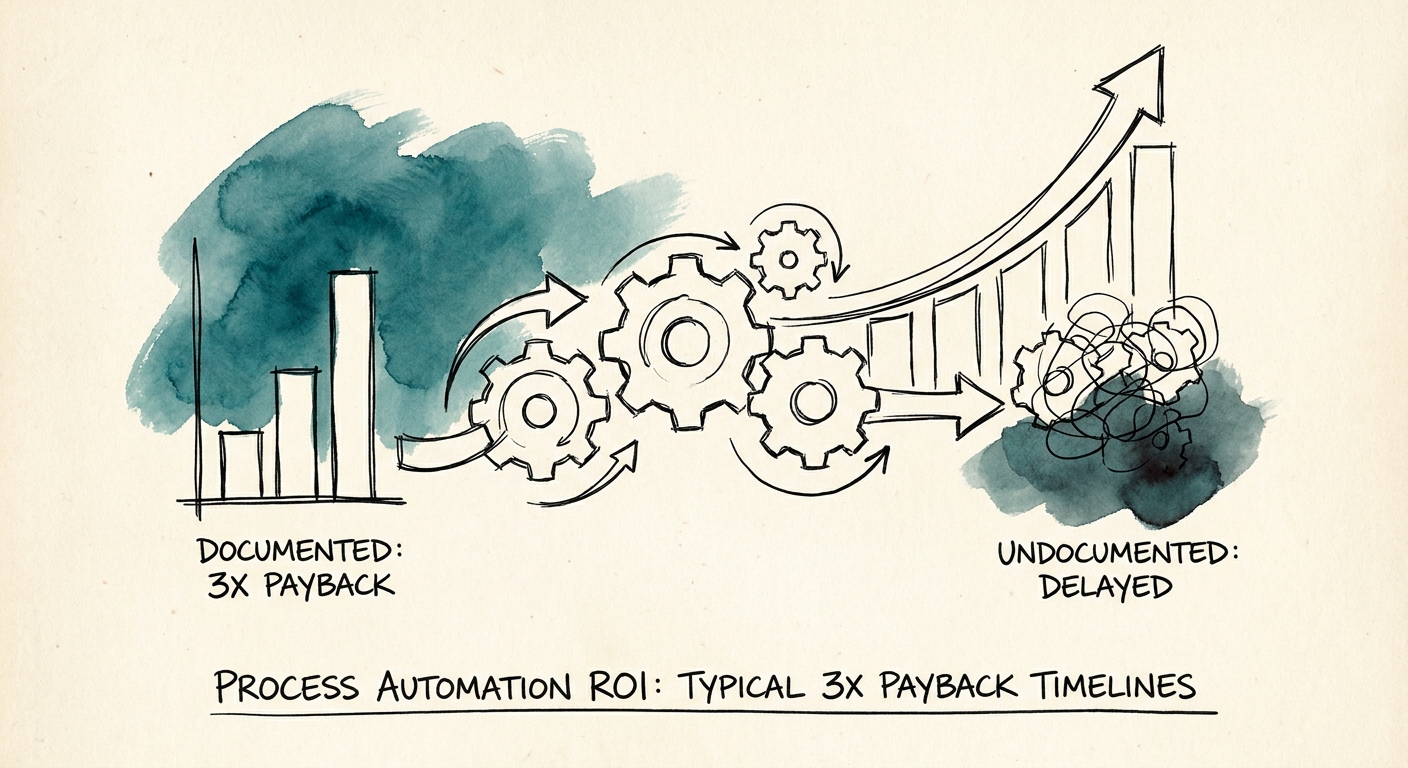
Months 4-6 — refactor before you automate. Now you kill the exceptions you just found. You force one standard procedure where there used to be five. This is the unglamorous phase that vendors never sell, and it is where the entire ROI delta gets decided. Forrester's work on process intelligence puts numbers on it: firms that run dedicated process mining and documentation before automating realize a 212% higher ROI than the roughly 40% baseline earned by teams that skip discovery and rush to deployment. Same software, same vendor, five times the return — the only variable is whether the process was clean before the bot touched it.
Months 7-12 — live, but still underwater. The bots run. Your savings don't show up yet, because every edge case you didn't catch in month two surfaces here as live exception-handling work. You are paying down what you deferred. Months 13-24 is where margin finally expands and the 3x lands. The curve is back-loaded by design; anyone promising a quarter-one inflection is selling you the demo, not the deployment. Before you start, baseline yourself against the documentation failures that tank exit valuations and confirm the foundation can carry algorithmic load at all.
Why a buyer pays for documentation, not for bots
Here is the part that turns this from an operations footnote into a valuation event. For a founder-CEO heading toward a sale, the value of automation is not the local cost saving — it is whether the asset transfers. A buyer will not pay a premium for a margin engine that only runs because one engineer keeps it alive on Sunday nights. They pay for systems that produce that margin without heroics, that survive the day your key people leave.
In operational due diligence, this is exactly what acquirers hunt for. A firm can show an 80% gross margin and still get marked down hard if a deeper look reveals automations that crash weekly and depend on a couple of people to quietly patch them. That is unquantified technical debt sitting on top of your numbers, and a disciplined buyer prices it as risk. Documented processes read as institutional memory you can hand over; undocumented automations read as a liability you're trying not to mention. It is the same dynamic we lay out in the ROI of process documentation on exit multiples.
The operators who actually hit enterprise-wide 3x understood where the budget goes. Harvard Business Review's analysis of automation at scale found that the firms reaching that return committed at least 35% of their total automation budget to up-front process re-engineering and documentation — not to licenses and implementation fees. The software was the cheap part. Process clarity was the asset.
So the move for this year is blunt: document first, optimize second, automate third. Pick your single highest-volume workflow, sit with the people who actually run it for an afternoon, and write down every exception they handle from memory. If that list runs to dozens of edge cases — and it will — you've just found why your last automation underdelivered, and you've started the only work that makes the next one pay back at all.