The practical answer
- Short answer
- Most PE reference calls predict performance no better than a coin flip. Here is the exact call structure that surfaces whether an executive can run your 100-day plan.
- Best fit
- Industry: Private Equity. Function: Talent Acquisition
- Operating path
- Team & Hiring → Operational Excellence → Transaction Execution Services
- Key metric
- 0.26 Predictive validity coefficient of an unstructured reference check.
The call where the former board chair calls your candidate "a visionary"
You are forty minutes from signing a comp package north of seven figures. The last gate is a reference call with the candidate's former board chair. He is warm, he is fast, and inside ten minutes he has told you the executive is "a true visionary," "incredibly strategic," and "exactly the kind of leader who elevates a room." You write it down. You feel good. You sign.
Eighteen months later that same executive has missed three forecasts, lost two of your best operators, and you are drafting a severance agreement. Here is the part that should bother you: the reference call did not fail. It worked exactly as designed. A board chair who only worked with someone in board meetings can only describe how they presented in board meetings. Presence is not the job. Rebuilding a comp plan after a botched integration is the job. Untangling the technical debt the prior CTO left buried is the job. And a quarterly board interaction tells you nothing about either.
This is not a soft problem. Decades of selection research put the predictive validity of an unstructured reference check at roughly 0.26 — barely better than a coin flip on future performance. Yet in private equity, where a single bad executive at a portfolio company can stall the entire hold thesis, sponsors still run these calls as a confirmation ritual and fold the results straight into their human-capital diligence. We are not gathering data on those calls. We are collecting permission to do what we already decided to do.
A reference who only has adjectives for the candidate never actually worked with them under load. The praise is a tell, not a signal.
The difference between an adjective and a scene
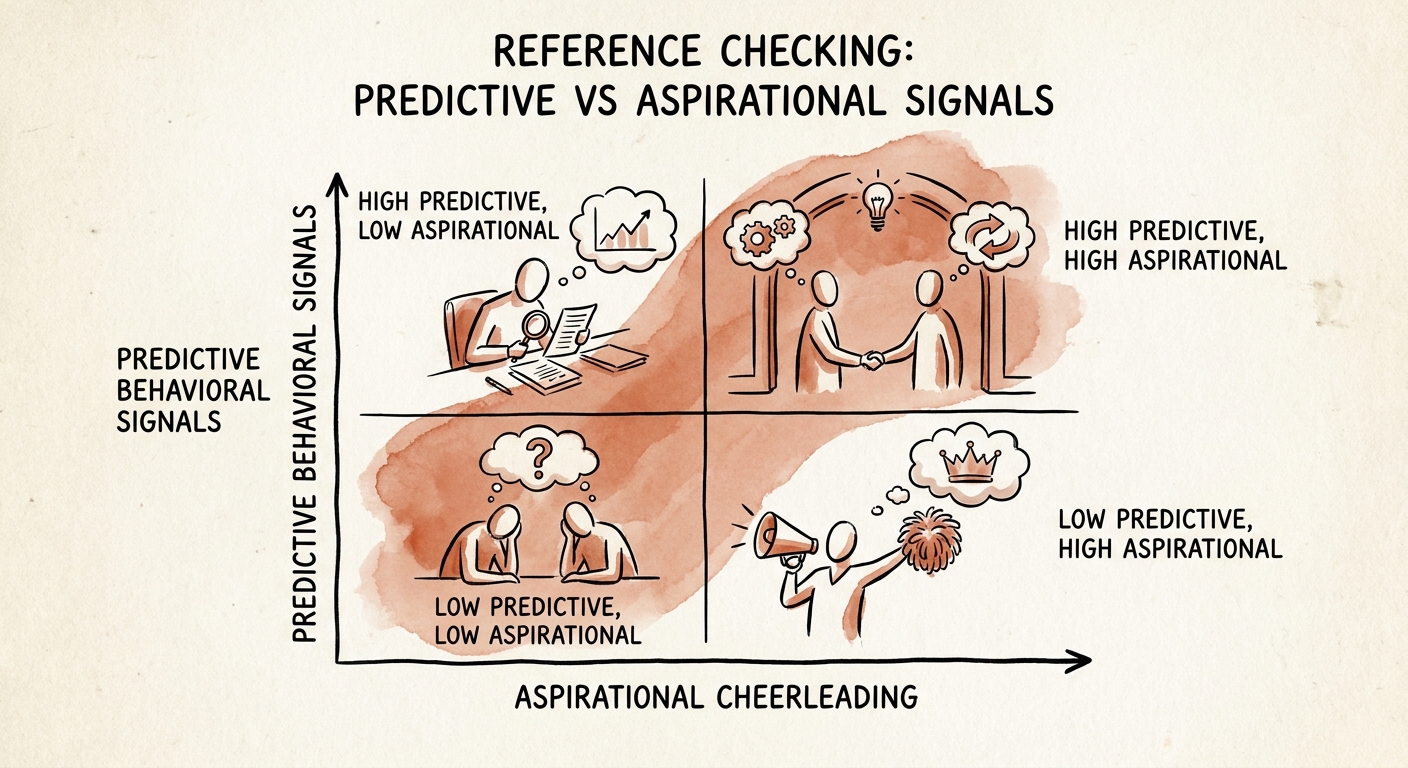
Run a quick test on your last three reference notes. Could a single sentence in them have been written about a completely different executive in a completely different industry? "Strong leader." "Great culture builder." "Sees around corners." If yes, you captured aspiration, not evidence. Aspirational praise is unfalsifiable by design — it cannot be wrong, which is exactly why it is useless. It tells you a former colleague liked the person. It does not tell you what the person does on a Tuesday when net revenue retention slips under 90 and the board wants answers by Friday.
A predictive signal is a scene, not a label. Compare the two. Aspirational: "Sarah is a phenomenal operator." Predictive: "When NRR dropped below 90, Sarah pulled the bottom twenty accounts herself, exited two CS managers inside a month, stood up a health-scoring model, and had us back to 104 by the third quarter." The second version is checkable, specific, and tells you precisely how the candidate behaves under the conditions your portfolio company is in right now. So when a reference reaches for an adjective, treat it as the start of a question, not an answer. "Resilient" — fine, name the crisis that proved it and walk me through what she actually did in the first week. If the reference can't, the adjective evaporates and so does the data point.
The reason this discipline matters in PE specifically is the leverage. The cost of getting it wrong does not stop at a salary you have to eat. By the time you account for the dead pipeline, the missed forecasts, and the top reps who quit in the wake, replacing a single VP of Sales runs to roughly $2.4 million — and that is before the deal-level damage. Harvard Business Review's work on new-executive transitions is a useful reminder of how much of the failure is situational and avoidable: the person was capable in their last context and drowning in yours, and a structured call would have surfaced the mismatch before you wired the comp.
Build the call around your 100-day plan, not the candidate's highlight reel
Two changes turn a reference call from theater into diligence. Neither is complicated. Both are uncomfortable, which is why most sponsors skip them.
First, stop accepting the candidate's curated list. Anyone can hand you three people who will sing. Ask instead for a former boss, a lateral peer who fought them for budget or headcount, and a direct report they let go or demoted. That last one is the whole game. An executive who can point you to someone they fired who still picks up the phone and speaks to their fairness has shown you something a board chair never could. An executive who can't — who has no such name, or visibly stalls when you ask — has told you how they handle the parts of leadership nobody applauds.
Second, anchor every question to the actual plan. Don't ask about generic strengths. Read the reference the real mandate: "We need this person to move our pricing from perpetual license to usage-based SaaS inside six months. You watched them run a transition like that — walk me through exactly what broke in month three, and what they did about it." A reference who lived through it will go straight to the mess: the billing system that couldn't handle metering, the sales team that revolted over comp, the two enterprise accounts that threatened to churn. A reference who is inflating the candidate's role will stay vague and pleasant. The specificity of the answer is the signal. ghSMART's CEO Genome work found that executives who reliably resolve concrete operational bottlenecks materially outperform in PE-backed settings — so the question you most need answered is whether this person has actually broken and fixed the specific thing you're hiring them to break and fix.
One more move for the reference who is clearly holding back out of legal caution or loyalty: never ask "what are their weaknesses." Ask them to rank. "Every executive over-indexes somewhere and under-invests somewhere. Between strategic vision, operational discipline, and developing the team, which one sits at the bottom — and where did you see that show up day to day?" Framing it as a trade-off rather than a flaw gives the reference cover to be honest, and the answer is almost always the truest thing they say on the call. Run your next reference this way before the package goes out — treat it as discovery, not a courtesy — and you'll either get the operational proof you need or the early warning that saves you the severance check.