
The practical answer
- Short answer
- Your first RevOps hire isn't triggered by $10M ARR -- it's headcount. The rep count where forecasts break, and the reporting line that makes the hire work.
- Best fit
- Industry: B2B Software & Tech Services. Function: Go-To-Market & Revenue Operations
- Operating path
- GTM Execution → Commercial Performance → Performance Improvement
- Key metric
- 19% Faster growth rate for companies with aligned revenue operations compared to siloed teams.
The forecast that disagrees with itself
Pull up your last board deck and find the pipeline-sourcing slide. Now ask your CMO and your VP of Sales, separately, what percentage of pipeline marketing actually generated. If the two numbers don't match -- and at your stage they almost never do -- you don't have a reporting problem. You have a missing function, and you've been quietly paying for it out of your most expensive payroll line.
Founders keep waiting for an ARR milestone to justify their first Revenue Operations hire. Usually it's the mythical $10M mark. That's the wrong instrument. The thing that actually breaks isn't revenue size -- it's the number of humans who now have to agree on the same definitions. Until you install someone who owns those definitions, the job of cleaning data, reconciling dashboards, and chasing down "why did this deal slip" lands on the one person whose time you can least afford to spend that way: your closer.
Here's the math nobody wants on the slide. Gartner's research finds B2B reps spend only 28% of their time actually selling. The other 72% goes to logging activity, hunting for the right deck, and fighting systems that don't talk to each other. Take a rep on $150K on-target earnings and roughly $108K of that comp is paying for non-selling work. Run that across even five reps and you've routed over half a million dollars a year into the most expensive CRM administration on earth. You wouldn't hire a $150K analyst to scrub spreadsheets -- but that's exactly the trade you're making by leaving the function unfilled.
The reason this sneaks up on founders is that early-stage selling runs on proximity. Your first two or three reps sat near you, absorbed the pitch by osmosis, and muscled deals through on instinct. That works beautifully right up until it doesn't. The osmosis model has no upper bound you can see coming -- it just snaps. Before you greenlight your next hiring sprint, it's worth getting clear on what the function even is: our diagnostic guide to Revenue Operations for scaling CEOs covers the architecture you're actually buying.
Somewhere around the eighth quota-carrying rep, your pipeline forecast stops being a measurement and starts being a wish. Nobody on the team agrees on what a Stage 3 deal even means anymore -- and that disagreement is the hire signal, not your ARR.
Why eight reps, not eight figures
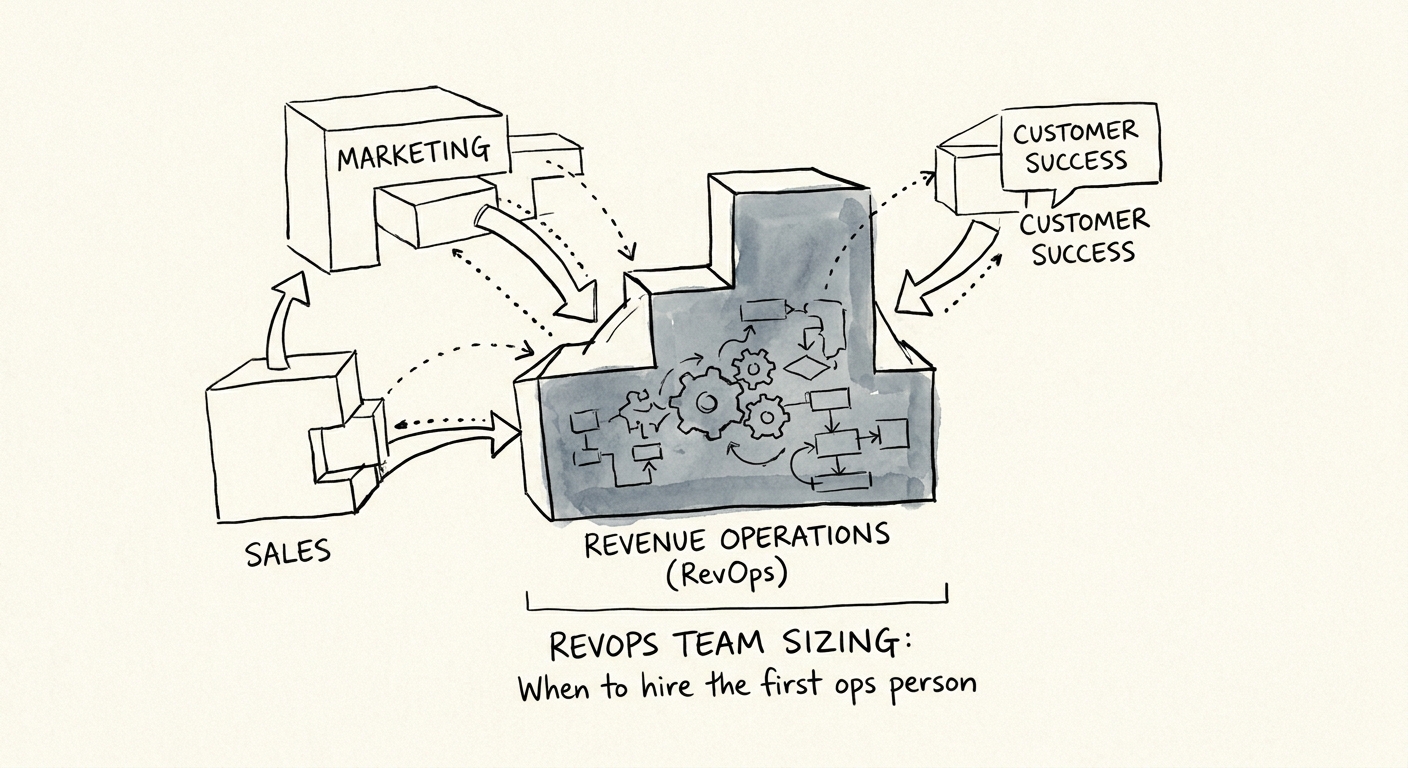
I've stood up this function three separate times for mid-market software companies, and the breaking point lands in roughly the same place every time: around the eighth quota-carrying rep. Not because eight is magic, but because of what eight implies. Two or three reps can hold the whole go-to-market motion in their heads and settle disputes over coffee. By the time you have eight, you've also got SDRs arguing over lead routing, AEs discounting to hit number, and a CS team inheriting accounts that were sold on promises nobody wrote down. The coordination cost crosses the line where one person can no longer keep it coherent.
You can feel the inflection before you can measure it. Two reps both work the same inbound account and find out in the deal review. A renewal blindsides everyone because the close-won notes never made it to CS. The same lead source shows up as "marketing" on one dashboard and "rep-sourced" on another. None of these are catastrophes on their own. Stacked together, they're the sound of an engine running without an operator.
The instinctive fix -- hire more reps to close the gap to plan -- is the move that quietly burns the most cash. Forrester's analysis found that companies running aligned revenue operations grow about 19% faster and run more profitably than those operating in silos. The lever isn't lead volume; it's conversion efficiency across the whole funnel. Bolting more reps onto a leaky motion doesn't add throughput -- it multiplies the leaks and drags your CAC up with it. You're scaling the chaos, then wondering why the chaos got more expensive.
One warning, because it's the most common shortcut and it backfires every time: don't solve this by promoting your sharpest SDR into a "sales ops" seat and calling it done. That's a real role, but it's a narrower one -- it optimizes the sales team's mechanics. The function you actually need spans the entire commercial arc, from the first marketing touch to the third-year renewal, and it has to own the definitions that make all three departments tell the same story. If you scope the job as sales-team plumbing, you'll write a junior job description and under-hire by a full level. Our breakdown of why Revenue Operations and Sales Operations are not the same role is worth ten minutes before you post anything.
The hire that decides whether the hire works
When you finally move, the fatal mistake is hiring a tool administrator and expecting a strategist. You are not filling a CRM-config seat. You're hiring someone who can take a board-level revenue target and reverse-engineer it into funnel math -- and then walk into a room and tell your VP of Sales that their pipeline-coverage assumptions are arithmetically impossible. That second part is the whole job.
Which is exactly why the reporting line matters more than the resume. If your first ops hire reports into the VP of Sales, you've structurally neutered them on day one -- you've asked them to audit the data of the person who controls their review. They cannot tell that person the coverage math is fiction if that person signs their comp. The function reports to the CRO, the CFO, or you. Get the org chart wrong and the seniority of the hire stops mattering, because they no longer have standing to say the uncomfortable thing.
Their first real win usually pays for the salary outright, and it's hiding in your tool sprawl. Alexander Group's benchmarks put the average B2B go-to-market stack at around 14 distinct tools -- each one quietly becoming its own version of the truth. Your enablement platform doesn't reconcile with your CRM; your billing system disagrees with your CS software. A competent operator walks in, kills the redundant licenses, and consolidates the stack into something that actually agrees with itself. Often that line-item alone covers the headcount cost.
Hold them to three deliverables in the first 90 days, in this order. One: a single shared data model -- one definition each of a qualified lead, a pipeline stage, and a closed-won deal, that marketing, sales, and CS all use. Two: rewritten rules of engagement and lead routing so two reps stop working the same logo. Three: one dashboard, locked, that everyone trusts well enough to argue strategy from instead of arguing about whose numbers are right. If you want the full build sequence past those 90 days, our RevOps implementation timeline from chaos to 90% forecast accuracy maps it out. Monday's move is small: get your CMO and VP of Sales to write down, independently, what counts as a Stage 3 deal. When the two answers don't match, you've found your trigger -- and your job description.