
The practical answer
- Short answer
- Adding HIPAA-sensitive healthcare workflows to SaaS requires more than a checklist. See the engineering, vendor, logging, and M&A diligence costs founders need to plan for.
- Best fit
- Industry: Healthcare SaaS. Function: Engineering & Security
- Operating path
- Compliance & Security → Turnaround & Restructuring → Turnaround & Restructuring Services
- Key metric
- 6 figures HIPAA-sensitive SaaS readiness can move into six figures once legal, security, cloud, and engineering work are included.
Adding HIPAA-sensitive healthcare workflows to a B2B SaaS platform is not a small legal checklist. It is an engineering, security, vendor-management, and operating-model commitment. Founders are often attracted to healthcare because the budgets are large and retention can be strong, but they underestimate what changes when the product may store, process, or transmit electronic protected health information (ePHI).
The core issue is architecture. HIPAA's Security Rule requires regulated entities and business associates to protect the confidentiality, integrity, and availability of ePHI through administrative, physical, and technical safeguards. For a SaaS company, that means access controls, audit controls, transmission security, risk analysis, incident response, vendor governance, and documentation need to be designed into the operating model rather than bolted on after the first healthcare customer signs.
The first-year cost is highly variable. Legal counsel, security tooling, penetration testing, logging infrastructure, sub-processor review, and engineering time can easily move into six figures for a mid-market SaaS platform. The exact number depends on data architecture, multi-tenant isolation, current SOC 2 maturity, cloud environment, and whether the product already supports role-based access and durable audit trails.
Healthcare revenue only deserves a premium when the product architecture, data flows, vendor controls, and operating procedures can survive diligence.
The Engineering Work Behind HIPAA Readiness
Technical founders sometimes reduce HIPAA readiness to encryption at rest and TLS in transit. Those are baseline controls, not the whole program. The real engineering work sits in identity and access management, audit logging, role design, data retention, backup and recovery, incident response, and Business Associate Agreement (BAA) management across sub-processors.
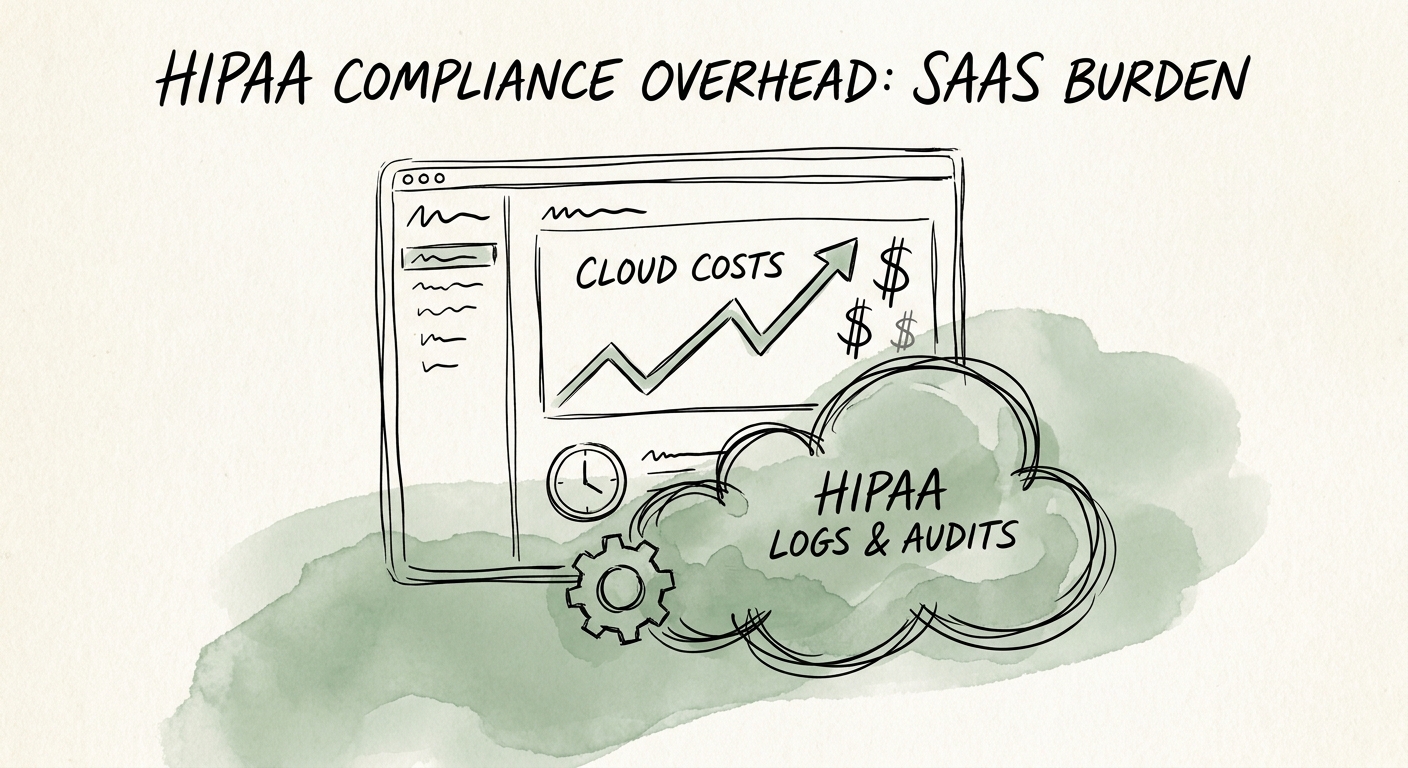
When you ingest ePHI, you need to know who accessed the data, when they accessed it, what system action occurred, and whether the access pattern was appropriate. That requires reliable application events, tamper-resistant logs, alerting, retention policies, and a support process that does not expose sensitive data unnecessarily. Those controls affect product design and cloud cost.
You also cannot rely on AWS, Azure, or Google Cloud to solve the problem by default. The shared-responsibility model means the cloud provider may offer HIPAA-eligible services, but the configuration, monitoring, data flow, and incident response remain your responsibility. Every API endpoint, analytics pipeline, AI feature, and support workflow that touches ePHI needs review.
The M&A Reality: Valuing the Compliance Deficit
Private equity buyers and strategic acquirers look closely at healthcare compliance claims during technical diligence. A missing BAA with a key vendor, weak access logging, unclear data-flow documentation, or an immature risk-analysis process is not just an administrative issue. It can become a remediation cost, a customer-risk issue, or a reason for valuation pressure.
When acquirers find a deficit, they estimate the remediation cost and timeline. If the platform requires a major refactor to isolate ePHI, strengthen access controls, or rebuild audit logging, the buyer will underwrite that cost into the deal. This is why healthcare ARR does not automatically deserve a premium. The architecture supporting that revenue has to be credible.
If healthcare is part of the growth plan, ring-fence the ePHI environment early, document data flows, formalize BAA review, and build the HIPAA control model into the product roadmap. Compliance should not be a side project for DevOps; it should be a product and engineering requirement that protects customer trust and equity value.