
The practical answer
- Short answer
- The 2026 SaaS cyber premium curve bends sharply at $10M ARR. Real benchmarks by revenue band, why deal models miss by ~40%, and how to bend the renewal back down.
- Best fit
- Industry: B2B SaaS. Function: Risk Management & Security
- Operating path
- Compliance & Security → Turnaround & Restructuring → Turnaround & Restructuring Services
- Key metric
- $125k-$250k The standard 2026 premium range for SaaS companies between $10M and $50M ARR seeking $5M-$10M in limits.
The line item that quietly resets your valuation
Open enough SaaS data rooms and you start reading the cyber insurance binder before the P&L. It tells you more. A founder who is paying $200,000 for a $5M limit at $20M ARR has already told the buyer everything about how the platform was built — the underwriter ran the diligence the seller never bothered to do, and the price tag is the verdict. The deal model, meanwhile, still carries a tidy five-figure placeholder for "insurance," because that is what cyber cost the last time anyone updated the template. The gap between that placeholder and the real number is not a rounding error anymore. It comes straight out of EBITDA, which means it comes straight out of enterprise value at the multiple.
Here is why the placeholder is so wrong: the market bifurcated. A clean penetration test and a completed questionnaire used to buy you a cheap premium. They do not now. Carriers split SaaS into two pools — companies that can prove their controls run continuously, and everyone else — and the pricing between those pools is not close.
The premium curve, by ARR band
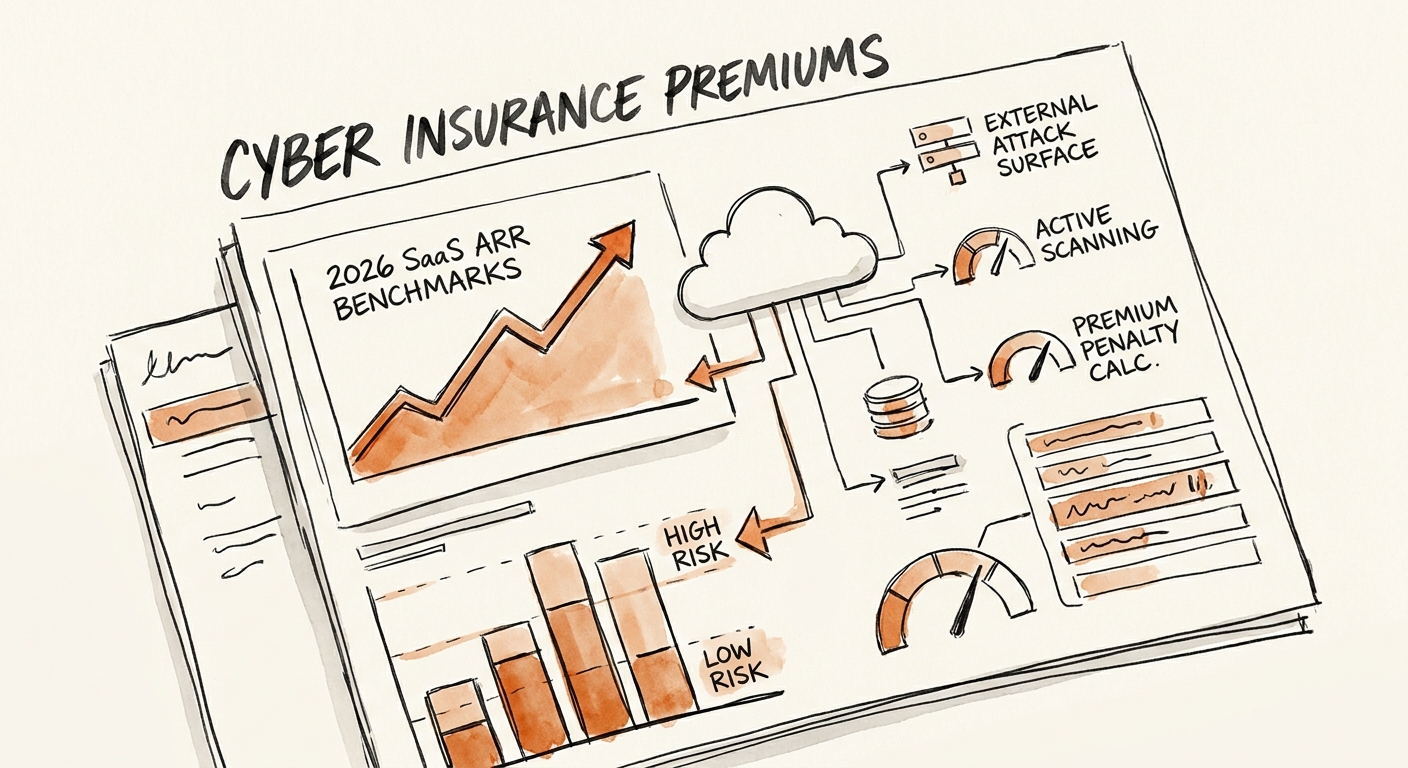
The shape of the curve matters more than any single figure, because it bends hard at one specific revenue point. Below roughly $10M ARR, a bare $2M limit settles in the high five figures on a clean posture; the moment the application touches meaningful PII or PHI, that floor climbs by half again. Then the middle market arrives and the math breaks. Between $10M and $50M ARR, $5M to $10M of coverage routinely runs six figures and well into the low-to-mid six figures — not because these companies are reckless, but because they are caught in the worst possible spot: the attack surface has exploded through API integrations and third-party vendors, while the internal security team is still two overloaded people and a backlog. Aon's Cyber Insurance Market Dynamics report tracks exactly this tiering, flagging the sharpest year-over-year premium increases for mid-market software vendors that can't demonstrate continuous threat exposure management.
Two numbers move in lockstep with the premium and matter just as much. Retentions — the deductible you eat before coverage kicks in — have ratcheted up across the mid-market, so you are simultaneously paying more and self-insuring more of the first dollar of any loss. And capacity tightens: the same band of companies that pays the most for a $5M limit often can't buy a $15M one from a single carrier at all. That is not a budget line. That is a structural feature of how SaaS gets underwritten in 2026, and it is the part deal models never anticipate.
A bloated cyber premium is the most honest line in the data room. A buyer reads $200K on a $5M limit and knows your architecture is a liability before they ever talk to your CTO.
Why "we passed our audit" no longer moves the price
Picture a $40M ARR vertical SaaS heading into renewal. The incumbent broker comes back with a quote that makes the CFO stop scrolling, and the founders' instinct is to wave the SOC 2 report and the last clean pentest. It changes nothing, because the underwriter never asked. They ran an external scan of the company's own attack surface first — exposed remote-access ports, an expired certificate on a forgotten subdomain, a service still running an unpatched known vulnerability — and they had that picture before the broker dialed in. When the controls a company self-attests don't match what the scanner sees from the outside, the premium reflects the gap, not the paperwork.
This is the single most expensive misconception in mid-market SaaS security: treating compliance as an annual event rather than a state you can prove at any moment. An annual audit is a photograph. Underwriters now price off the live feed. That is why SOC 2 spend is best read not as an audit cost but as an insurance offset — continuous control monitoring wired into your cloud environment is the thing that closes the gap between attested and observed, and it shows up directly in the renewal.
Data concentration: the limit you can't buy
The other lever underwriters pull is data concentration. They model the blast radius of a single compromised IAM role across your AWS or Azure footprint — if one over-privileged credential can reach the entire customer dataset, your worst case is the whole book of business, and they price for the whole book. The Marsh Global Insurance Market Index shows insurers trimming maximum capacity for exactly this profile: high concentration without strict logical segmentation.
Walk through what that does to a $75M ARR platform that needs a $15M limit. No single carrier will write it, so the broker stacks three $5M layers across three carriers, and every layer above the primary carries its own markup — the all-in cost climbs comfortably into the mid-six figures a year. You are effectively pre-funding the carrier's worst-case payout, the incident that kills the deal, out of your own operating cash. The only exit from the stack is architecture: segment the environment so a single compromise can't move laterally to everything, and the primary carrier will extend a higher limit on its own rather than forcing you to assemble a syndicate.
How to bend the renewal back down before you go to market
When we prep a portfolio SaaS for exit, the cyber binder is a Day 1 file, because a sophisticated buyer reads it as a proxy for everything they can't yet see in the code. The good news is that the same scan-driven, evidence-based underwriting that punishes a sloppy posture rewards a clean one quickly — these controls are checkable, so the discount is real and it lands at renewal, not in three years.
Start with the controls underwriters now treat as table stakes rather than upgrades. Multi-factor authentication is the floor, not the differentiator — carriers want phishing-resistant MFA, FIDO2 or hardware keys, on every privileged and administrative login. They want managed detection and response at full endpoint coverage, and "full" means full: a deployment sitting at 94% reads as a fail and drops you into the high-risk pool, because the gap is exactly where an attacker lands. And they read your incident response retainer — a containment commitment measured in hours, not days, is increasingly the difference between a clean quote and a surcharge.
Map to the federal baseline and stop negotiating subjectively
The move that takes the most leverage away from the underwriter is aligning your architecture to the CISA Cybersecurity Performance Goals. Modern risk models calibrate against the CPGs, so when you can show your controls map to them line by line, you replace a subjective back-and-forth with a checklist the carrier already trusts — and you set the terms instead of reacting to them.
Say a 30-to-50-person SaaS at $20M ARR runs this playbook six months before going to market: a hard security posture assessment, identity gaps remediated, data stores actually segmented, patching automated rather than scheduled-and-skipped. That work routinely takes a meaningful double-digit slice off the premium at renewal — savings that drop straight to EBITDA and get capitalized at your exit multiple. The premium was never just an insurance cost. It was the underwriter taxing operational debt, and the buyer was going to find that same debt anyway. Fix it on your timeline, not theirs.