
The practical answer
- Short answer
- The $50k SOC 2 Type II budget ignores 420 engineering hours and a 6-month observation window you can't cram for. Here's the real 2026 cost and timeline math.
- Best fit
- Industry: B2B SaaS. Function: Operations & Engineering
- Operating path
- Compliance & Security → Turnaround & Restructuring → Turnaround & Restructuring Services
- Key metric
- 65% Percentage of total SOC 2 cost driven by internal engineering labor
The line item that wasn't on the quote
Picture a 60-person B2B SaaS company at $28M ARR. The CFO signs a $32,000 auditor engagement letter, a $18,000 annual Drata contract, and writes "$50k — SOC 2" on the board deck. Eleven months later the real number lands somewhere north of $120,000, and nobody can point to a single padded invoice. That's the trap: the overrun isn't in the line items you can see. It's in the two senior engineers who spent six weeks rebuilding IAM, segmenting production, and back-filling change-management evidence instead of shipping the integration three design partners were waiting on.
I've stood up this function inside five portfolio companies, and the misread is identical every time. The CEO files SOC 2 under "IT spend," when it's actually a tax levied directly on R&D velocity. The EY 2026 Technology Risk Study puts internal labor and engineering reallocation at 65% of total compliance spend for mid-market software companies. Read that again: the auditor and the platform — the two costs founders actually budget for — are the minority of the bill. The majority is your most expensive people writing access-review procedures and documenting why a pull request got merged.
The timeline gets distorted the same way. Automation vendors sell "SOC 2 in two weeks," which is true the way "lose 20 pounds in two weeks" is true — it describes the easy part and hides the part that actually takes time. You can automate evidence collection. You cannot automate the four months it takes to fix the controls the evidence is supposed to prove. Gartner's 2025 SaaS Security Compliance Report found 73% of mid-market SaaS companies miss their initial six-month timeline by an average of 4.2 months. The auditor is almost never the bottleneck. The roadmap is.
Type II isn't an audit you pass. It's six months of your own logs testifying for or against you — and the worst exceptions are the ones you create in month two and forget about by signing day.
Type II is the test you can't cram for
Here's the distinction every Type I survivor underestimates. Type I asks: were your controls designed correctly on one specific day? You can stage that. Type II asks: did those controls actually operate, continuously, across a window of three to twelve months? You cannot stage six months. The observation period is a recording, and it captures everything — including the things you wish it hadn't.
Concretely: if a developer ships a hotfix at 2 a.m. in month two and bypasses the code-review gate, that bypass is a control exception. It doesn't get erased because you fixed the process in month four. It gets written into the final report as a finding, and a buyer's diligence team reads it line by line. I watched a roughly $100M exit slip three quarters because the target couldn't show clean offboarding evidence — terminated employees whose access wasn't revoked inside their own SLA, logged in their own system, during their own window. There was no fixing it after the fact. The window had already closed.
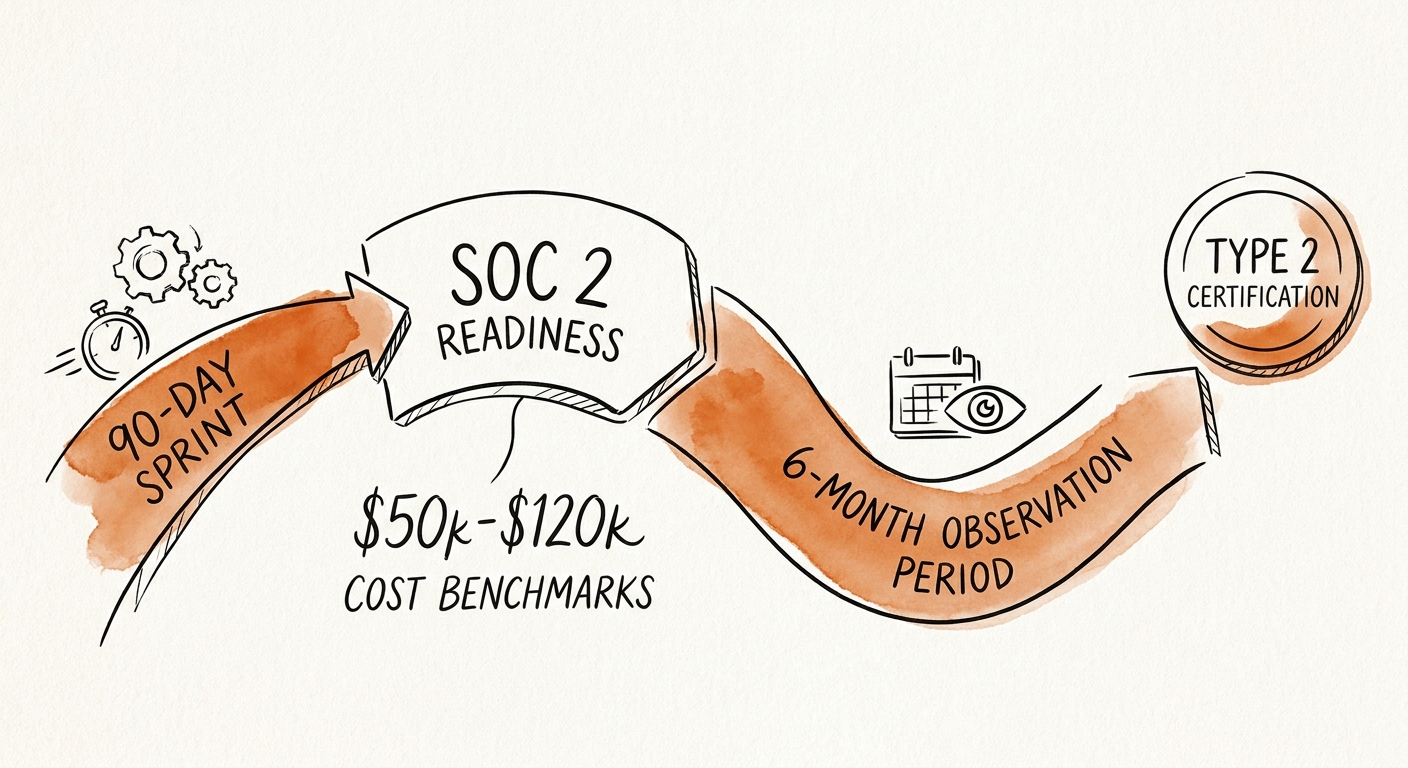
So the work has to be sequenced, not parallelized. Phase one is readiness and remediation: 60 to 90 days of unglamorous infrastructure work before the clock even starts. The Deloitte 2026 Cyber Risk Economics Report pegs baseline readiness at roughly 420 dedicated engineering hours for a $20M-ARR company — call it two engineers for a month, full stop, not "around their other work." Shortcut this and you don't save time; you start a six-month observation window on top of broken controls and guarantee a report full of exceptions. Run that phase as a real sprint with an owner and a burndown — the approach in our SOC 2 Certification Timeline: The 90-Day Sprint to 'Audit Ready' framework — and the observation window starts clean. Then it's just a matter of not breaking your own controls for six months, which is harder than it sounds. The KPMG 2025 M&A Due Diligence Survey reports 41% of enterprise software deals slip 90 days or more specifically on incomplete Type II observation periods. The math is brutal and unforgiving: if you want a clean Type II in hand for a 2027 raise or exit, your remediation has to be done and your window open right now.
Build the $120k budget your board won't have to renegotiate
Stop presenting a single SOC 2 number. Present four, because that's how the money actually behaves. Compliance platform (Vanta, Drata, Secureframe): $15k–$25k a year — the part everyone budgets. External CPA firm for the Type II opinion: $25k–$45k. Third, a manual penetration test, not an automated scan — sophisticated acquirers reject the cheap scans on sight, which is the whole reason we wrote The $35,000 Vulnerability Scan: Why Your Penetration Test Will Fail PE Due Diligence — so add $15k–$30k. Sum the visible costs and you're already past $50k before a single engineer touches a keyboard.
The fourth pillar is where the $50k budgets actually die: internal remediation and ongoing maintenance. Enforcing MFA across every system, walling off production from dev, standing up identity governance, and then keeping all of it operating cleanly through the window — scaling companies routinely burn $50k+ in engineering time on this alone. It's also where the long-game payoff hides. PwC's 2026 Cloud Compliance Cost Benchmark shows continuous-monitoring shops cut recurring audit cost 31% year over year versus teams chasing evidence in spreadsheets. You pay the remediation tax once; you pay the spreadsheet tax forever.
Here's what you do Monday. Open a four-pillar budget — platform, auditor, pen test, internal remediation — and force a dollar figure into the fourth line before you commit to a window start date. Then name one owner for the readiness sprint, not a committee. If the headcount and infra complexity math doesn't pencil yet, work it against our breakdown on What Does SOC 2 Compliance Actually Cost? A Breakdown by Company Size before the board asks. A clean Type II isn't a checkbox you buy — it's the credential that closes the enterprise deals and erases the "compliance discount" a buyer would otherwise carve out of your valuation. Budget for the real number, run the sprint, open the window now.