
The practical answer
- Short answer
- Discover the true cost of GDPR and CCPA non-compliance in 2026. Learn why private equity buyers apply a 15% valuation haircut for privacy architecture failures.
- Best fit
- Industry: B2B SaaS & Technology. Function: Information Security & Compliance
- Operating path
- Compliance & Security → Turnaround & Restructuring → Turnaround & Restructuring Services
- Key metric
- $3.42B Total US state privacy fines levied in 2025, an unprecedented acceleration in regulatory enforcement.
The End of the Awareness Era: Enforcement by the Billions
The true cost of GDPR and CCPA non-compliance in 2026 is not just the headline-grabbing regulatory fine. It is the buyer concern that appears when a data room reveals an indefensible privacy architecture. Regulators have shifted from market education toward enforcement, and the financial ramifications for scaling technology companies are material.
In diligence, missing data maps, weak consent records, and unclear vendor processing flows create immediate questions about remediation cost and indemnity exposure. Technical founders often optimize for feature velocity and defer privacy debt until the moment a buyer audits the data supply chain. By then, the leverage is gone.
The pace of regulatory penalties has weakened the argument that compliance can wait for the next funding round. According to Gartner's 2026 analysis on U.S. state privacy fines, regulators levied an unprecedented $3.425 billion in penalties during 2025 alone—a figure larger than the previous five years combined. This is a highly coordinated, multi-state enforcement machine designed to target mid-market software companies.
Across the Atlantic, the enforcement tempo is equally aggressive. Data from DLA Piper's 2026 GDPR Fines and Data Breach Survey reveals that European authorities are now receiving hundreds of breach notifications per day, driving €1.2 billion in fines over the past year. When your systems lack the telemetry to identify a breach within the 72-hour window, you are creating regulatory exposure before you have the facts organized.
If your organization cannot prove where its data lives and who has access to it, privacy debt becomes an operating and diligence risk.
The Compounding Cost of the Modern Data Breach
A compliance failure rarely exists in a vacuum; it is often a precursor to a serious data breach. When a company fails to enforce strict data minimization protocols or implement robust access controls, the blast radius of any security incident expands exponentially. The financial damage of these events has reached unprecedented levels, particularly for North American organizations in highly regulated sectors.
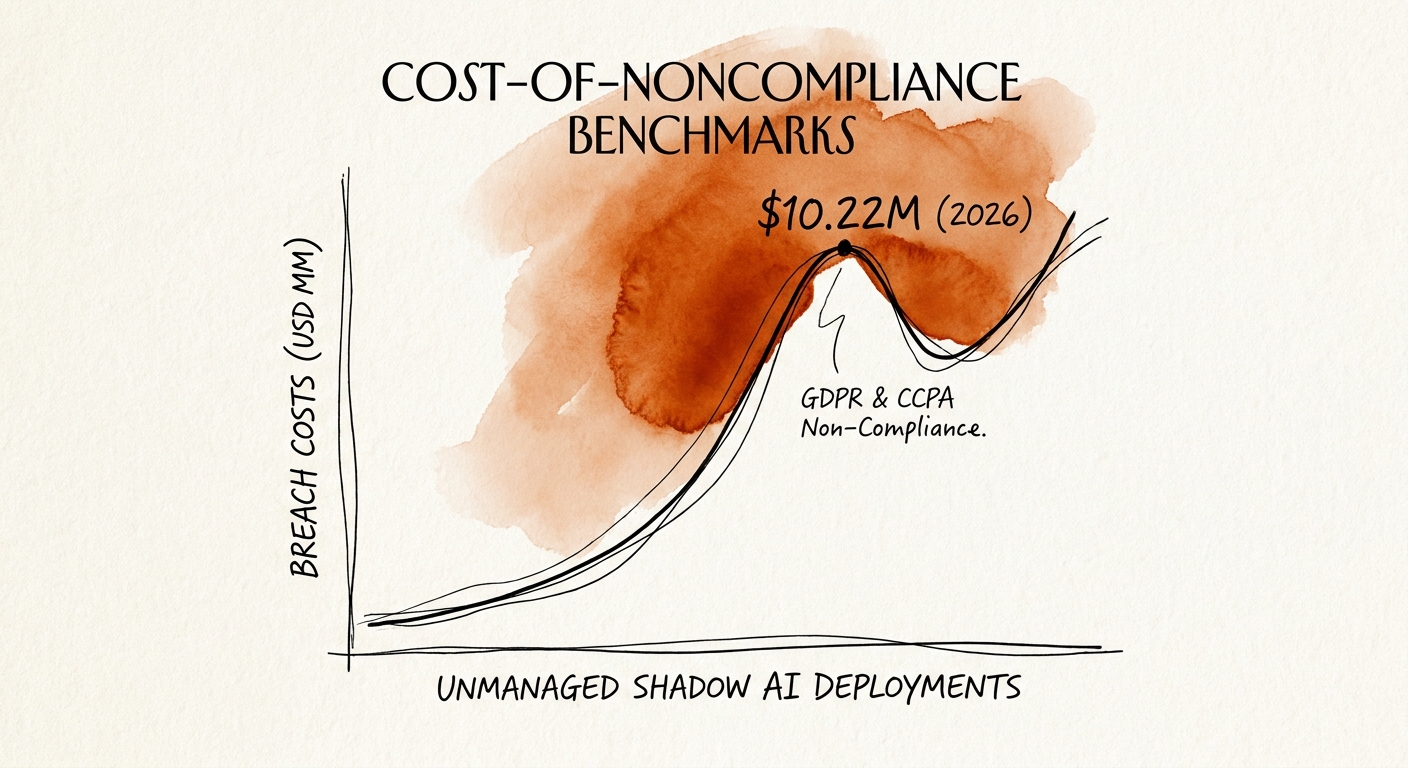
Recent empirical data underscores this escalating threat. According to IBM's 2025 Cost of a Data Breach Report, the average cost of a breach in the United States hit a record $10.22 million, fueled by higher regulatory fines and the cost of detection. While global breach costs saw a slight dip due to automated security tools, U.S. companies still face major exposure when foundational data governance is weak.
This governance deficit is being rapidly exacerbated by the uncontrolled adoption of artificial intelligence. Teams are routinely deploying generative AI features without updating their privacy impact assessments or mapping how personally identifiable information (PII) flows into large language models. The exact same IBM 2025 analysis on AI-related security breaches found that a shocking 97% of AI-related breaches occurred in organizations that lacked proper AI access controls. Shadow AI can spread sensitive data into systems that were never reviewed for privacy, security, or retention obligations.
Sophisticated buyers in 2026 know exactly how to spot this dynamic. They know that a lack of CCPA or GDPR compliance is not merely an administrative oversight; it is an indicator of fragile engineering culture. This is precisely why acquirers rely on a rigorous Security Posture Assessment to quantify these exact risks in dollar terms before even considering signing a letter of intent.
Translating Compliance Debt into Valuation Reality
For C-suite operators, the most immediate danger of privacy non-compliance isn't necessarily a random audit from a state attorney general. The real, acute danger is the private equity due diligence gauntlet. When an institutional buyer discovers that your $20M ARR business cannot reliably execute a Data Subject Access Request (DSAR) or demonstrate defensible consent architecture, the deal mechanics can move against the seller.
We see this quantified as compliance debt." Savvy acquirers will calculate the engineering cost to remediate your technical infrastructure, factor in the potential regulatory exposure, and subtract a risk premium from your enterprise value. As detailed in Kiteworks' 2026 Data Privacy Enforcement Trends, with cumulative GDPR fines officially surpassing €7.1 billion and enforcement expanding well beyond Big Tech into routine B2B operations, buyers simply will not absorb this systemic risk. They will structure the deal with specific indemnities, escrow holdbacks, or pre-close remediation asks.
The Compliance Discount outlines how these operational gaps can be used during negotiations. The days of treating privacy compliance as a tedious checkbox exercise for the legal team are officially over. In 2026, defensible data mapping and rigorous AI governance are non-negotiable components of your revenue engine.
If your organization cannot definitively prove where its data lives and who has access to it, you are not operating a diligence-ready enterprise. Fixing this requires pulling privacy out of the legal silo and embedding it directly into agile engineering sprints. The M&A market demands turnkey compliance, and companies that fail to deliver it will pay the ultimate price at exit.