
The practical answer
- Short answer
- SOC 2 or ISO 27001 first? The answer is in your pipeline map, not your security backlog. Justin Leader on sequencing the badge to where your revenue lives.
- Best fit
- Industry: B2B SaaS & Enterprise Software. Function: Information Security & Compliance
- Operating path
- Compliance & Security → Turnaround & Restructuring → Turnaround & Restructuring Services
- Key metric
- 18% Valuation haircut during due diligence for compliance misalignment
The badge wasn't the problem. The geography was.
A fintech I worked with had a spotless SOC 2 Type II report and a sales team that kept losing European deals at the security-review stage. Three opportunities, all into EMEA enterprise buyers, all stuck. The executive team assumed a clean American attestation traveled — that "we're SOC 2" was a universal trust signal. It isn't. A European procurement officer running a vendor-risk intake doesn't have a column for SOC 2; their template asks for an ISO 27001 certificate number. No certificate, no checkbox, no progress. The deals didn't die in a meeting. They quietly stalled for the better part of a year while an internal champion ran out of political capital and the buyer drifted toward a vendor whose badge fit the form.
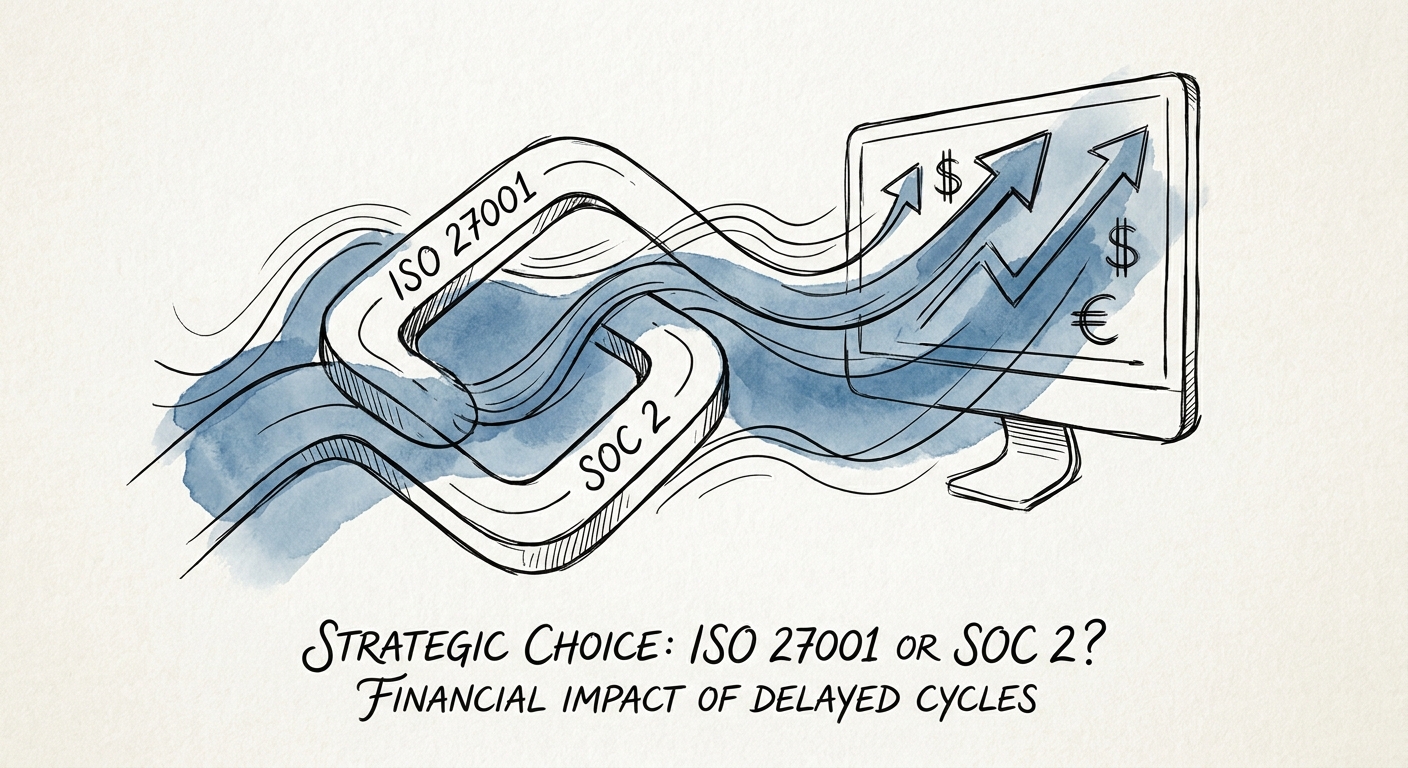
That's the whole game, and most founders miss it because they treat SOC 2 versus ISO 27001 as a security-architecture question. It isn't. The underlying controls overlap heavily. The decision is about which document unblocks the procurement form your specific buyers are filling out. North American enterprise buyers — and the PE firms diligencing your company — speak SOC 2. Buyers in Europe, the Middle East, and large swaths of Asia-Pacific speak ISO 27001, often by regulatory reflex rather than preference. Your buyer will not rewrite their vendor-risk protocol to accommodate the framework you happened to pursue. The badge has to be live on your trust page before the RFP goes out, not promised "in a few months" once a deal is already wobbling.
So the work isn't choosing the "better" standard. It's mapping your compliance roadmap onto your actual revenue pipeline — by deal, by region, by who's signing the security questionnaire. That mapping is also what turns compliance from an engineering cost center into something your sales team can lead with. We've written before about making compliance a sales-enablement asset rather than a tax; step one is knowing which badge your next ten qualified buyers will actually accept.
Your buyer's procurement team will never change their vendor-risk checklist to match your security backlog. Pick the badge their checklist already demands.
Attestation vs. certification: why the words on the page change the cost
The terminology gap is where the budget surprises hide. SOC 2 is an attestation — an auditor's report describing how your controls operated against the AICPA's Trust Services Criteria across an observation window, usually six to twelve months. ISO 27001 is a certification — a registrar's stamp confirming you run a functioning Information Security Management System, the ISMS, that identifies and manages risk on a continuous cycle. One documents what your systems did. The other certifies that you operate a governance machine designed to catch and correct failures on its own.
That distinction explains why the second framework costs more even with the same controls underneath. As a rough planning anchor for a roughly 150-person SaaS company, a baseline SOC 2 Type II runs in the range of $115K in year one once you stack readiness work, penetration testing, automation tooling, and the audit itself. ISO 27001 lands meaningfully higher — call it $145K — and not because the technical bar is higher. It's the governance scaffolding: a standing internal-audit function, formal management reviews, documented risk-assessment cycles. Per ISO's own guidance, the ISMS has to be operational and internally audited before the external registrar shows up. You're not buying a report; you're buying proof that an operating rhythm exists. That rhythm consumes executive attention, which is the cost line founders never put in the model.
The mechanics also land differently when a buyer's diligence team digs in. SOC 2 asks your engineers to prove specific controls — access revocation, deployment approvals — ran without exception across the period. ISO 27001 is more interested in whether your ISMS caught a lapse, logged it as a non-conformity, and closed it through a corrective-action plan. Forrester finds the overwhelming majority of enterprise procurement teams now ingest these reports through automated risk platforms, so a missing certificate field isn't a conversation — it's a silent disqualification. It's also why PE buyers obsess over the Type I versus Type II distinction in diligence: a Type II demonstrates a track record of operational discipline over time, and disciplined operations read straight through to a cleaner control environment and a stronger exit case.
Sequence it, don't stack it
The expensive mistake is chasing both at once from a standing start. Running dual-track compliance before you have the muscle for either burns engineering capacity you can't spare and drags your gross margin — which shows up in your Rule of 40 just when investors are watching it. Unless a single eight-figure buyer is explicitly funding the dual effort, sequence the work to where your pipeline actually points.
Here's the order I'd run on a Monday. If roughly 70% or more of your revenue sits in North America, start with SOC 2 Type II — the automation ecosystem is mature enough that a lean security team can hold continuous monitoring without a dedicated compliance hire. Then watch one number: projected ARR from EMEA or APAC. When it crosses about a quarter of your pipeline, trigger the ISO 27001 roadmap. The reason sequencing beats stacking is the overlap — a well-run SOC 2 control environment already satisfies the large majority of ISO's technical requirements. Map them once against a unified control set so you're not re-evidencing the same thing twice, and the ISO leg becomes mostly governance work: stand up the ISMS, name an Information Security Officer, run your first internal audit. You're formalizing what you already do, not rebuilding it.
Then comes the part nobody budgets for: keeping it alive after the report ships. The day the auditor signs off, decay starts — access reviews slip, the incident response plan ossifies into a document nobody has opened since the audit, and year two arrives with surprises. Gartner reports a substantial share of mid-market SaaS companies hit major non-conformities in their second compliance year for exactly this reason. The fix is unglamorous: wire the controls into the daily engineering workflow — deploy gates, automated access attestations, evidence collected as a byproduct of how the team already ships — so the next audit is a screenshot, not a fire drill. A framework that accelerates revenue and holds up in diligence earns its cost. A framework that's a logo on your homepage and a binder nobody reads is just an expensive plaque.