The practical answer
- Short answer
- A 35% blended sales churn rate hides two opposite diseases. Here's how to split 12-month rep turnover into voluntary vs. involuntary and read what it actually means.
- Best fit
- Industry: B2B SaaS / Technology. Function: Revenue Operations & Sales Leadership
- Operating path
- Team & Hiring → Operational Excellence → Transaction Execution Services
- Key metric
- 35% The baseline annual turnover rate for B2B sales reps in 2025/2026, creating massive hidden EBITDA leaks.
Put two B2B SaaS sales orgs side by side. Both run a 40-rep team. Both report a 35% trailing-twelve-month churn rate — right in line with the averages the HubSpot and Bridge Group sales development data have logged for years. On the board deck, they look identical. On a roster audit, they are nothing alike.
Company A lost 14 reps last year. Eleven of them quit. Company B lost 14 reps too — but the company fired eleven of them. The blended number erased the only fact that matters. One has people sprinting for the exits; the other is executing people on the way to it. You cannot fix either until you know which one you're holding.
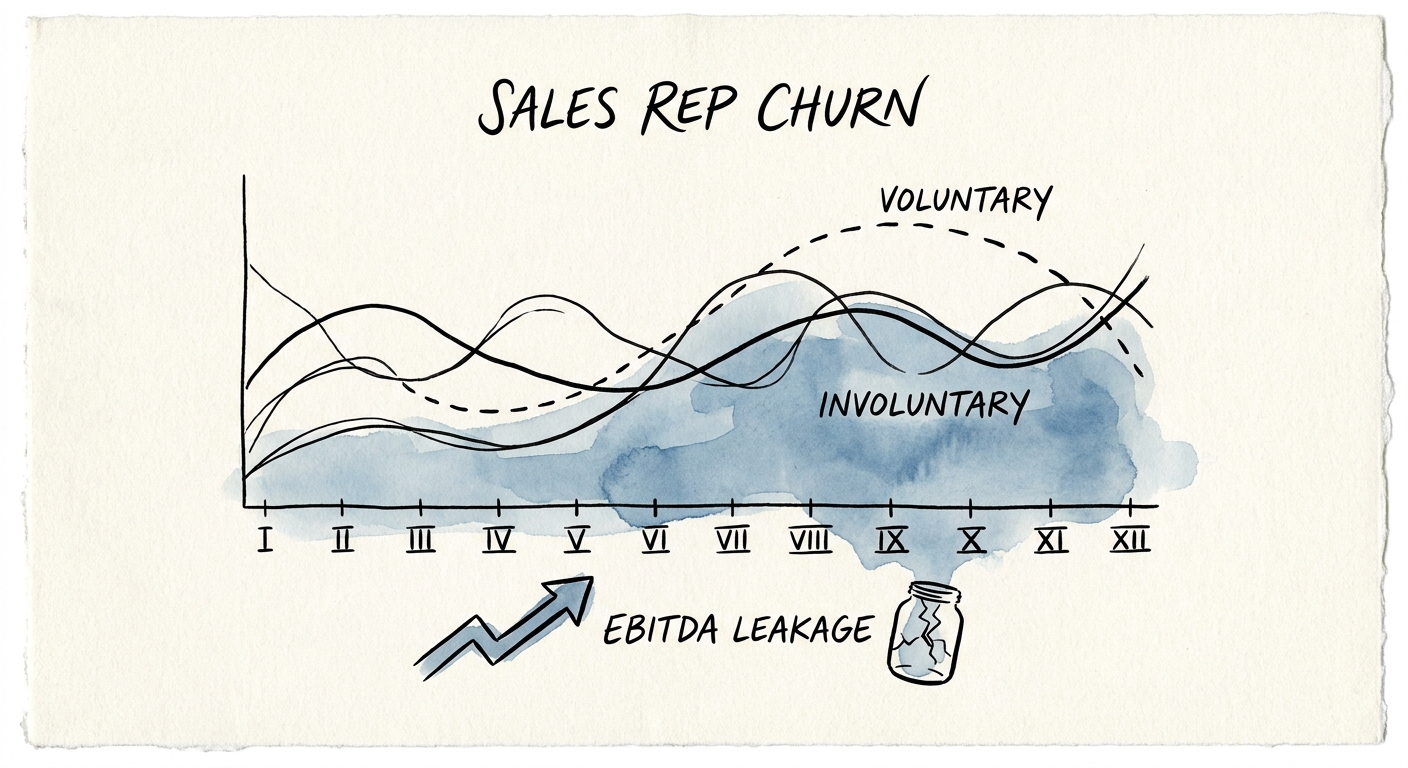
This is the first thing I do when I open a 12-month roster in diligence: I throw out the headline churn rate and rebuild it from the regret codes. Voluntary on one side — chose to walk. Involuntary on the other — was asked to leave. The split is the diagnosis. A heavily voluntary book is a compensation and enablement failure: you are losing people you'd have kept. A heavily involuntary book is a hiring and leadership failure: you are recruiting people you can't ramp. Same EBITDA leak, opposite root cause, opposite fix.
And the leak is real. By the time you fold in the recruiting fees, the months a territory sits dark, and the deals that quietly slipped because no one was working the account, replacing one mid-market rep runs into six figures fast — call it a quarter-million dollars a seat. At 35% on a 40-rep team, you're rebuilding fourteen seats a year. That's not a recruiting budget. That's a structural margin hole, and most portfolios book it as the cost of doing business instead of the engineered failure it actually is. The same blind spot shows up in VP of Sales hires that fail inside 18 months: the seat looks full, the tenure tells the truth.
A blended churn number is a clinical average that tells you the patient is sick. The voluntary-involuntary split is the diagnosis — and the two diseases get treated by opposite hands.
When the quits cluster at month six
Voluntary churn has a fingerprint, and it's the calendar. Healthy attrition is spread out — a rep at month eight, another at month nineteen, life happens. Broken attrition clusters. When I plot voluntary exits against tenure and see a spike right around the 180-day mark, I already know the story before I've talked to a single person who left.
Here's why that window is lethal. The DePaul University data Forbes cited puts the full ramp for an enterprise field rep at roughly 6.2 months. So the cluster at month six isn't reps leaving after they ramped — it's reps leaving exactly when they were supposed to start producing, and realizing they never would. The on-target earnings they signed for required a quota the comp plan never gave them a runway to hit. They do the math, see the OTE was fiction, and jump before a missing year shows up on a resume. You didn't lose closers. You ran a six-month bait-and-switch and they noticed.
The forensic move is simple and most teams skip it: overlay your voluntary-exit tenure curve on your average ramp time. If quits pile up before the ramp line, you have an expectations problem, not a talent problem. The product takes six months to sell competently; the comp plan front-loads a quota that assumes month two. Nobody set those two numbers next to each other before the offer letters went out.
Then there's the voluntary loss that actually hurts — the tenured top-quintile rep who leaves at month twenty. That one doesn't cluster, but it cascades. They take the relationships, the live pipeline, and the institutional read on which deals are real. The seat sits empty for two quarters while the territory drifts, the remaining reps absorb the orphaned accounts on top of their own number, and a single departure quietly metastasizes into three more. This is the same hidden bill as the true cost of a bad hire, except here you had a good one and let the system push them out.
When the firings mean leadership can't read its own funnel
Now flip the ledger. A heavily involuntary 12-month book — leadership aggressively managing out "underperformers" — wears the costume of high standards. It's almost never high standards. It's a company that hasn't learned to graduate from founder-led selling, hiring seasoned reps as a savior and firing them at month nine when the savior act doesn't land. The rep didn't fail. The rep walked into a company with no repeatable motion, no documented playbook, and an ideal-customer profile that lives in the founder's head, and was then blamed for not reproducing it.
The tell is in the lead source, not the rep. When reps are getting fired for "weak pipeline generation" while marketing is feeding them unqualified leads and there's no RevOps engine routing the good ones, the firing is just an expensive way to protect an executive ego. The brightest red flag I look for in a roster: three sales leaders and twenty AEs cycled through inside 24 months. That isn't a string of bad hires. That's a company manufacturing failure and charging it to the people it hires.
Breaking either cycle starts with one number per exit. For every departure in the trailing twelve months, force an honest cause code — not the comfortable "bad cultural fit," but the real one: comp ramp misaligned, lead quality, no onboarding, no playbook, genuine underperformance against a fair quota. Stop hiring for the mythical golden Rolodex; the cost of stacking headcount you can't ramp outruns the pipeline it's supposed to buy. And measure new reps on leading indicators inside the ramp window — meeting quality, territory plan, qualified pipeline built — instead of waiting for lagging revenue to tell you, six months too late, what an honest week-four scorecard already knew.
Run this Monday: pull last year's exits, tag each one voluntary or involuntary, then plot the voluntary ones against tenure and the involuntary ones against lead source. If voluntary clusters before your ramp line, fix the comp plan and the onboarding. If involuntary clusters around a broken funnel, fix RevOps and the ideal-customer definition before you fire one more person. Drive a 40-rep team from 35% blended churn toward a controlled 15% and you don't just save recruiting spend — you recover the margin straight to EBITDA. Turnover isn't an act of God. It's an engineered outcome, and the split tells you exactly which lever built it.