
The practical answer
- Short answer
- For SAP Concur and Ariba partners, specialization alone isn't enough. Learn the valuation multiples, M&A trends, and strategic pivots that turn a 6x implementation shop into a 12x strategic asset.
- Best fit
- Industry: IT Services & Consulting. Function: M&A Strategy
- Operating path
- Exit Readiness → Operational Excellence → Transaction Advisory Services
- Key metric
- 10.1x Median EBITDA multiple paid by Private Equity buyers in 2025, significantly higher than the 8.6x paid by corporate acquirers.
The Great Valuation Bifurcation: Commodity Implementers vs. Strategic Assets
If you are running a $15M to $25M SAP Concur or Ariba practice, you are likely sitting in the most dangerous zone of the services ecosystem: The Generalist Trap disguised as Specialization.
For years, the playbook was simple: Pick a module (Spend Management), get certified, and ride the SAP ecosystem wave. But the 2025 M&A data tells a brutal story. While top-quartile IT consulting firms are trading at a median 13.0x EBITDA, the bottom quartile—traditional time-and-materials implementation shops—are struggling to break 6.5x.
Why the 2x spread? Because Private Equity (PE) and strategic acquirers like Accenture have stopped buying "capacity" and started buying "capability."
The "Clean Core" Valuation Impact
SAP’s aggressive push for the "Clean Core" (standardized S/4HANA Public Cloud) has eviscerated the valuation of firms that rely on heavy customization. If your revenue model depends on long-tail custom code maintenance, your acquirer views that as Technical Debt, not recurring revenue. In due diligence, we are seeing acquirers apply a 20-30% discount to EBITDA generated from legacy customization work.
Conversely, partners who have built proprietary IP accelerators—pre-packaged integrations, industry-specific AI models, or automated compliance workflows—are commanding the premium. When Accenture acquired Camelot Management Consultants, they didn't just buy bodies; they bought a supply chain platform mentality. To command a 10x+ multiple, you must demonstrate that your revenue is decoupled from headcount growth.
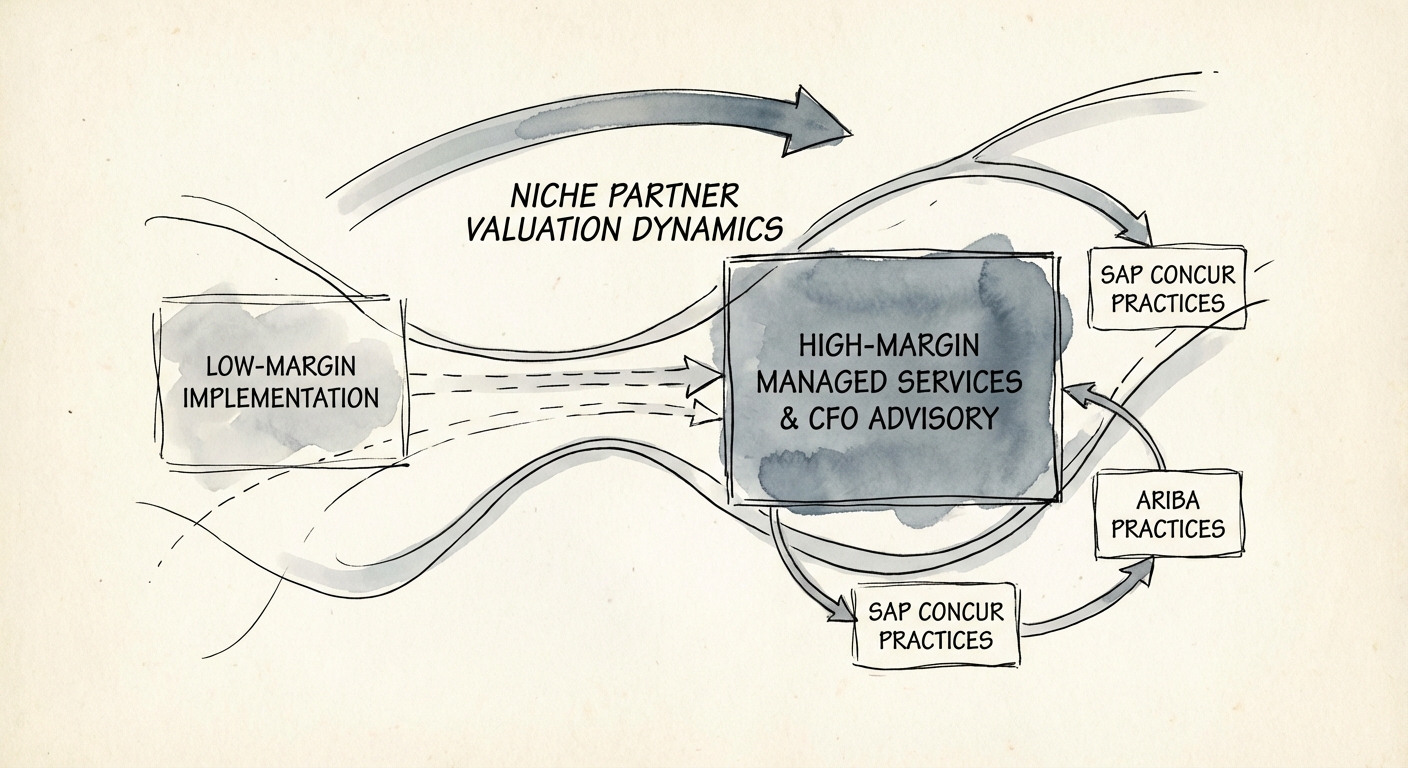
Technology implementation is a commodity; Financial Transformation is a strategic asset. The partners commanding 13x multiples aren't selling 'configuration'—they're selling cash flow optimization.
The "Office of the CFO" Pivot: Moving Upstream
The single biggest lever to double your exit multiple isn't technical—it's positional. founders often market themselves as "The Best Ariba Implementers." This is a mistake. Technology implementation is a commodity; Financial Transformation is a strategic asset.
The highest-value transactions in 2025 involved partners who positioned themselves as owners of the Office of the CFO. Instead of selling "Ariba configuration," they sold "Spend Visibility" and "Cash Flow Optimization."
The Metrics That Matter to PE Buyers
When a PE firm like Thoma Bravo or Vista looks at a niche SAP partner, they ignore your "Gold Partner" badge and look at three specific metrics:
- Services Gross Margin: If you are below 45%, you are a staffing firm. Top-tier specialized consultancies operate at 55-60% by using lower-cost delivery centers for the heavy lifting while high-bill-rate architects own the client relationship.
- Revenue Concentration: If your top client is more than 15% of revenue, or your top referral source (e.g., SAP direct sales) is more than 30%, your multiple collapses. You don't own your destiny; SAP does.
- IP Attach Rate: What percentage of your projects use your proprietary IP? If it's under 20%, you have no leverage.
We advised a client recently who shifted their positioning from "Concur Implementation" to "T&E Compliance & Fraud Prevention." They built a simple proprietary dashboard that sat on top of Concur data. That tiny piece of IP didn't generate massive ARR, but it shifted the conversation from $175/hour rates to value-based pricing, pushing their blended gross margins to 52%. Their exit valuation increased by $8M.
Surviving the Consolidation Wave
The market is consolidating. In 2024 alone, Accenture completed over 30 acquisitions, aggressively rolling up niche players to feed its managed services engine. For a founder-led firm, this creates a binary outcome: Be the Platform or Be the Bolt-On.
If you are doing $10M-$20M in revenue, you are too small to be a platform for a large PE fund, but you are the perfect size for a strategic "tuck-in." The danger here is the "Earnout Trap." Strategic buyers love to lock founders into 3-year earnouts based on aggressive growth targets that you have no control over once integrated.
Your Defensive Playbook
To secure a cash-at-close deal (the "21-Cent Dollar" principle), you must present a "plug-and-play" operational engine. This means:
- Documented GTM: You need a sales engine that generates leads independent of the SAP ecosystem. If SAP creates 90% of your pipeline, you are buying a job, not selling a company.
- Second-Layer Management: If you (the Founder) are the only one who can close the big deals or calm the angry CIO, your business is unsellable. PE firms pay a premium for "management redundancy."
- Recurring Revenue Wrapper: You likely won't have true SaaS revenue, but "Managed Application Services" (MAS) contracts—multi-year support deals—should make up at least 30% of your revenue mix. This proves stickiness beyond the initial go-live.
You are fluent in SAP. Now you must become fluent in EBITDA. The gap between a 6x and a 12x exit isn't better code; it's better business architecture.