
The practical answer
- Short answer
- ServiceNow Elite Partner status is a commodity, not a differentiator. Here is the due diligence framework to assess true delivery capability, talent density, and exit value.
- Best fit
- Industry: IT Services / Private Equity. Function: M&A Due Diligence
- Operating path
- Team & Hiring → Operational Excellence → Transaction Execution Services
- Key metric
- 40% YoY increase in demand for ServiceNow technical roles (Architects/Devs) vs. functional roles.
The "Elite" Badge is a Commodity, Not a Differentiator
In 2025, buying a ServiceNow partner based on their "Elite" or "Global Elite" status is like buying a car because it has four wheels. It is the minimum requirement to be on the road, not a signal of performance. With over 2,200 partners in the ecosystem and a tiered system that incentivizes "badge collecting," the distinction between a high-margin strategic consultancy and a low-margin body shop has blurred.
The ServiceNow Partner Program evaluates the "4Cs": Capacity, Competency, Customer Success, and Capability. While these metrics look impressive on a CIM, they often mask operational fragility. The requirement for Elite status includes a Customer Satisfaction (CSAT) score of just 4.2 out of 5. In a services business, a 4.2 is not excellence; it is a warning sign of mediocrity. Top-tier acquirers should be looking for a Net Promoter Score (NPS) of 60+ and a CSAT consistently above 4.8 across complex implementations, not just simple ticket closures.
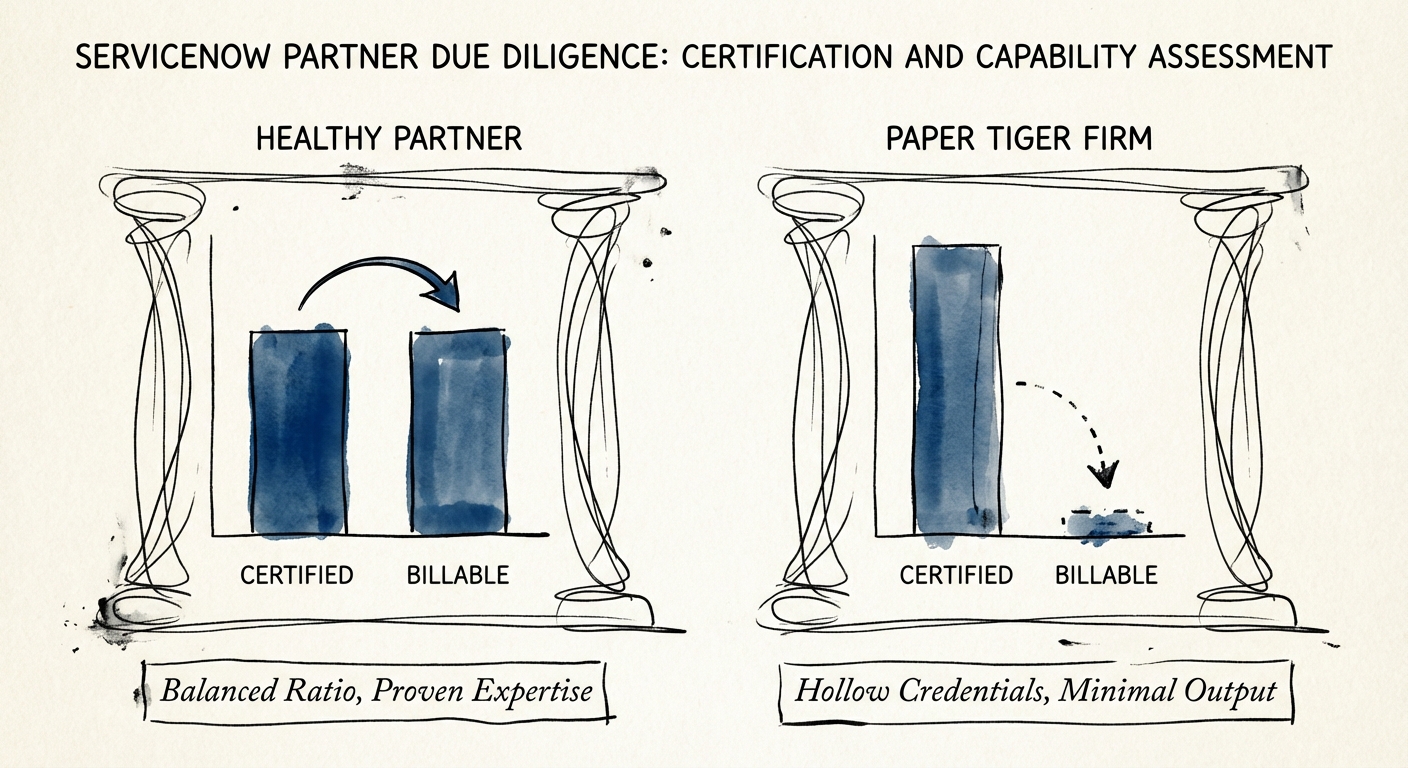
Furthermore, the "Capacity" metric—driven by the number of certified individuals—incentivizes firms to certify everyone from the receptionist to the sales rep. I have seen diligence files where 30% of the "certified workforce" had zero billable hours in the last trailing twelve months (TTM). You are not acquiring a bench; you are acquiring a certification farm. If you pay a 12x EBITDA multiple for "talent" that cannot deliver, you are effectively buying empty seats.
You don't pay premium multiples for a badge that anyone can rent. You pay for the proprietary delivery IP and the technical bench that can actually deploy it. If the 'Elite' status disappears when three people quit, you didn't buy a company; you bought a latent risk.
The Talent Audit: Architects vs. Paper Tigers
The scarcity of genuine technical talent in the ServiceNow ecosystem is the primary constraint on growth. Demand for technical roles—Architects, Developers, and Engineers—surged by over 40% in 2024, significantly outpacing functional roles. This supply-demand imbalance has created a dangerous phenomenon: the "Paper Tiger" Architect.
A Paper Tiger is a senior resource on paper—boasting 10+ certifications, including the coveted Certified Technical Architect (CTA) or Certified Master Architect (CMA)—who lacks the hands-on capability to lead a complex digital transformation. In due diligence, you must go beyond the resume. We recommend a Technical Capability Audit that tests for:
- Recency of Delivery: When was the last time this "Lead Architect" committed code or configured a workflow in a production instance? If it is longer than 6 months, they are management, not delivery.
- Certification Stacking: Beware of employees who gained 5+ certifications in a single quarter. This indicates "cramming" for partner status requirements rather than organic skill acquisition.
- The Key Person Dependency: In many sub-$50M revenue partners, the entire technical delivery standard rests on 2-3 individuals. If those key employees leave post-close—often triggering a 33% attrition cliff—the firm's ability to deliver high-margin projects evaporates.
The "Certified-to-Billable" Ratio
Calculate the ratio of active certifications held by billable delivery staff versus total certifications claimed in the CIM. A healthy ratio is above 85%. Anything below 70% suggests the firm is inflating its competency score with non-delivery overhead, a clear sign of certification inflation that will not survive the first board meeting.
The Margin Killer: Utilization & Delivery Models
Ultimately, the valuation of a ServiceNow partner comes down to its delivery model. Are you buying a high-leverage consultancy or a low-leverage staffing firm? The multiple arbitrage between the two is massive—often the difference between 6x and 12x EBITDA.
The critical metric here is Effective Utilization. For a specialized ServiceNow partner, blended utilization across the delivery organization should sit between 72% and 78%.
- > 85% Utilization: The team is burning out. You are acquiring a retention bomb. Expect immediate churn post-close.
- < 65% Utilization: The firm is bloated, or worse, they are benching expensive talent because they cannot sell complex work. This is a "body shop" in disguise, relying on low-margin staff augmentation to keep lights on.
Look specifically at the Project Margin vs. Rate Card delta. High-quality partners maintain project margins of 50%+ by using high-leverage teams (one expensive Architect guiding four mid-level Developers). Low-quality partners have project margins of 30% because they throw senior bodies at junior problems. If you don't validate the delivery pyramid in diligence, you will spend the first 18 months of your hold period trying to fix utilization leakage instead of growing the business.