service pillar 2

Operational Scalability

The operating infrastructure that makes PE buyers pay premium multiples.

Every PE firm has the same nightmare.

They acquire a promising tech company, and within six months they discover the founder IS the company. The org chart shows 80 employees. The reality is one person making every decision, approving every hire, and personally delivering to the top 10 clients.

We've been that founder. And we've been the operators who fix it.

Operational Scalability isn't about adding headcount or buying software. It's about building the systems, processes, and infrastructure that let a company run without its founder—and scale without breaking. This is what PE buyers pay premium multiples for. This guide shows you how to build it.

What "Exit-Ready" Actually Means

When PE firms evaluate a technology company, they're not just buying revenue. They're buying a machine that can operate without its current owners. Exit-ready means:

Documented Processes
- Every critical workflow exists outside someone's head. Onboarding, delivery, escalation, QA—all documented, all repeatable, all trainable.
- If your best employee quits tomorrow, the company doesn't skip a beat.
- How do you build pricing power instead of discounting to win?
Scalable Hiring
- How do you move from founder-led sales to a repeatable GTM motion?
- What's the right sales methodology, coverage model, and capacity plan?
- How do you align marketing, sales, and customer success into one commercial engine?
Clean Financials
- Do your CAC and LTV actually support your growth ambitions?
- Are you building EBITDA margin or buying growth at any cost?
- Can you survive without the next fundraise?
Founder Extraction
- Does your board see the numbers that matter—or vanity metrics?
- Can you forecast accurately enough to make confident hiring decisions?
- Is your commercial data clean enough to survive due diligence?

Most founders think they can build this in the 6 months before a sale. They can't. Exit-ready operations take 18-24 months to build properly. Start now, or accept a lower multiple later.

Service Offerings

We've worked inside dozens of tech companies in the $5M-$50M range. The patterns are consistent. Every commercial breakdown we've seen falls into one of five failure modes:

The Five Scalability Failure Modes

The Heroic Founder

The founder is still the best salesperson. Win rates drop 40%+ when they're not on the call. Pricing decisions escalate to their desk. The company can't grow faster than the founder's calendar.
Related Intelligence Reports:
Learn more
$500M+ in value delivered
$18M+ relationships rescued
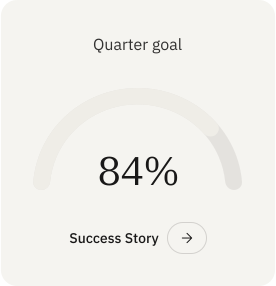
Dashboard-style card showing “Quarter goal” progress at 84% with a link labeled “Success Story.”
Tribal Knowledge
Critical processes exist only in people's heads. When someone leaves, the knowledge leaves with them. Training new employees takes months because nothing is written down. Every departure is a crisis.
Related Intelligence Reports:
Learn more
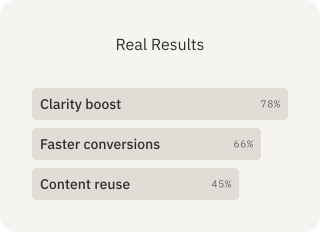
Dashboard card titled “Real Results” showing three progress bars for Clarity boost 78%, Faster conversions 66%, and Content reuse 45%.
4x revenue growth achieved
30-day project unblocking
Hiring Roulette
Every hire is a gamble. No structured interview process. No objective evaluation criteria. The founder "goes with their gut." Result: 30%+ mis-hire rate. Each bad hire costs $45K+ in direct costs plus 6 months of lost productivity.
Related Intelligence Reports:
Learn more
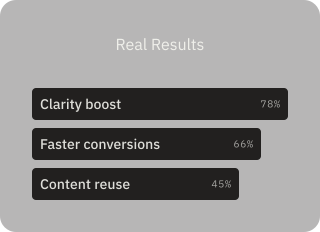
Dashboard card titled “Real Results” showing three progress bars for Clarity boost 78%, Faster conversions 66%, and Content reuse 45%.
4x revenue growth achieved
30-day project unblocking
Financial Fog
The books technically balance, but nobody trusts them. Revenue recognition is creative. Expense categorization is inconsistent. Unit economics are calculated differently each quarter. Due diligence will be a nightmare.
Related Intelligence Reports:
Learn more
Dashboard card titled “Real Results” showing three progress bars for Clarity boost 78%, Faster conversions 66%, and Content reuse 45%.
4x revenue growth achieved
30-day project unblocking
Customer Concentration
Three clients represent 60% of revenue. One of them has the founder's cell phone. The relationships are personal, not institutional. If the founder leaves, the clients might follow. PE hates this
Related Intelligence Reports:
Learn more
Dashboard card titled “Real Results” showing three progress bars for Clarity boost 78%, Faster conversions 66%, and Content reuse 45%.Portrait of a woman with curly hair looking thoughtfully at the camera.
4x revenue growth achieved
30-day project unblocking

The diagnostic question: Which failure mode is costing you the most? Most companies we work with have two or three active simultaneously.

Operator-led execution

The Scalability Assessment (Week 1-2)

Request a Turnaround Assessment
Team having a discussion around a meeting table in an office.
Engagement phases
Diagnostic Assessment
Cursor icon showing a hand pointer
Turnaround Plan
Implementation
Value Capture
Founder Time Audit
Where does the founder actually spend their time? (Not where they think they spend it—we time-study it.) Which activities could be delegated? Which require founder judgment? What's the path to <10 hours/week of founder involvement?
People walking through a bright hallway with wooden floor and neutral decor.
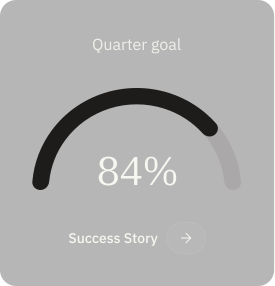
Card displaying “Quarter goal” progress at 84% with a blurred background and link labeled “Success Story.”
Process Inventory
What processes exist? (Really exist, in documentation—not just in someone's head.) What's the gap between documented and actual? What's the cost of that gap in onboarding time, error rates, and rework?
Close-up of hands typing on a laptop at a wooden desk.
Card titled “Real Results” showing progress bars for Clarity boost 78%, Faster conversions 66%, and Content reuse 45% over a blurred laptop background.
Hiring Forensics
What's your actual mis-hire rate? (Track it—most companies don't.) What's the cost per bad hire? What's missing from your hiring process that's causing failures?

The output: A founder extraction roadmap. What needs to be delegated, in what order, with what systems in place. Timeline to exit-ready operations.

The Four Pillars of Operational Scalability

Fix these in order. Each builds on the one before.

Pillar 1: Process Documentation
You can't delegate what isn't documented. Start with the highest-value processes: client delivery, sales handoffs, financial close. Don't write 50-page manuals—create decision trees and checklists that people actually use. Video walkthroughs work better than text. Update monthly.
Pillar 2: Scalable Hiring
Build an interview process that works without the founder. Structured interviews with consistent questions. Evaluation rubrics that multiple people can apply. Work samples or trial projects when possible. Reference checks that actually reveal signal. We got to 92% hiring accuracy—you can too.
Pillar 3: Financial Infrastructure
Pillar 4: Founder Extraction
Systematically remove the founder from daily operations. Start with the activities that don't require founder judgment—just founder habit. Move to activities that require judgment but can be trained. End with activities that truly require founder involvement (usually: key client relationships and strategic decisions). Track founder hours weekly.

"We retained 95% of our customers and 100% of our staff through the acquisition. The operational infrastructure Justin's team built meant the transition was seamless—the acquirer was buying a machine, not a founder."

Center for Excellence Director
Enterprise Hardware Manufacturer

The Scalability Health Dashboard

Metric
Healthy Range
Warning Sign
Founder Hours/Week
<20
40+
Process Documentation Coverage
80%+
<50%
Hiring Accuracy (12-month)
85%+
<70%
Average Discount
Below 10%
Above 20%
CAC Payback
12-18 months
18-24 months
Gross Margin
70%+ (SaaS)
Below 65%
Net Revenue Retention
110%+
Below 100%

The Metrics that Matter

Track these metrics weekly. Not monthly—weekly. By the time a monthly metric shows a problem, you've lost 30 days of correction time.

Leading vs. Lagging

The mistake most companies make: obsessing over lagging indicators (revenue closed, logos acquired) while ignoring leading indicators (pipeline created, stage conversion rates, activity volume).

By the time revenue misses, it's too late. The deal was lost 90 days ago when you didn't have enough pipeline, or when Stage 2 conversion dropped, or when activity slipped. Fix the leading indicators and the lagging indicators follow.

Benchmarks by Stage

$5-20M ARR (Series A-B):

  • CAC Payback: 12-18 months
  • LTV/CAC: 3:1 minimum
  • Net Revenue Retention: 100%+
  • Magic Number: 0.75-1.0

$20-50M ARR (Series B-C):

  • CAC Payback: 15-24 months (can extend with proven retention)
  • LTV/CAC: 3:1 minimum
  • Net Revenue Retention: 110%+
  • Magic Number: 0.5-1.0 (efficiency matters more)

$50M+ ARR (Growth Stage):

  • CAC Payback: 18-30 months (justified by scale)
  • LTV/CAC: 3:1 minimum
  • Net Revenue Retention: 115%+
  • Rule of 40: Combined growth rate + EBITDA margin ≥ 40%
measure what matters

When clarity compounds, everything improves

110%+
Net Revenue Retention Target
3:1
LTV/CAC Minimum
85%+
Forecast Accuracy Standard
12
CAC Payback Target (months)

The 18-Month Exit-Ready Timeline

If commercial performance is broken now, here's the realistic timeline:

Team having a discussion around a meeting table in an office.
Days 1-30: Diagnose and Stabilize
• Audit 8 quarters of pipeline data
• Map actual sales process vs. documented
• Identify primary failure mode(s)
• Stop the bleeding (tighten ICP, fix broken forecasting)
People walking through a bright hallway with wooden floor and neutral decor.
Days 31-60: Install the System
• Implement stage-gate criteria
• Launch operating rhythm (weekly pipeline, monthly metrics)
• Document playbooks from top performers • Clean up data hygiene
Close-up of hands typing on a laptop at a wooden desk.
Days 61-90: Optimize and Measure
• Track conversion by stage
• Compare forecast accuracy before/after
• Adjust methodology based on data
• Begin capacity planning for scale

Ready to Fix Your Revenue Engine?

Most founders wait until they've missed three quarters to address revenue problems. By then, you've lost board credibility, team morale, and 12-18 months of growth. Get ahead of it.