
The practical answer
- Short answer
- A delayed software implementation destroys 56% of projected ROI. Learn the 14-day sprint compression strategy to rescue stalled projects and regain board trust.
- Best fit
- Industry: Technology Services. Function: Project Management
- Operating path
- Project Recovery → Turnaround & Restructuring → Transaction Execution Services
- Key metric
- 56% Reduction in predicted ROI caused by massive software project timeline delays.
Large software projects that fall behind schedule don't just lose time—they destroy value, delivering 56% less ROI than predicted while running 45% over budget. When a project sponsor tells the board, "We are six months behind schedule," they are masking the real timeline and their investors. The project is not six months behind; it is fundamentally paralyzed. The underlying architecture is broken, the governance model has collapsed, and the engineering team is caught in an endless loop of 'percent complete' updates that mask exactly zero consumable output. We see this constantly in private equity turnarounds. A portfolio company misses a crucial integration date, and the legacy PMO responds by generating a massive, updated Gantt chart. They attempt to "re-plan" the failed timeline with another monolithic six-month roadmap.
This reaction is the definition of insanity. It is exactly why the Project Management Institute reports that $122 million is wasted for every $1 billion invested due to poor project performance. You cannot plan your way out of a delivery crisis. You must execute your way out of it, and you cannot do that in massive, multi-quarter increments. The traditional PMO measures effort instead of outcomes. They track how many hours were logged, how many steering committee meetings were held, and how many story points were marked "in progress." This creates a dangerous hallucination of momentum. To actually recover a failing implementation, you have to break the delusion entirely. You must force the entire delivery organization to stop looking at the distant horizon and start looking at the ground directly in front of them. For a deeper look at recognizing these fatal patterns early, read 8 Warning Signs Your Digital Transformation Will Fail (And How to Fix It).
You cannot plan your way out of a delivery crisis. You must execute your way out of it, and you cannot do that in massive, multi-quarter increments.
In our last engagement rescuing a stalled ERP implementation, we saw this exact pattern unfolding in real time. I have rebuilt this team three times across different portfolios, and every single time, the fix was identical: we stopped talking about 'Q3 deliverables' and mandated a strict 14-day release cycle. We isolated the core technical team, stripped away all non-critical governance meetings, and demanded that something functionally complete be shipped to a staging environment in exactly fourteen days. No exceptions. No excuses. No carrying over incomplete work to the next phase.
If you let a timeline drift under the guise of "getting the foundation right," you risk entering what researchers explicitly call "black swan" territory, where 17% of large IT projects go so badly they threaten the very existence of the company. The 14-Day Timeline Rescue acts as an immediate, non-negotiable circuit breaker. It forces a complete psychological reset within the engineering, product, and delivery teams. By shrinking the delivery window to a hyper-compressed timeframe, you eliminate the padding that allows scope creep and over-engineering to thrive.
The empirical math behind this compression strategy is proven across multiple industries. You don't need a longer runway; you need a shorter, more intense sprint. Bain & Company's analysis of capital and technology projects proves that applying rigid, cross-functional Agile sprints can compress execution timelines by over 30%. When the timeline is constrained to two weeks, developers stop architecting gold-plated solutions and start writing code that solves the immediate business requirement. They stop debating hypothetical edge cases that might happen in 2028 and build the specific feature required for go-live next month. If you are struggling with a stalled delivery, I outline the exact mechanics of this reset in The Project Reset Framework: Recovering Stalled Implementations.
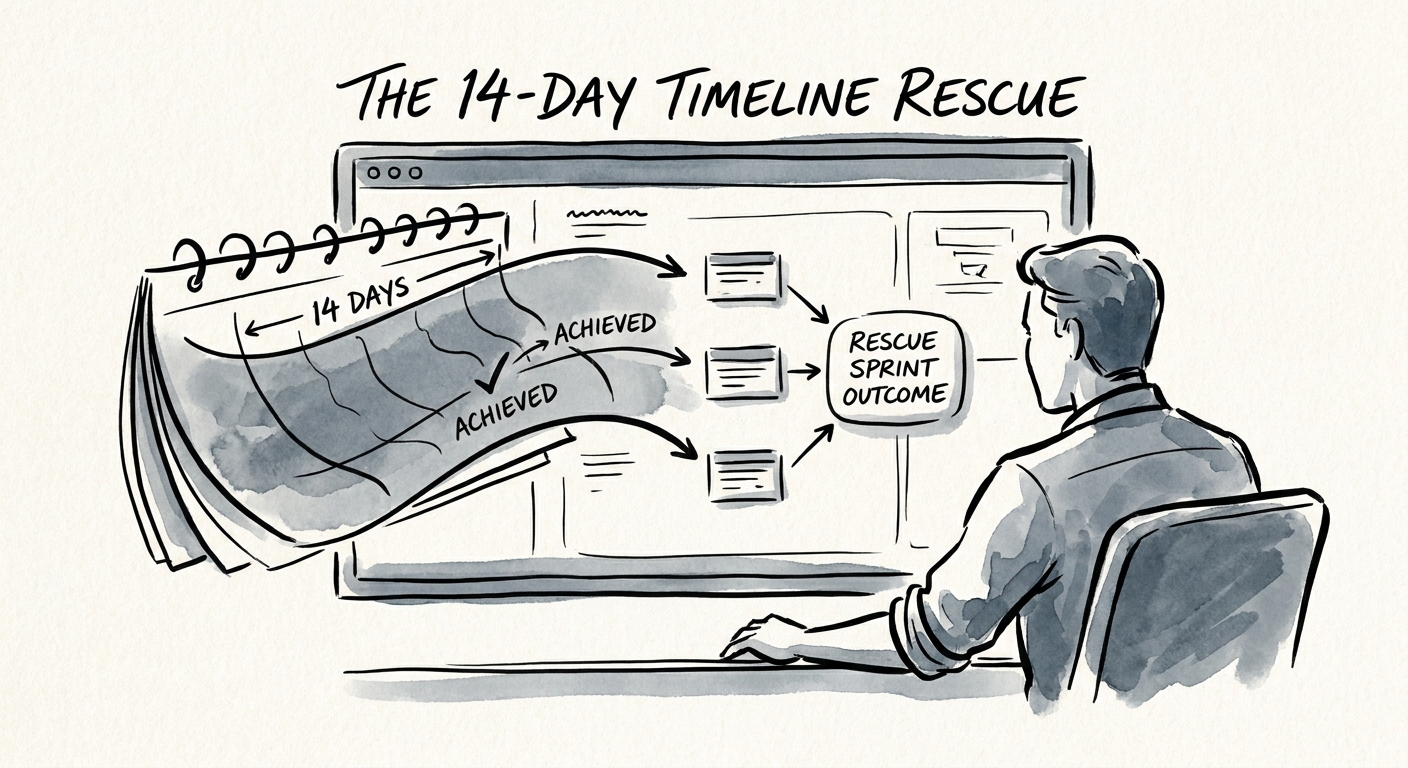
The only way to successfully execute a 14-day sprint is through disciplined, uncompromising scope reduction. If a feature or integration takes longer than 14 days to build, test, and deploy to a live environment, it is not a core requirement—it is a wishlist item, and it must be cut from the immediate sprint. This is where most founders, IT leaders, and C-Suite executives lack the necessary operational discipline. They want everything promised in the original, flawed business case, even though that original business case is currently burning millions of dollars in budget overruns with nothing to show for it.
You must force a cultural shift from activity tracking to output tracking. As Gartner's 2026 executive reporting correctly identifies, boards and leadership teams continuously struggle to realize value because project managers measure success through activity-based metrics rather than tangible financial or operational outcomes. A 14-day sprint forces absolute accountability because the output is binary: the feature is either live in the production environment, or it is not. There is no "90% complete" in a 14-day rescue sprint. There is no "code complete but pending QA." It either ships, or the sprint fails.
Rebuilding trust with your private equity sponsors and board of directors requires shipping working software, not delivering updated PowerPoint decks about "revised delivery phases." When you stand in front of your investors, you need to show them working code and operational improvements. The 14-Day Timeline Rescue guarantees that within two weeks, you will have a tangible, demonstrative win to present. It stops the cash bleed, forcefully aligns the technical team around immediate deliverables, and transforms a catastrophic six-month delay into a manageable, iterative recovery operation. For a definitive guide on communicating this strategic shift without losing your seat at the table, review How to Tell Your Board the Project Is 6 Months Behind (And Keep Your Job).