The practical answer
- Short answer
- When your portfolio company's software project blows past its budget, traditional PMO fixes won't save it. Justin Leader outlines the 5-step recovery plan to stop the bleeding and salvage EBITDA.
- Best fit
- Industry: Enterprise Software. Function: Technology Operations
- Operating path
- Project Recovery → Turnaround & Restructuring → Transaction Execution Services
- Key metric
- 52% of software projects suffer from uncontrolled scope expansion due to a fundamental lack of executive governance.
According to McKinsey's analysis of large IT project overruns, large IT projects run 45% over budget, 7% over time, and deliver 56% less value than predicted. For a private equity-backed company operating on an aggressive 36-to-48-month timeline to exit, a $2M budget overrun isn't just an isolated IT problem. It is a direct hit to EBITDA, a massive drain on free cash flow, and a significant threat to your exit multiple.
I have rebuilt this team three times and recovered dozens of red-status implementations across our portfolio, and the pattern is always the same: management waits six months too long to intervene. The board listens to comfortable assurances from the CIO that the project is "just turning the corner" or "working through some technical debt," while the burn rate accelerates and critical milestones vanish into the next sprint. The reality is that software projects don't fail overnight in a dramatic explosion. They fail one day at a time, hidden beneath layers of Agile jargon and vanity metrics.
When a project is suddenly declared to be $2M over budget, the PMO will inevitably blame shifting business requirements or unforeseen complexity. However, PMI's research on software scope creep reveals that 52% of projects suffer from uncontrolled scope expansion largely due to a fundamental lack of initial executive governance. As an Operating Partner or a pragmatic CEO, you cannot accept "the business needed more features" as an excuse for capital destruction. The root cause is a failure of leadership to lock the scope and defend the budget. In this environment, the only way out is a brutal, objective intervention.
We are not building software to win awards or fit into a Gartner Magic Quadrant feature matrix; we are building to restore EBITDA. Every remaining feature must be mathematically justified by its direct, short-term impact.
The 5-Step Budget Recovery Plan
When a software initiative breaches its budget by millions, conventional project management methodologies will not save it. You need a financial restructuring playbook designed to salvage value.
Step 1: Quarantine the Budget and Halt Feature Development
You cannot fix a leak while the water is still running. Step one is a total, mandatory freeze on all net-new feature development. Move the engineering and delivery teams entirely to bug-fixing, technical debt remediation, and architectural stabilization. If the architecture is failing to scale, you must apply the Sunk Cost Exit Framework immediately. Do not throw good money after bad simply because executive sponsors are too embarrassed to admit the initial strategy was flawed. The cash must be protected first.
Step 2: Conduct a Brutal 5-Day Audit
You must separate fact from fiction. Internal reporting in a failing project is almost always compromised by optimism bias and the "watermelon effect"—where the status looks green on the outside but is bleeding red on the inside. Bring in an external perspective to perform a 5-day operational assessment. The data shows that blind spots in executive visibility are lethal; Deloitte's tech project monitoring survey found that 33% of projects fail simply due to a lack of regular, accurate monitoring by senior leadership. You need to know exactly what is built, what is half-built, and what is merely a hallucination on a Jira board.
Step 3: Slash Scope to the "Minimum Viable Return"
In our last engagement rescuing a stalled ERP rollout for a manufacturing portfolio company, the project was $1.8M underwater. On day one of the intervention, we rigorously cut 40% of the product backlog. We are not building software to win awards or fit into a Gartner Magic Quadrant feature matrix; we are building to restore EBITDA. Every remaining feature must be mathematically justified by its direct, short-term impact on revenue generation or cost reduction. If a module doesn't move the valuation or deliver immediate ROI, it gets permanently deleted from the scope. Period.
Step 4: Audit and Restructure Vendor Contracts
In the vast majority of runaway software projects, the budget overrun is actively driven by a third-party systems integrator or development shop operating under a time-and-materials (T&M) contract. When the meter is running, vendors have zero incentive to finish. Gartner's data on vendor-related IT failures explicitly notes that 20% of enterprise projects fail because of poorly managed vendor relationships and misaligned contract structures. You must aggressively renegotiate these agreements. Transition the vendor to fixed-fee, milestone-based payments tied strictly to user acceptance testing (UAT). If they refuse to share the risk of delivery, you must be prepared to fire them and bring in a recovery specialist.
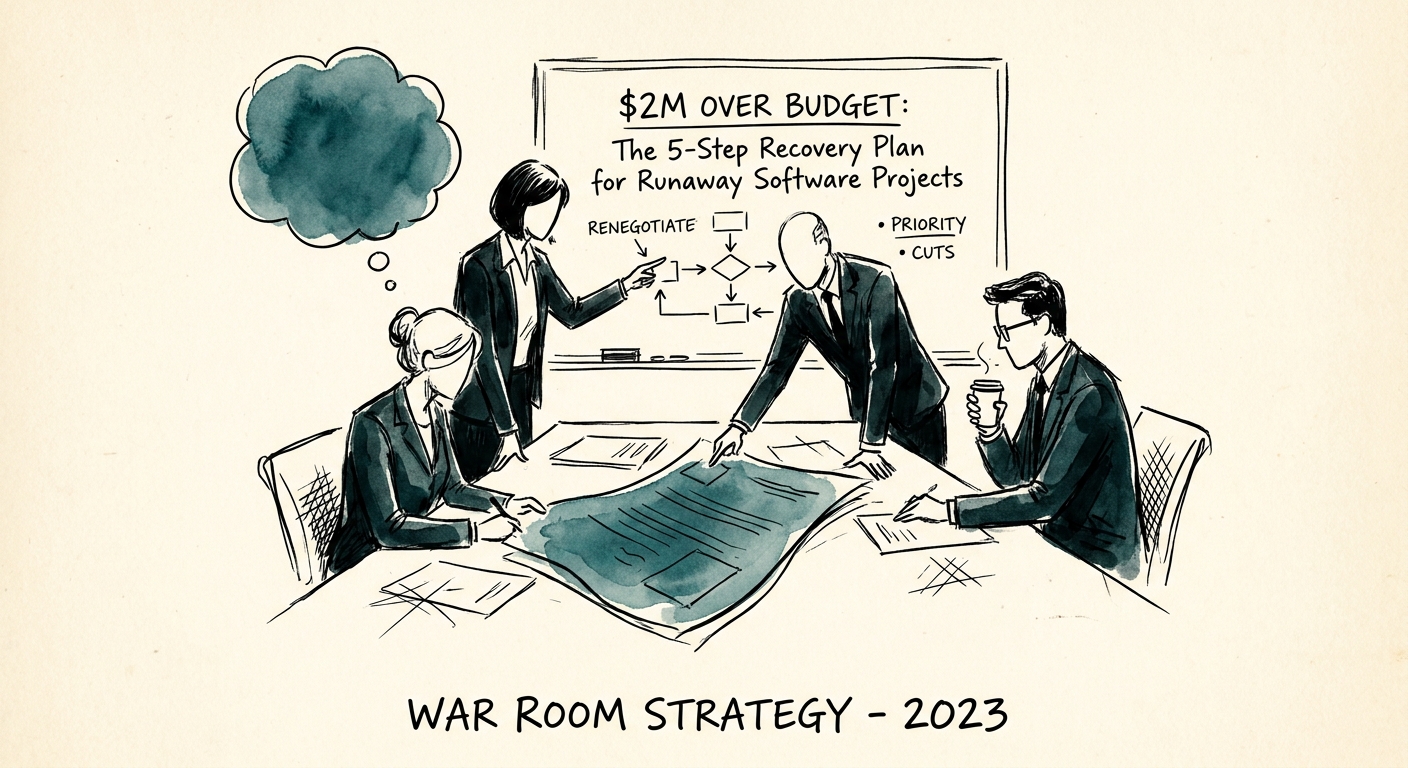
Step 5: Re-Baseline with a "War Room" Governance Cadence
The final step is establishing an aggressive governance structure that physically prevents future overruns. Replace the theatrical monthly steering committee with a weekly "War Room" cadence. Every Friday, the project lead must defend the week's spend against the actual, shipped software. Track execution against a 90% confidence re-baselined schedule, utilizing the forecast accuracy benchmarks that private equity firms demand. There is no more hiding behind "progress percentage"; software is either deployed to production, or it has zero value.
If you choose to ignore the warning signs and allow the project to drift, the consequences will be catastrophic. A landmark Harvard Business Review's study on black swan IT overruns warned that 1 in 6 IT projects experience cost overruns in excess of 200%, creating massive "black swan" events that can completely bankrupt a company's financial roadmap. For PE sponsors, recovering a runaway project isn't about saving the software; it's about protecting the exit. By executing this five-step recovery plan, you can immediately stop the financial bleeding, reset board expectations, and rebuild the operational discipline necessary to secure your premium valuation. If you do not take decisive control today, your projected exit multiple will disappear into the cloud.