
The practical answer
- Short answer
- Why 70% of Workday implementations fail to meet PE investment thesis goals. A diagnostic framework for Operating Partners to assess project risk, pricing adjustments, and timeline delays during due diligence.
- Best fit
- Industry: Private Equity. Function: Operations
- Operating path
- Project Recovery → Turnaround & Restructuring → Transaction Execution Services
- Key metric
- 189% Average cost overrun for discrete manufacturing ERP implementations (Panorama Consulting, 2025).
The "Watermelon" Project Dashboard
In 2025, Gartner reported that over 70% of ERP initiatives fail to fully meet their original business goals. For a Private Equity Operating Partner, this statistic isn't just an operational headache—it is a direct threat to your hold period and exit multiple. You acquire a platform company with a growth thesis built on scalable infrastructure, only to find that the "90% complete" Workday implementation is actually a "watermelon" project: bright green on the dashboard, but deep red on the inside.
The typical scenario is painfully consistent. The CIM (Confidential Information Memorandum) claims the digital transformation is "substantially complete" with a go-live date set for 30 days post-close. The Steering Committee decks show green lights across all workstreams. Yet, three months post-close, you are hit with a $1.2M change order, a six-month delay, and a realization that the "completed" data migration was merely a spreadsheet exercise.
Why does this happen? Because Workday—unlike legacy on-premise ERPs—requires a fundamental shift in business processes, not just a technical lift-and-shift. When portfolio companies treat it as an IT project rather than a business transformation, they fail. As an acquirer, your due diligence must pierce the veil of the System Integrator's (SI) status reports. You need to identify the technical debt accumulating in the configuration and the process debt accumulating in the workforce before you sign the check. If you don't, you aren't just buying a company; you're buying a rescue mission.
The Steering Committee deck says 'Green.' The General Ledger says 'Chaos.' In Due Diligence, the only truth is found in the error logs and the change orders.
The 5-Point Workday Risk Diagnostic
Stop reading the slide decks and start auditing the artifacts. Here are the five specific red flags that indicate a Workday implementation is off the rails, backed by benchmarks from over 50 rescues.
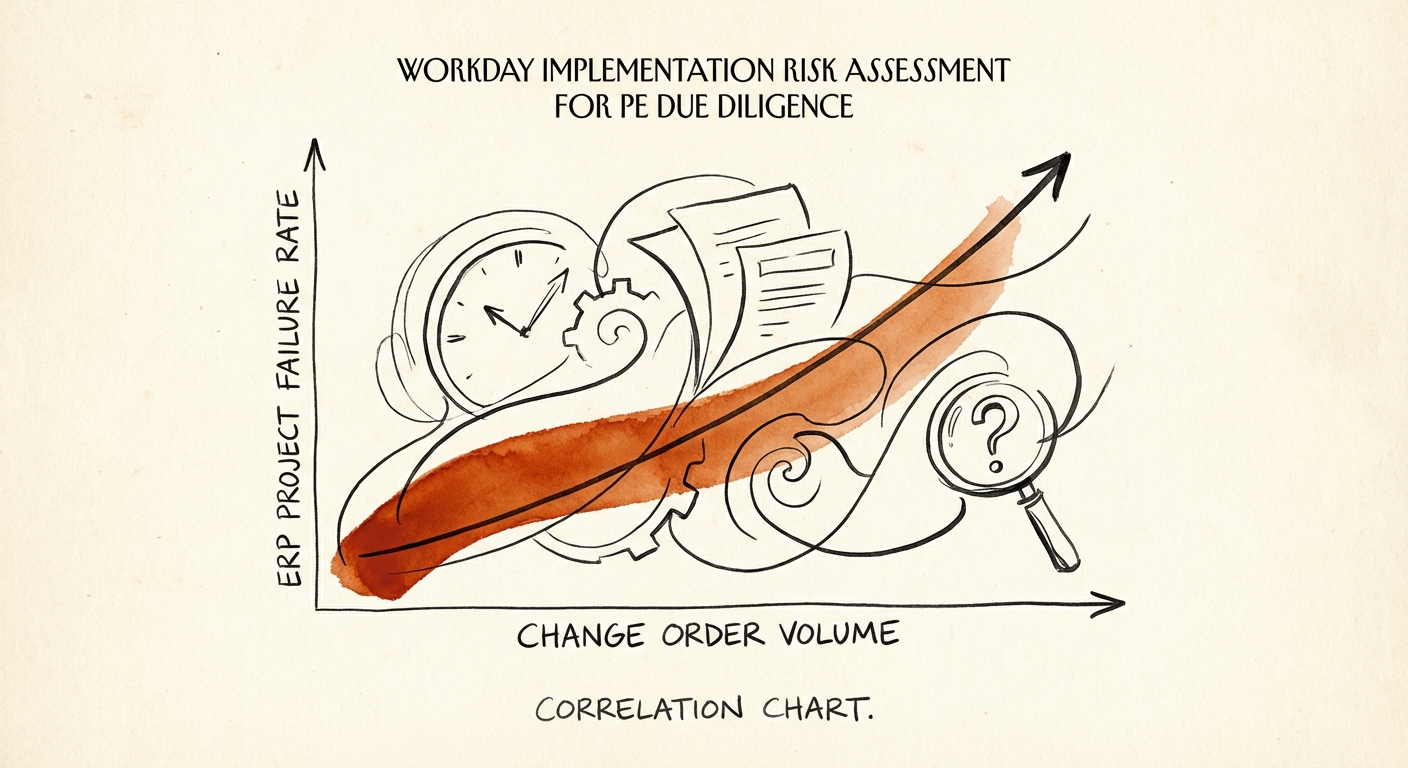
1. The Change Order Ratio > 15%
Request the full log of Change Orders (COs) against the original Statement of Work (SOW). A healthy project has a CO ratio of under 5-10% of the total contract value. If the CO ratio exceeds 15%, the scope was never defined, or the SI is using "assumptions" to profit from your portfolio company's ignorance. Metric to check: Total value of executed and pending change orders divided by original SOW value.
2. The Undefined Integration Pile
In Workday, integrations are the longest pole in the tent. Ask to see the Integration Tracker. If more than 30% of integrations are marked as "Not Started" or "Requirements Gathering" within 90 days of the planned go-live, the date is a lie. Specifically, look for the "middleware logic" status. If the team hasn't defined how data maps between Salesforce, the warehouse management system, and Workday, they aren't implementing; they're hallucinating.
3. The Data Migration "Parallel" Trap
If the Project Manager tells you data cleansing is happening "in parallel" with testing, you are in trouble. Data migration is the number one cause of stalled ERP implementations. You cannot test a system with dirty data. The Test: Ask for the error logs from the most recent "Mock Conversion." If the error rate is >5% or if they haven't run a full volume load yet, add 4 months to the timeline immediately.
4. The "Body Shop" Bait-and-Switch
Review the bios of the actual consultants logging hours this week, not the Partners who sold the deal. SIs often front-load a project with "Solution Architects" and back-fill with junior "Configuration Analysts" who have never seen a Series B scale-up before. If the lead architect has changed more than once, institutional knowledge has evaporated.
5. UAT Participation Rates < 80%
User Acceptance Testing (UAT) is the only proxy for adoption. If the "pass rate" is high but the "participation rate" is low, the project is failing. It means users are too busy to test, or they don't know how. A passing test script executed by a consultant, rather than a business user, is a false positive.
Converting Risk to Valuation Adjustments
You cannot simply "manage" this risk post-close; you must price it. A failed Workday implementation is not an OpEx problem; it is a CapEx hole that drains cash and distracts management. When you identify these red flags, you must adjust your EBITDA add-backs and working capital requirements.
First, calculate the Remediation Capex. If the project is "yellow" on our diagnostic, budget 50% of the original SOW for remediation (re-work, data cleansing, external Project Recovery leadership). If it is "red," budget 100-150%. This is the avoidable cost you avoid paying by catching it now.
Second, adjust the "Synergy" timeline. If your investment thesis relies on headcount reduction or shared services consolidation enabled by Workday, push those synergies out by 12 months. McKinsey data suggests large IT projects run 45% over budget and 7% over time. Do not build your Year 1 value creation plan on a platform that doesn't exist yet.
Finally, demand a Code Audit of the tenant. Just as you wouldn't buy a SaaS company without inspecting the codebase, do not buy a company mid-implementation without a tenant audit. We often find "hard-coded" logic in Workday integrations that will break the moment you try to scale. This is technical debt masquerading as completed milestones.
The Bottom Line: A Workday implementation is binary. It is either an accelerator that justifies a premium multiple, or an anchor that drags down your IRR. Use this diagnostic to ensure you know which one you are buying.