
The practical answer
- Short answer
- The SAP S/4HANA 2027 deadline creates a massive hidden liability for PE buyers. Here is the operator's diagnostic to assess implementation risk and protect deal value.
- Best fit
- Industry: Private Equity. Function: Technology Due Diligence
- Operating path
- Project Recovery → Turnaround & Restructuring → Transaction Execution Services
- Key metric
- 70% of ERP initiatives will fail to fully meet business goals by 2027 (Gartner)
The 2027 Deadline: A $50M Liability Hiding in the CIM
If you are reviewing a CIM for a manufacturing or distribution asset doing over $500M in revenue, you will almost certainly see a slide about their "Digital Transformation" or "Next-Gen ERP Journey." The slide will feature green checkmarks, a timeline that ends comfortably before your exit, and a budget that looks surprisingly reasonable.
You need to treat this slide as a risk register.
Here is the reality the CIM ignores: SAP has set a hard deadline for the end of mainstream maintenance for its legacy ECC 6.0 system—December 31, 2027. While extended support is available until 2030, it comes at a significant premium and requires a specific migration path.
This isn't just an IT upgrade; it is a forced march. ERP implementations fail at an alarming rate, but the S/4HANA migration is particularly brutal because of the timeline compression. According to 2025 data from Gartner, over 70% of ERP initiatives will fail to fully meet their original business goals by 2027. Even more concerning for a sponsor model, only about 28-37% of legacy ECC customers had successfully migrated by early 2025.
This creates a massive "transfer of liability" risk. If you acquire a company today that is "mid-migration" or "planning to migrate," you are not buying a platform for growth. You are buying a technical debt balloon payment that will explode during your hold period. If the migration stalls or fails, it will consume your EBITDA growth story, distract your management team for 18-24 months, and potentially force you to sell the asset at a discount because the next buyer won't want to inherit the mess.
The "Green" Dashboard Trap
In due diligence, you will often be shown a Project Management Office (PMO) dashboard. It will almost always be green (on track) or yellow (minor risks). In my experience recovering stalled projects, these dashboards are "watermelons"—green on the outside, deep red on the inside.
To evaluate the real status, you must bypass the PMO summaries and ask for the Interface Control Document (ICD) and the Data Migration Error Logs. A healthy project has specific, dwindling error rates. A failing project has undefined ownership in the interface definitions and "Plan to Fix" notes on data errors that have persisted for months.
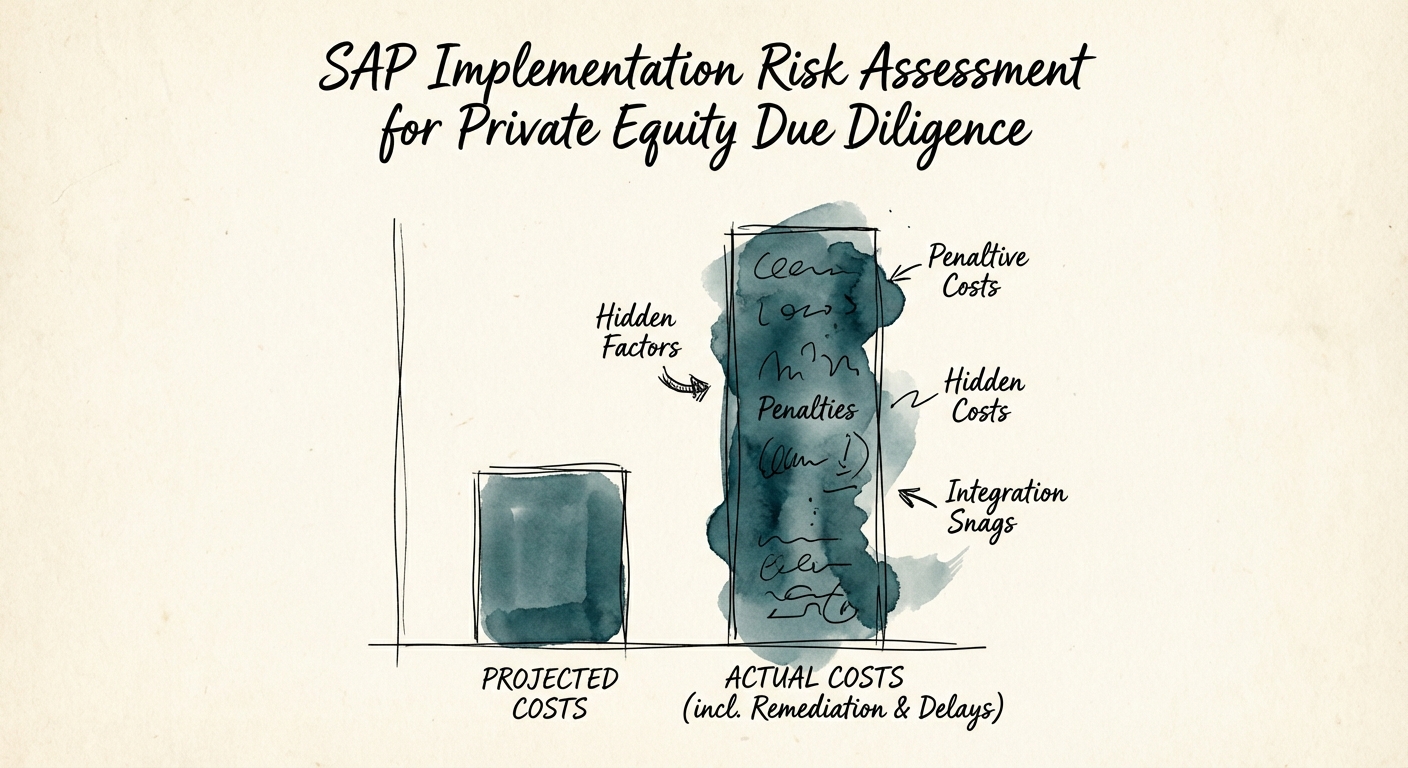
In 90% of the deals I've advised on, the 'Remaining CapEx to Complete' for the ERP project is understated by a factor of 3x. If the CIM says $5M, model $15M.
Quantifying the "Completion Capex"
The most dangerous number in the data room is the "Remaining CapEx to Complete" for the ERP project. In 90% of the deals I've advised on, this number is understated by a factor of 3x.
Why? Because the target company assumes a "happy path" to go-live. They do not budget for:
- Parallel Runs: Running both systems simultaneously for 3-6 months (essential for risk mitigation but expensive).
- Re-implementation of Customizations: S/4HANA is not a simple upgrade. Your target's highly customized ECC environment likely won't port over. The code must be rewritten or standard processes adopted—both of which take time and expensive external consultants.
- Change Management: The number one cause of operational failure.
Recent research from Godlan and Panorama Consulting indicates that discrete manufacturing ERP projects typically experience cost overruns averaging 215%. If the CIM says it will cost $5M to finish the migration, you should model $15.75M in your integration budget. This directly impacts your purchase price consideration.
The EBITDA Adjustment You Must Make
You cannot accept the "ERP Implementation" as a standard non-recurring add-back without scrutiny. If the project is failing, the "fix" is not one-time; it is an operational drag that will last years. I recommend structuring a Working Capital adjustment or a specific Escrow holdback tied to successful system go-live milestones. Do not let the seller transfer the execution risk of a $20M project to you at the closing table without indemnification.
The 5-Day Technical Diagnostic Framework
You do not have months to assess this risk. You have days. When your technical diligence team goes in, give them this specific mandate. Do not let them come back with a generic "IT Assessment." Demand answers to these five questions:
1. The Custom Code Audit
Ask for the SAP Readiness Check report. Specifically, look at the "Simplification Items" and "Custom Code Analysis." If the report shows >20,000 lines of custom code that are incompatible with S/4HANA, the timeline in the CIM is a lie. That is a re-implementation, not a migration.
2. The Data Quality Test
Ask to see the results of the last three Mock Conversions. If they haven't done a mock conversion yet, they are at least 9 months from go-live, regardless of what the Gantt chart says. If they have, look at the record rejection rate. Anything above 1% is a go-live blocker.
3. The Partner "B-Team" Check
Who is actually doing the keyboard work? Big 4 strategy decks are fine, but look at the bios of the implementation team. If the "Senior Architect" has less than 5 years of S/4HANA specific experience (not just generic SAP), you are paying for their on-the-job training.
4. The Business Process Master List (BPML) Status
Request the BPML and filter for "Not Started" or "In Discussion" test scripts. In a healthy project approaching go-live, this should be zero. In a failing project, the difficult operational decisions (e.g., "how do we handle intercompany transfers?") are often deferred until the end. These are the decisions that pause projects for months.
5. The "Clean Core" Alignment
Is the project adhering to SAP's "Clean Core" strategy? If they are building heavy customizations inside the core ERP rather than on the SAP Business Technology Platform (BTP), they are building technical debt that will make future upgrades impossible. This destroys the "future-proof" narrative of the investment.
If the answers to these questions are unsatisfactory, you have two choices: Retrade the deal to account for the $15M+ risk exposure, or walk away. The 2027 deadline does not negotiate.